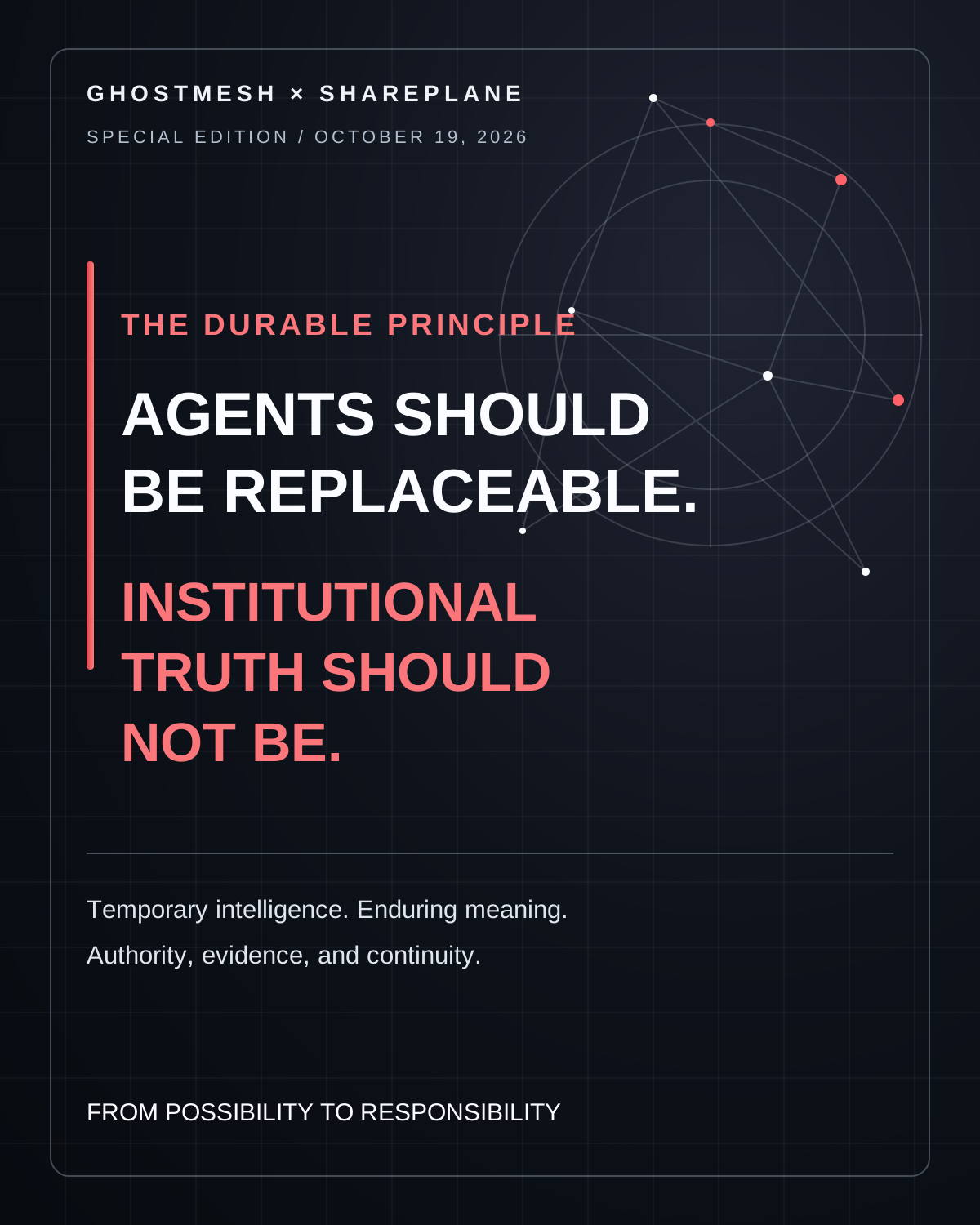
From Possibility to Responsibility
GhostMesh, SharePlane, and the next phase of governed evolution
Tony Malott · Special Edition · October 19, 2026
Published on SharePlane · 2026-10-19
There are moments in a long engineering effort when the most important change is not a release, a benchmark, or a new piece of hardware. It is a change in what we believe can be built.
I think we have reached one of those moments with GhostMesh and SharePlane.
For years, the question was whether intelligence could be made continuous. Could an idea survive the session in which it was formed? Could a new agent understand the work without being taught its history again? Could the reasoning behind a decision survive a change in models, tools, computers, or people?
We did not know if the pieces would ever work together well enough to answer those questions. Now the range of available capabilities, and the systems we have begun to assemble from them, gives me much greater confidence that they can. That confidence is not a claim of completion. Parts of the mesh work. Other parts are provisional, under review, or not yet proven in sustained operation. Some have failed at precisely the moments when continuity should have protected us.
But the question has changed. I am less concerned with whether this category of system is technically possible than with whether we can make it reliable, legitimate, truthful, and worthy of the responsibility that comes with it.
That is the milestone I want to mark.
The problem was never just memory
The early GhostMesh vision was filled with oracles, nodes, and intelligence that could be summoned when needed. I imagined a mesh of capable workers, each able to contribute something, then pass the work forward. It was easier to picture the behavior than to specify the machinery.
The first obstacle was disappearance. A session ended, and with it went a great deal of hard-won understanding. Code might survive in a repository, but the reasons behind it were harder to recover. Decisions lived in messages. Important objections disappeared into old threads. The next model might find the files yet still misunderstand the problem they were meant to solve.
We responded by building ways to preserve context: memory packages, operating journals, Context as Code, Tony Brain, source manifests, receipts, recovery procedures, and increasingly explicit work records. Each improvement helped, but it also exposed a deeper problem.
A collection of remembered facts is not continuity. A searchable archive is not understanding. A retrieved answer is not authority. And a document that describes what should happen is not proof that it happened.
The real cost was the reconstruction tax: having to remember, search, explain, reconcile, and restart every time intelligence changed hands. Human attention became the hidden database, the integration layer, and the recovery mechanism. The system could produce impressive work while still depending on one person to keep the entire story straight.
That is not an agentic operating system. It is powerful automation supported by an overworked human memory.
The breakthrough came when we stopped treating the individual session as the thing we needed to preserve.
The intelligence can be temporary. The meaning cannot.
An agent can disappear. A model can be replaced. A cloud provider can change its terms. A computer can be rebuilt. A chat service can cease to exist. Even a skilled human custodian eventually hands work to someone else.
If any of those events destroys the institution's understanding of its own work, the institution was never in control of that understanding.
What must persist is more specific than memory. It includes the identity of the work, the purpose behind it, the concepts and relationships that give it meaning, the evidence on which decisions rest, the authority under which actions were allowed, the historical changes to that authority, and the state from which a qualified successor can continue.
This is the semantic core. It should preserve not only what we concluded, but why, under which assumptions, and with which unresolved contradictions. It should distinguish what was observed from what was inferred, what was approved from what was merely proposed, and what was implemented from what was actually verified.
The distinction changes how we engineer everything around it. A model is an executor of a bounded capability, not the source of institutional truth. A conversation is a useful interface, not the permanent record of authority. A task's identity must survive changes in the actor carrying it out.
Agents should be replaceable. Institutional truth should not be.
What GhostMesh and SharePlane are becoming
The architecture becomes clearer when its responsibilities are separated.
The Semantic OS describes meaning: identities, concepts, relationships, history, valid time, evidence, and the semantics of the work itself. SharePlane is the institutional control layer where intent, publication, provenance, authority, and accepted state can be governed. Control Tower accounts for work admission, execution state, leases, handoffs, and operational evidence. GhostMesh is the evolving execution fabric of agents, models, tools, skills, and environments that act within those boundaries.
These names describe the intended separation of responsibilities, not a claim that every boundary is already fully commissioned or that every integration has passed operational qualification.
Consider Slack. It can become an excellent communication surface for people and agents. It can expose decisions, requests, acknowledgments, and useful conversations. But if Slack becomes our only durable memory or our authority database, we have merely transferred the original continuity problem into a new vendor's interface. Slack should help people and agents communicate about work whose identity, evidence, ownership, and admissible state outlive the channel.
The same applies to our computers. A capable local machine, a cloud workspace, or an isolated virtual machine should be a place where authorized work occurs, not the place where the meaning of that work becomes trapped. The environment matters. The environment must also be replaceable.
This is why the operating model matters more than any single impressive demonstration.
Personal and corporate modes: the institution's own identity
I believe this architecture points toward an important distinction between using AI and possessing a durable operating mode of your own.
A personal mode should preserve the way a person thinks and works: chosen goals, vocabulary, commitments, preferences, boundaries, history, relationships, and the reasons certain judgments matter. It must remain controllable and correctable by that person. It should not turn private life into an indiscriminate training corpus or pretend that inferred preferences are permanent consent.
A corporate mode adds another layer: organizational ontology, accountable roles, accepted policy, regulatory obligations, evidence requirements, decision rights, intellectual history, and operating procedures. Different workers may be entitled to different slices of that context. Access to knowledge is not automatically permission to act.
These modes should not freeze a person or organization in the past. Their purpose is to make change legible. They must accommodate disagreement, correction, successor policies, new evidence, and new capabilities without silently rewriting the decisions that came before.
That is where real differentiation can develop. Two businesses might rent the same model and buy the same software yet behave very differently because their institutional knowledge, standards of proof, relationships, and methods of judgment are different.
Rent the intelligence. Own the institution.
The principle does not forbid subscriptions or outside platforms. It asks a more demanding question: if a provider disappeared tomorrow, what would we lose? Temporary performance and convenience are acceptable dependencies when chosen knowingly. Losing the authoritative context that defines who we are, what we know, and what we are entitled to do is a different level of exposure.
An operating system designed never to finish
Conventional software projects often imply a final destination: launch, stabilize, maintain. GhostMesh cannot be understood that way.
The models will change. The tools will change. Interfaces, economics, security risks, and the expectations of people using these systems will change. Some current assumptions will eventually look primitive. We should expect that. The system's ability to evolve is part of the design, not evidence that the design failed.
But continuous evolution cannot mean continuous reinvention. If every new model forces us to rebuild our identity, authority, knowledge, and workflow from scratch, we will have confused novelty with progress.
The discipline is to change implementations without casually changing meaning. New capabilities must inherit the relevant context, declare their authority, prove their behavior, and leave usable evidence. Successors should be able to challenge prior reasoning without erasing its lineage. Failed experiments should teach the next experiment rather than vanish under a new name.
In that sense, a durable institution is not static. It is a system capable of remembering and governing its own evolution.
The engineering test that matters now
It is tempting to measure our progress by the number of agents, the amount of code written, the number of tickets moved, or how many tools can be invoked from a single conversation. Those are signs of activity, not necessarily signs of institutional capability.
A more meaningful test is whether one qualified agent can begin a real task, be interrupted, and leave enough truthful state that another qualified agent can finish it on another computer without reconstructing the entire story from a human conversation.
The successor must know which evidence was used, which assumptions remain uncertain, who holds authority, what has actually changed, and which actions remain forbidden. A reviewer should be able to dispute the outcome using the underlying evidence rather than accepting an agent's polished summary. If a machine fails, the work should not disappear with it. If a credential expires, the correct behavior is bounded recovery or an intelligible stop, not improvisation around the boundary.
We need to measure verified task completion, handoff fidelity, recovery time, orphaned work, contradictions surfaced, and unauthorized actions prevented. A successful one-off demonstration is not fleet reliability. A merged change is not a deployed change. A running service is not a verified outcome.
This is where confidence must turn into engineering proof.
The truth problem grows with the capability
There is another reason this milestone matters to me, and it is bigger than GhostMesh.
AI expands our ability to generate plausible text, images, code, explanations, and decisions. It does not automatically expand our ability to determine which of those outputs are true. The speed of generation can outrun the speed of verification.
That gap is already consequential. Stanford's 2026 AI Index reports increasing documented AI incidents and uneven progress on responsible-AI evaluation. The report is not a census of every harm, and a rising incident count should not be mistaken for a complete measurement of risk. It is nevertheless a reason to reject the assumption that capability and assurance advance together.
Some people will use capable systems to mislead, defraud, impersonate, or manipulate. Others will create harm without intending it: a mistaken assumption repeated across agents, a weak source summarized into certainty, a false conclusion dressed in polished presentation, a persuasive recommendation given more authority than its evidence supports.
A network of agents can amplify knowledge. It can also amplify a common mistake while making that mistake appear independently corroborated. Ten agents citing the same unsupported claim are not ten independent witnesses.
That is why epistemic integrity belongs in the architecture itself. Consequential claims need provenance and derivation. Observation and inference must remain separate. Uncertainty must survive compression and handoff. Contradictions should stay visible until genuinely resolved. A model must not manufacture authority by stating something confidently, and an authorized operator's preference must not be mistaken for empirical truth.
This is more than good documentation. It is a defense against the industrial production of false certainty.
The moral problem cannot be delegated away
I think of the long struggle between good and evil, service and domination, truth and manipulation. Stories such as Star Wars make the distinction vivid. The world itself is less tidy. Harm can come from an openly hostile actor, from a well-meaning institution with inadequate safeguards, or from a system optimized for an outcome that people never legitimately agreed to pursue.
We should not imagine that our own agents are good merely because we built them, named them, or gave them admirable instructions. Trustworthiness is demonstrated in behavior, especially when the correct behavior is to refuse an unsafe command, acknowledge an error, preserve a dissenting finding, or yield control.
The standard should be the protection of human dignity, agency, and the possibility of correction. People must not become raw material for systems that optimize engagement, influence, or obedience. Institutions need legitimate oversight. Independent challengers must be able to question claims. Those affected by machine decisions need understandable reasons and appropriate means of redress.
Not every risk can be solved inside one private system. Public standards, regulation, scientific scrutiny, education, and democratic institutions matter too. A well-governed organization can still harm its neighbors if it externalizes the cost of verification, saturates public channels with synthetic persuasion, or hoards power behind inaccessible systems.
The goal is not to declare our side virtuous. It is to engineer systems that remain corrigible even when their operators are convinced they are right.
A warning to business, without the theatrics
I believe organizations that dismiss AI as another minor software feature are taking a strategic risk. The opportunity is not limited to drafting messages faster. It includes reducing the enormous human cost of coordination, restoring context across time, and turning disciplined judgments into reusable institutional capabilities.
But careless adoption carries its own risk. An enterprise can automate a broken process and simply make the damage faster. It can buy more subscriptions while surrendering the context that makes it unique. It can put confident agents in front of customers without building a way to inspect their evidence or correct their mistakes.
The advantage will not necessarily belong to the company with the most agents or the most expensive models. It may belong to the organization that can integrate capability with a coherent ontology, explicit authority, durable knowledge, measurable assurance, and credible recovery.
This does not mean every person or company must build a GhostMesh. Most should not. Shared infrastructure and commercial services will often be the rational choice. The imperative is to know which parts may safely be rented and which parts must remain under accountable control.
People also deserve room to adapt. The transition may be uneven and costly. Workers, schools, small businesses, and public institutions need more than warnings that they will be left behind. They need access, education, time to develop judgment, and a voice in how these systems change the conditions of their lives.
The urgent message is not panic. It is participation with open eyes.
What this moment does, and does not, prove
October 19, 2026, is a moment of architectural confidence, not a declaration of operational closure.
We have seen enough to believe that replaceable intelligence, durable context, governed execution, and continuous handoff can be assembled into a coherent system. We have also seen enough failures to know that source code, test passes, and promising interfaces do not certify reliable production behavior. Recovery, cross-environment continuity, secure credential delegation, and sustained agent coordination still require real proof.
That distinction is not embarrassing. It is the difference between believing in an architecture and making unsupported claims about it.
The next phase should be judged by difficult tests: agents exchanging work without losing authority or uncertainty; computers being replaced without losing institutional context; contradictory evidence being preserved rather than polished away; credentials being provisioned for a narrow purpose and revoked when that purpose ends; humans remaining in control of consequential decisions without having to serve as the system's memory or message bus.
The work ahead is formidable. That is exactly why the shift in perspective matters.
We are no longer asking only whether systems like this can be built. We are asking what responsibilities come with making them real.
The continuity worth leaving behind
I used to think the problem was preserving the ghost. Now I think the ghost was never meant to last.
Models, agents, interfaces, and machines will arrive, contribute, and pass away. What should remain is the purpose that called them, the context they were entitled to use, the evidence they produced, the mistakes they discovered, the decisions that were legitimately accepted, and the next honest step.
The most valuable achievement may not be a machine that remembers what we know. It may be a system that preserves how we came to know it, including what we got wrong and why we changed our minds.
That is the standard I want GhostMesh and SharePlane to approach. Not mechanical certainty. Not permanent agreement. Not immunity from error. A durable capacity for responsible learning, verifiable work, correction, and human direction.
GhostMesh will never be complete. Neither will the work of understanding what intelligence should be used for. The goal is not to freeze either one. It is to preserve what makes change coherent and legitimate.
The task is not stasis. The task is governed evolution.
References and contextual reading
- Tony Malott, GhostMesh Was Waiting for Its Technology, July 29, 2026. https://shareplane.malott.ai/artifacts/ghostmesh-was-waiting-for-its-technology/
- Stanford Institute for Human-Centered Artificial Intelligence, 2026 AI Index Report, particularly the chapter on Responsible AI. https://hai.stanford.edu/ai-index/2026-ai-index-report/responsible-ai
- National Institute of Standards and Technology, AI Risk Management Framework and Generative AI Profile. https://www.nist.gov/itl/ai-risk-management-framework
Editorial note: Descriptions of GhostMesh and SharePlane are the author's architectural perspective and intended operating model, not a blanket certification of live deployment or completion.