This stopped being “DHH’s Arch dotfiles.”
That description was once directionally fair. In August 2026 it is technically amusing and strategically obsolete.
Omarchy is still built from conventional Linux primitives: Arch Linux, systemd, Wayland, Hyprland, pacman, Btrfs, LUKS, Quickshell, KVM and a large body of ordinary open-source software. It did not invent a new kernel or new graphics stack. The innovation is the contract binding those pieces together.
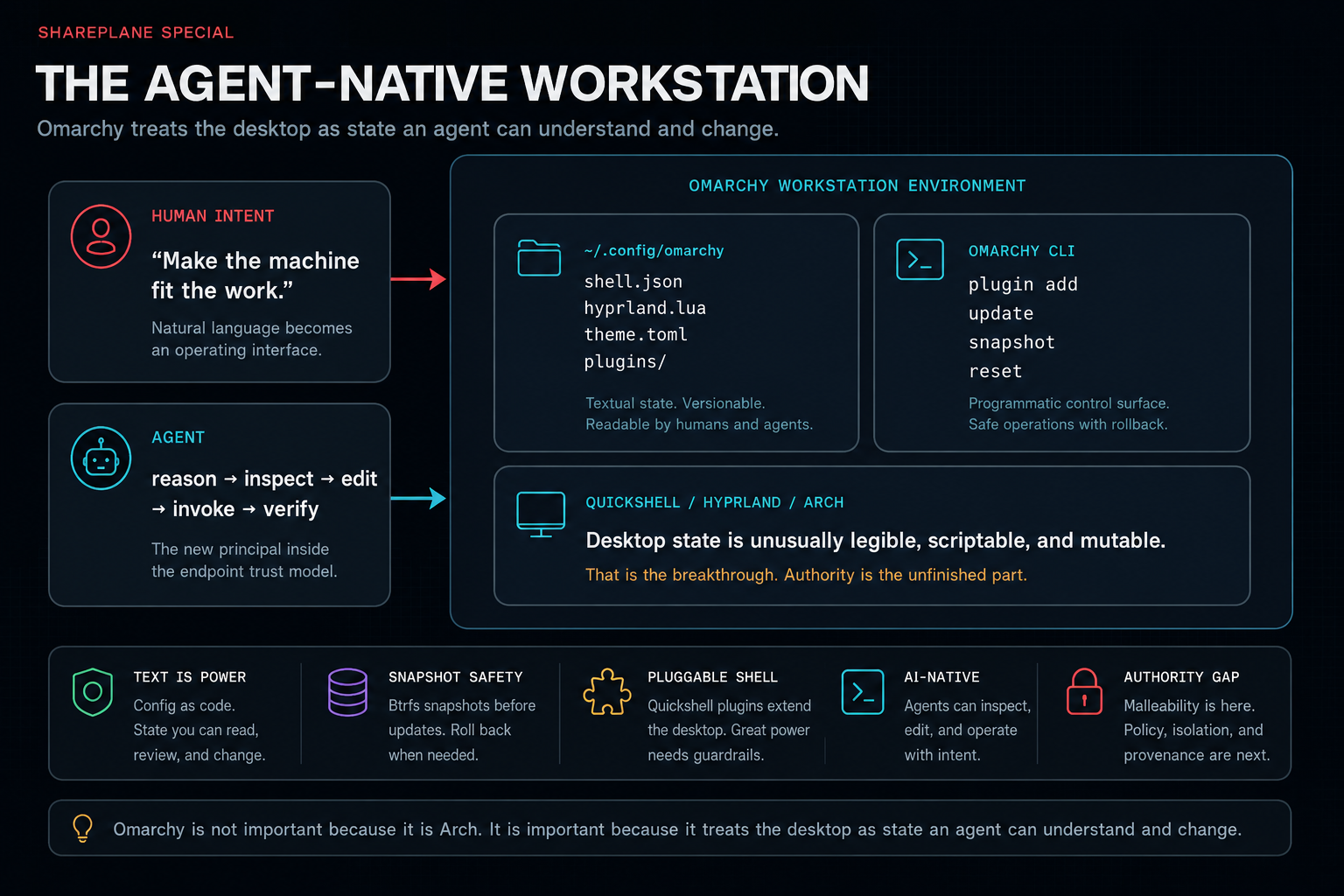
That contract now covers installation, defaults, shell behavior, package channels, migrations, themes, plugins, agent launchers, snapshots, recovery, a Windows fallback and a growing hardware story. The project itself describes Omarchy as “the malleable OS for the age of agents.” That positioning is not decorative. It names the architectural idea that separates Omarchy from a conventional distribution.
The relevant question is no longer “Is this Arch with opinions?” It is “Has someone finally productized Linux as an agent-addressable workstation?”
The answer is increasingly yes.
Quattro changed the category.
Omarchy 4.0, released 14 August 2026, replaced a typical Linux desktop assembly with one persistent Quickshell process called omarchy-shell. Waybar, Walker, Mako, SwayOSD, hyprlock, hypridle, swaybg and polkit-gnome were removed from the default composition. The bar, launcher, menus, notifications, OSDs, panels, lock screen and polkit agent moved into a common shell and plugin model.
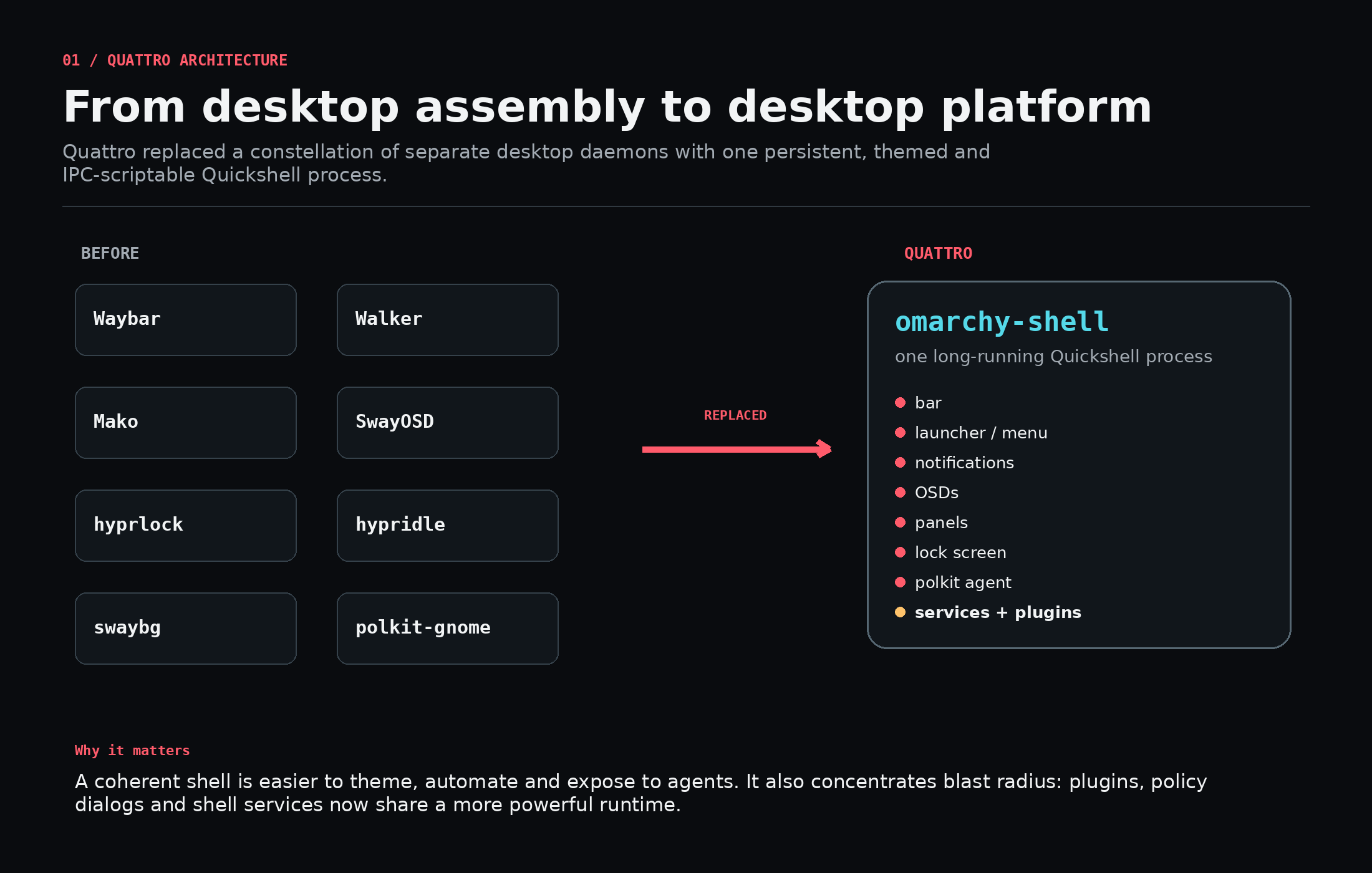
This is a real architectural simplification. A coherent shell is easier to theme, script, introspect and modify. It also means Omarchy increasingly owns a platform-level trust boundary. Once a shell mediates notifications, authorization prompts, plugins, menus and system interaction, it is not “UI glue.” It is security-sensitive platform code.
Textual state is AI infrastructure.
The most important Omarchy feature is not a widget. It is legibility.
User configuration is concentrated in conventional files under ~/.config. Hyprland configuration is Lua. Omarchy shell state is JSON. Hooks are executable files in predictable directories. The omarchy CLI exposes machine operations. Coding-agent launchers for Codex, Claude Code, GitHub Copilot CLI, OpenCode and others are explicitly first-class.
That changes the interaction model. A traditional GUI forces automation through bespoke APIs or brittle interface manipulation. Omarchy makes a surprising amount of workstation state readable as files and commands. An agent can inspect the current state, infer the desired change, edit configuration, invoke a command and verify the result.
Windows and macOS mostly add AI to the operating system. Omarchy is exploring an operating environment designed so AI can operate on the system itself.
This distinction is strategically important. Natural language begins to sit above declarative machine state. “Move the bar to the other monitor,” “make this repository’s development environment work,” or “build me a distraction-free writing profile” can become intent that an agent resolves into actual configuration.
Integration is the innovation.
Dismissals that list the upstream components miss the same point critics once missed about Rails. A product can be architecturally novel because of the constraints, defaults and interfaces it composes, not because every primitive originated inside the project.
omarchy-shell and plugin architectureThe result is best described as a curated, mutable workstation platform, not merely an Arch install script.
Omarchy does not make Windows disappear.
The Linux compatibility renaissance is real, but Omarchy does not make Win32 applications “native.” Games benefit from the broader Wine/Proton/Vulkan ecosystem. Native Linux and web applications are preferred where they fit. For software that genuinely requires Windows fidelity, Omarchy offers a Windows 11 VM using KVM and a Docker-managed environment surfaced through RDP.
That is the right kind of pragmatism. The VM shares sound, microphone, clipboard and a bounded ~/Windows directory, and its network ports are localhost-bound. Omarchy also documents the limitation clearly: the default setup has no GPU passthrough and is therefore inappropriate for high-performance Windows gaming or video editing.
The strategic point is not that every Windows application now runs on Linux. It is that the workstation can choose the lowest-friction execution substrate per workload.
This is not raw bleeding-edge Arch.
Omarchy’s stable channel uses its own Arch mirror that normally trails upstream by roughly one month. The intent is straightforward: allow incompatibilities to surface before they reach ordinary stable installations, while selectively advancing important fixes. Omarchy itself ships as pacman packages and runs migrations during updates.
Every Omarchy update also creates a Btrfs snapshot. Through Limine, users can boot and restore an earlier root filesystem. The limitation matters: /home, including ~/.config, is not rolled back. That protects personal data but can produce a restored operating system paired with newer user configuration.
Snapshots are recovery. They are not full deterministic reconstruction.
For enthusiast and developer systems, this is a strong compromise. For governed fleets, it needs more: defined security-patch SLAs, a formal advisory process, configuration provenance, drift detection, reproducible or attested builds, and machine-readable update evidence.
The product vision is ahead of the security model.
Eleven days after Quattro, Omarchy 4.0.1 shipped as a security-heavy fast-follow. Its release notes include fixes for agent bypass behavior, a video-title command-injection path, installed-theme code execution, predictable temporary authentication material, notification action execution, Docker-group privilege, Git transport handling and other trust-boundary problems.
An independent security critique published at the same time was severe, arguing that several bugs reflected predictable unsafe handling of untrusted input rather than obscure edge conditions. The rhetoric is deliberately sharp. The important analytical point is that Omarchy’s own release notes corroborate multiple vulnerability classes at issue.
Both interpretations can be true: the response speed is encouraging, and the bug classes are evidence that the trust architecture is still young.
Secure Boot and TPM are the clearest enterprise stop sign.
The current Omarchy installation guide instructs users to disable Secure Boot and/or TPM and characterizes them as Microsoft security schemes. That characterization is incorrect. Secure Boot is part of the UEFI platform standard; TPM is standardized by the Trusted Computing Group.
This is not a pedantic terminology complaint. On managed endpoints, Secure Boot and TPM support measurable trust properties: boot-chain verification, measured boot, device-bound credentials, key protection and device-health signals used by modern conditional-access and zero-trust systems.
For a personal workstation, disabling Secure Boot may be a choice. For a high-assurance fleet, it is an architectural disqualifier until an equivalent supported trust path exists.
Omarchy does offer LUKS disk encryption and hardware-authentication options. Those are useful controls. They do not substitute for a complete measured and attested platform-boot architecture.
The plugin model is brilliant and dangerous for the same reason.
Quattro’s shell plugins are simple to create and distribute. A third-party plugin can be cloned from Git, validated and enabled without modifying Omarchy’s core source. The manual explicitly warns that third-party plugins run as arbitrary, unsandboxed code inside the long-lived shell process with the user’s permissions.
This is exactly the tradeoff that makes agent-assisted personalization explode. It is also a familiar platform trap: extensions quietly become applications before the permission model evolves to treat them as applications.
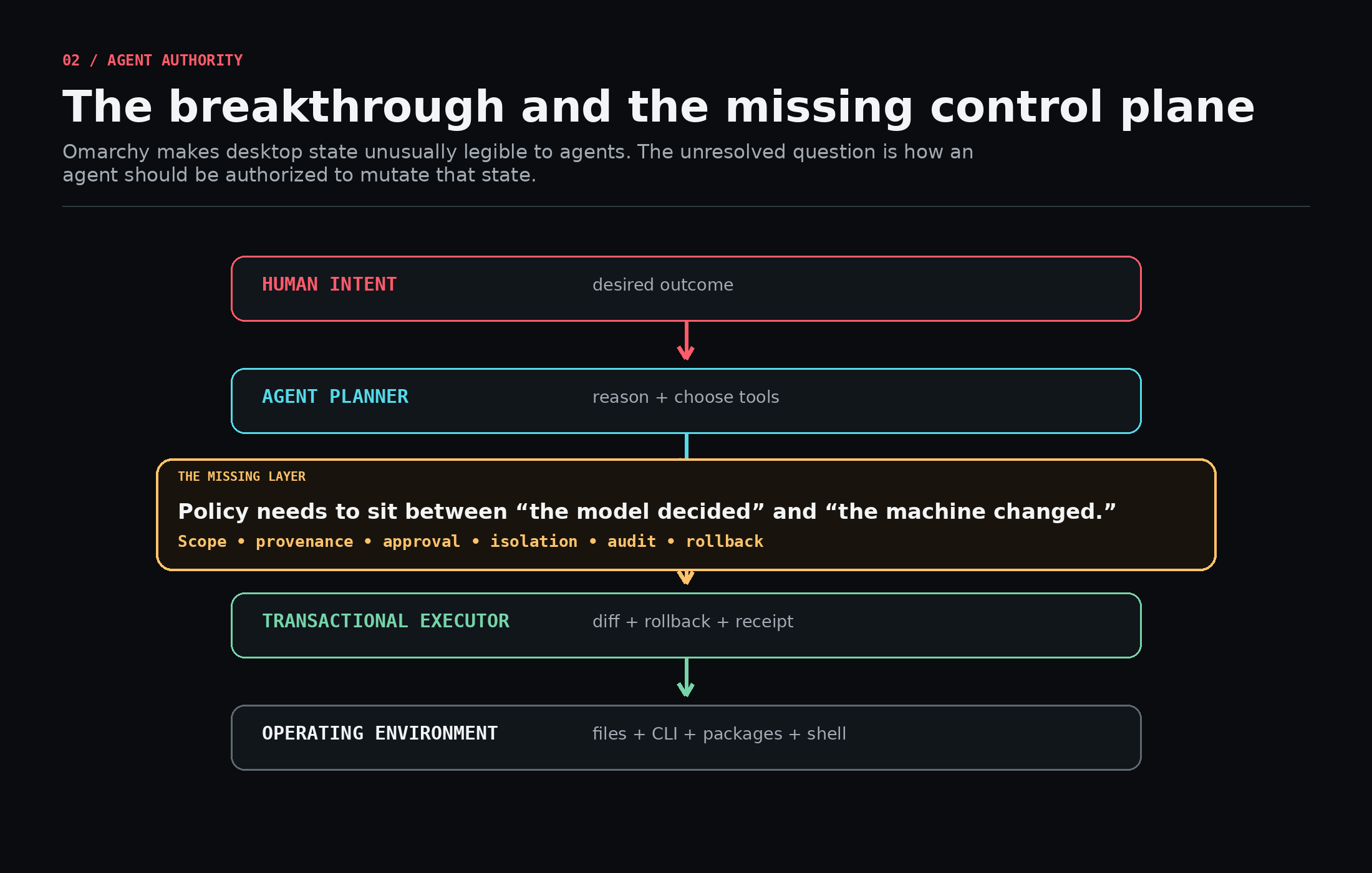
A mature endpoint architecture needs a manifest of requested capabilities, brokered access to privileged operations, runtime isolation, update provenance, policy decisions and auditable receipts. “Read the source before enabling it” is useful advice for enthusiasts. It is not a fleet-control model.
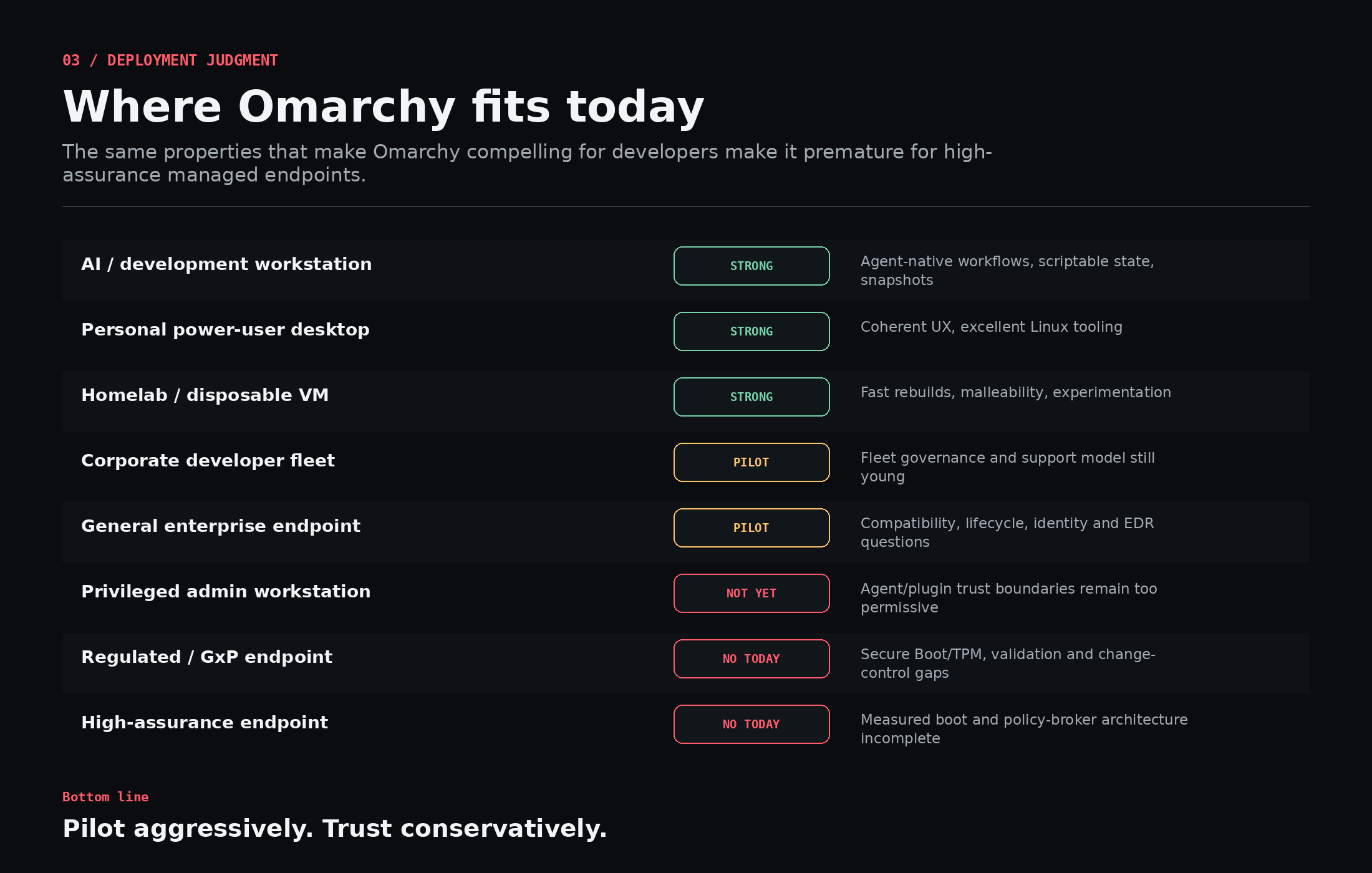
Pilot aggressively. Trust conservatively.
Omarchy is already a strong candidate for AI development workstations, personal power-user desktops, homelabs and disposable development VMs. The farther the workload moves toward privileged administration, regulated computing or high assurance, the more the unresolved authority model dominates the decision.
37signals’ announced three-year migration of Ops and Ruby programming teams is meaningful dogfooding. It proves a sophisticated software company is willing to depend on the environment. It does not establish regulated-industry readiness, formal endpoint-support lifecycles, EDR certification, GxP suitability or enterprise validation evidence.
Authority has to become a first-class subsystem.
Omarchy’s biggest opportunity is to preserve its malleability while refusing to equate “agent can technically do it” with “agent is authorized to do it.” The future control plane should make every meaningful mutation pass through explicit capability and evidence semantics.
That architecture would turn Omarchy’s current strength into something much larger. Instead of an AI-friendly desktop, it could become a reference design for how agents safely operate personal computers.
Minimum enterprise evolution
Malleability is not authority. Authority is not durability.
Omarchy supplies a piece that the agent-computing conversation has largely ignored: an endpoint substrate that software agents can actually understand and reshape. That does not make Omarchy a governance plane, and it does not make the workstation the durable system of record.
The cleaner architecture separates those responsibilities. Omarchy is the malleable execution environment. GhostMesh is the authority and context plane that decides what an agent may do, under which conditions, against which evidence. SharePlane is the durable Work plane that preserves accepted results, provenance, relationships and projections after execution is complete.
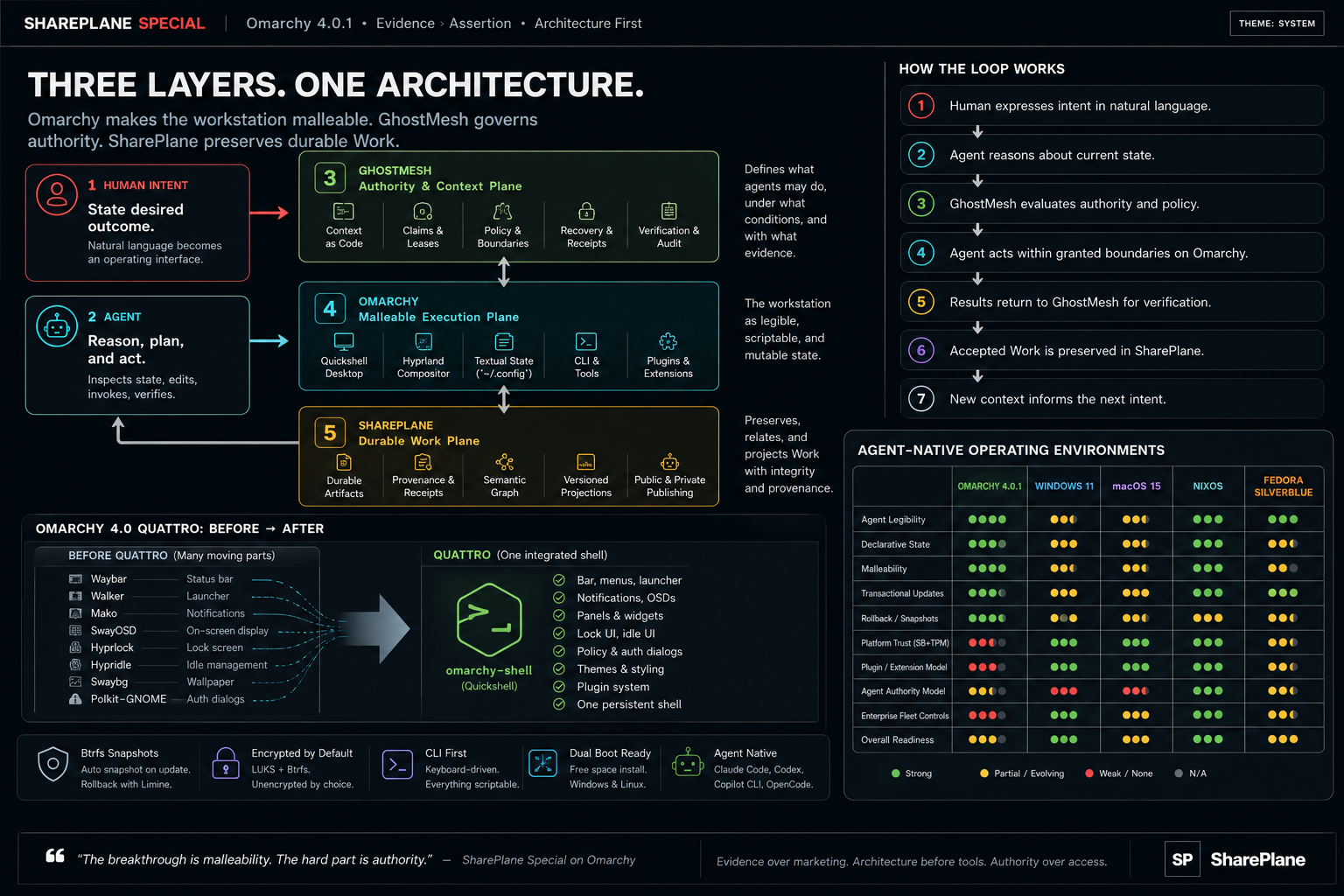
Make the machine adaptable.
Legible configuration, CLI surfaces, plugins, snapshots and a coherent desktop give agents something they can inspect and operate.
Decide what may happen.
Context, claims, leases, boundaries, recovery, verification and receipts prevent capability from silently becoming authority.
Preserve what was accepted.
Artifacts, provenance, semantic relationships and versioned projections keep Work durable after the agent session and workstation state have moved on.
The cooperation loop
Comparison: different systems optimize different control surfaces
Omarchy 4.0.1
Windows 11
macOS
NixOS
Fedora Atomic desktops
Semantic graph
Typed relationships around this Work
Omarchy makes the endpoint operable by agents. GhostMesh makes agent action governable. SharePlane makes accepted Work durable. The architecture becomes stronger when those jobs remain separate.
The follow-on should design the enterprise-grade endpoint that results when malleable execution, bounded authority and durable Work are treated as distinct cooperating planes.
Omarchy may matter even if Omarchy does not win.
There are three plausible outcomes. Omarchy could become a durable developer and enthusiast distribution. It could become the leading implementation of an agent-native personal computer. Or its ideas could be absorbed by larger platforms while the project itself remains comparatively small.
The recent momentum makes the second and third outcomes more credible than they were a year ago. The Omacom Foundation reports $10 million in funding. It is directly sponsoring Hyprland, Quickshell and mise. Omarchy reported more than 100,000 ISO downloads in a week and more than a thousand plugins in Quattro’s first week. These are project-reported momentum signals, not proof of durable installed base, but they materially change the project’s ability to fund upstream dependencies and survive beyond a hobby cycle.
The enduring idea is simple: the operating system should become legible enough for an agent to operate, but governed enough that the agent never becomes accidental root.
That is a much bigger thesis than “Linux looks good now.” It is a new endpoint-control problem arriving in plain sight.