01 · Lineage
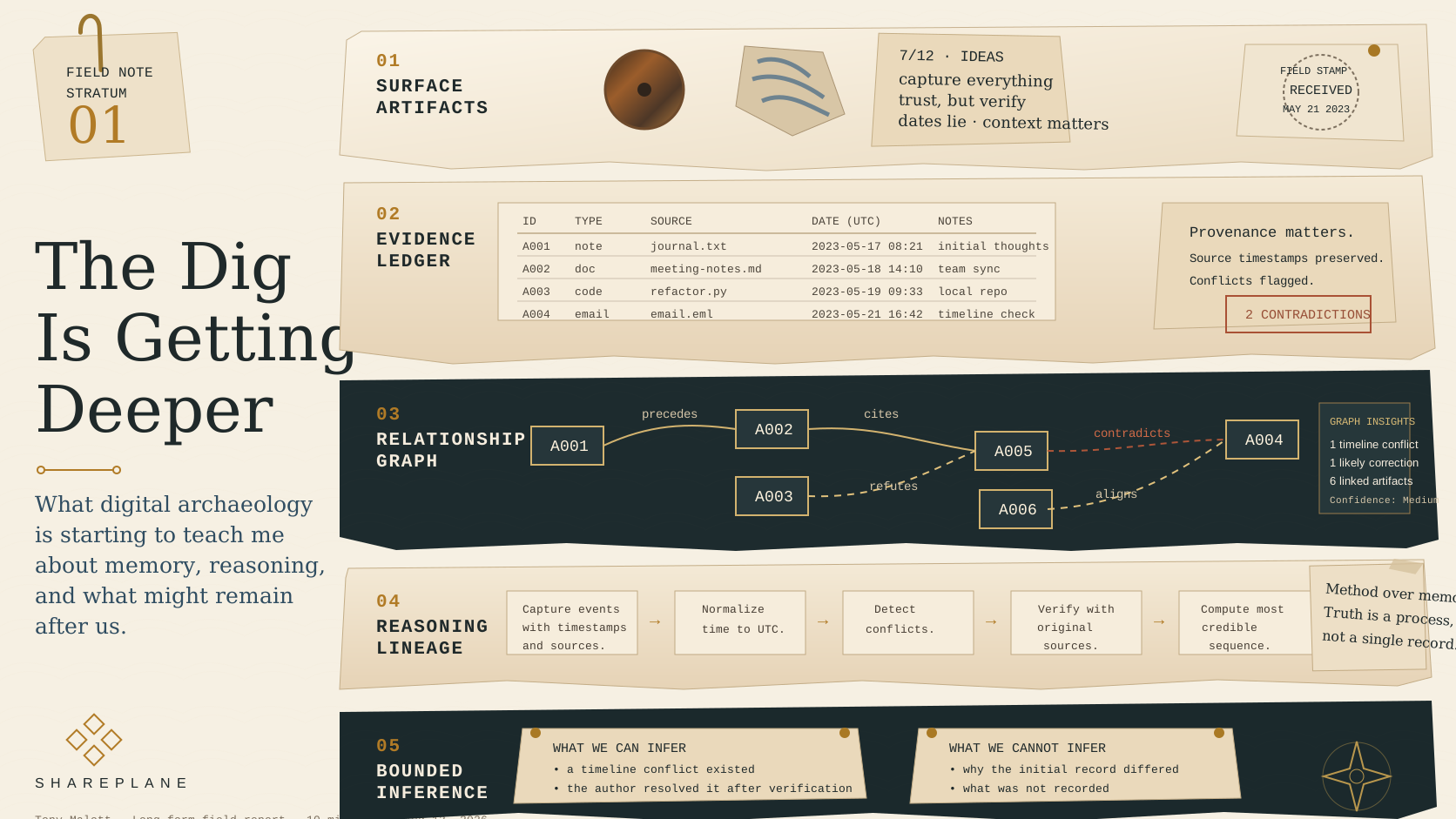
An artifact can tell you what happened. A lineage can tell you why.
One old email can establish that I believed something at a particular point in time. A document can show how I described a problem. A repository can show what eventually got built.
Connect enough of those things across time and another layer starts to appear.
A frustration becomes an experiment. The experiment exposes a failure. The failure produces a rule. The rule gets generalized into a principle. Years later, the original technology may be gone, but the principle is still influencing a completely different decision.
That lineage is usually invisible when we look only at the final artifact.
It is also why the expedition has become much more interesting than I expected. We keep finding early versions of ideas that I thought were newer. We find assumptions that later disappeared. We find cases where the terminology changed repeatedly while the underlying problem stayed almost exactly the same.
More importantly, we find contradictions.
I changed my mind. Sometimes the evidence shows why. Sometimes it only proves that the change happened. Sometimes my current recollection and the contemporary record do not line up neatly at all.
That is not a defect in the archive. That is part of the archive. If the objective were to manufacture a clean story about a person, contradiction would be annoying. If the objective is to reconstruct how somebody actually thought over time, contradiction is evidence.
02 · Evidence classes
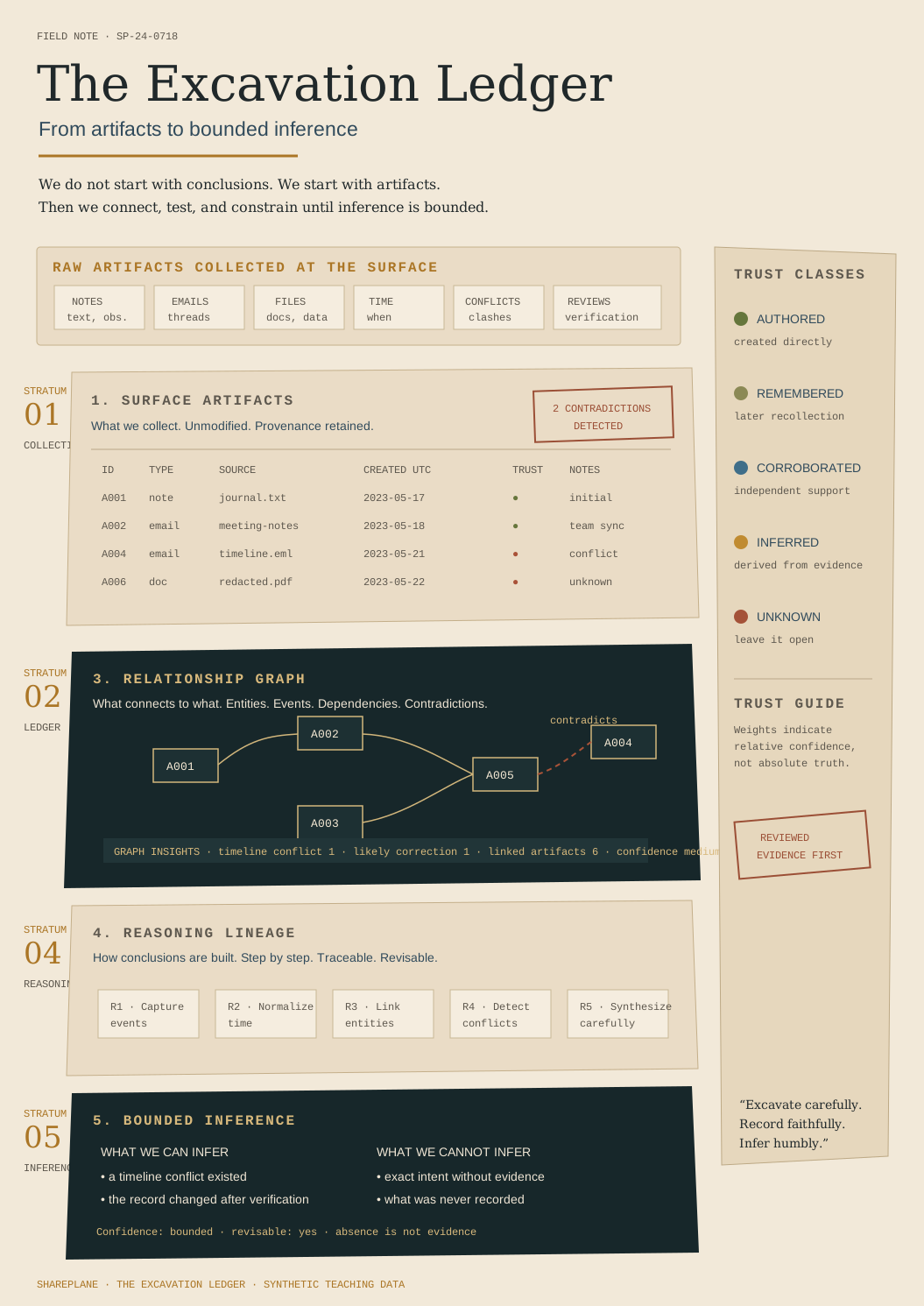
Memory, evidence, and inference are not the same thing.
One of the more sobering parts of this work has been seeing how memory behaves when it finally has to stand next to records created at the time.
I can remember the meaning of an event very clearly and still be wrong about the date, the sequence, the technology involved, or what happened immediately before it.
That does not make memory useless. It means memory belongs in the evidence model instead of sitting above it.
I have started thinking about the excavation in at least three layers: what I remember, what the surviving evidence establishes, and what we can reasonably infer when multiple independent pieces are connected. Those layers can reinforce one another, but they should never quietly collapse into a single voice of certainty.
Created directly at the time.
Later recollection, useful but fallible.
Supported by independent evidence.
Derived from connected evidence.
Insufficient evidence. Leave it open.
Sometimes the evidence confirms the memory almost perfectly. Sometimes it corrects it. Sometimes it opens another hole in the ground. And sometimes the best answer is simply that we do not know yet.
A reconstruction engine that cannot say insufficient evidence is not doing archaeology. It is writing historical fiction with very good autocomplete.
03 · The negative space
The missing areas are becoming part of the map.
The more material we recover, the easier it becomes to see what is not there.
Some periods of my life and work are represented by extraordinary amounts of evidence. Other periods are thin. Some systems survived almost intact. Others vanished years ago. Some decisions can be triangulated from conversations, files, code, and later consequences. Others may be represented by one surviving artifact and a memory that needs to be treated carefully.
So the expedition is producing two maps at the same time. One maps what we have found. The other maps where the evidence remains weak, missing, contradictory, private, or simply not yet examined.
That second map may ultimately be just as important as the first. It puts boundaries around what a future system is allowed to claim.
04 · The question changes
Then the question got stranger.
At some point, this stopped being only a historical problem for me.
I started asking what happens when the corpus becomes sufficiently rich. Not merely large in bytes. Large in behavioral and reasoning evidence.
Suppose decades of decisions, arguments, corrections, failures, preferences, technical judgments, personal reflections, recurring objections, and changes of mind have been preserved with chronology and provenance.
At that point, a system can do more than answer: What did Tony say about this?
It can begin to examine a harder question: How did Tony tend to reason when he encountered problems like this?
That distinction is enormous. The first is retrieval. The second is reconstruction.
And if reconstruction becomes good enough, a future system may be able to estimate how I would probably approach a question I was never directly asked.
That does not mean the machine becomes me. It does not mean consciousness continues. It does not mean personality has been uploaded. It does not mean that enough email eventually produces a soul, despite what the marketing department of some future startup will almost certainly claim after raising an irresponsible amount of money.
It means reasoning leaves evidence. And sufficiently well-preserved evidence may support bounded inference about reasoning.
05 · Continuity
From a digital estate to a cognitive estate.
We already understand the idea of a digital estate: photos, videos, messages, documents, accounts, creative work, financial records, and probably a heroic number of files called final, final2, and final-really-this-time.
Future generations are going to inherit enormous quantities of this material. But possession is not understanding.
Ten million files without chronology, provenance, relationships, interpretation, and retrieval are mostly a landfill with sentimental value.
The archaeological work is making me think about a different kind of inheritance. I have started calling it a cognitive estate.
Not because a mind has somehow been stored in a database, but because the estate preserves more than objects. It preserves authored thought, decisions, revisions, contradictions, evidence, relationships between ideas, and the context that explains why one conclusion eventually replaced another.
A cognitive estate should also preserve uncertainty. It should know which statements were authored directly, which came from later recollection, which are corroborated elsewhere, which are machine inferences, and which questions simply do not have enough evidence to answer.
That is the difference between continuity and impersonation.
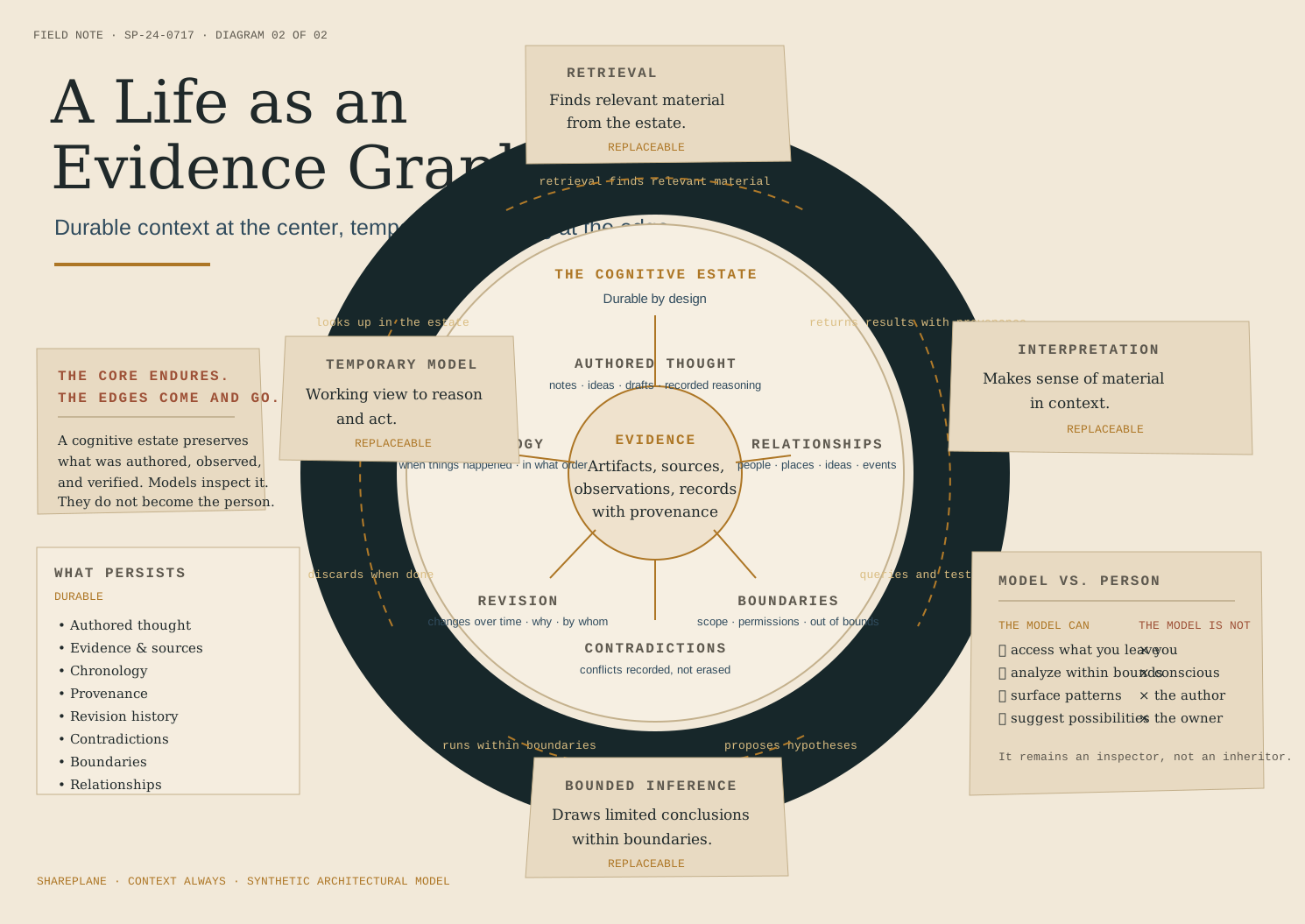
What persists
- Authored thought
- Evidence and sources
- Chronology and provenance
- Revision history
- Contradictions
- Boundaries
- Relationships
What is replaceable
- Retrieval results
- Interpretations
- Summaries
- Models and prompts
- Inferences
- Hypotheses
- Temporary graphs
06 · The failure mode
The counterfeit version will be easy.
There is an obvious cheap version of this idea.
Collect somebody's writing. Clone the voice. Put a photograph on the screen. Give the chatbot a few stories and preferences. Let it confidently answer questions in the first person.
Technically impressive. Emotionally persuasive. Epistemically rotten.
Without provenance, chronology, contradiction, evidence classes, and a hard ability to abstain, the system will gradually become a fictional character based on the person it claims to preserve. It may sound exactly right while being completely wrong.
That is probably the most dangerous version because people will want to believe it.
The more responsible architecture is almost the opposite. The system should not say, Tony says...
It should say something closer to: Based on the surviving evidence, Tony repeatedly applied these principles in analogous situations. The strongest evidence suggests this is how he might have approached the question. Confidence is moderate. Here is the supporting record.
And when the record is weak, it should stop.
That answer is less magical. It is also much more honest.
07 · Beyond one life
The applications go far beyond one person.
A family could preserve more than photographs and stories. It could preserve how beliefs developed across generations and where the historical record is uncertain.
A historian could reconstruct how a scientist's thinking changed across notebooks, correspondence, drafts, experiments, and published work rather than seeing only the polished endpoint.
An engineering organization could preserve why architectural rules exist instead of handing the next generation a pile of standards whose original failures and tradeoffs have been forgotten.
A founder or long-serving leader could leave behind decision reasoning without pretending that a synthetic version of that person should continue running the organization from beyond the grave. We have enough questionable governance models already.
Researchers could trace idea lineage. Institutions could preserve institutional memory without turning institutional memory into folklore.
The common asset is not the model. Models will change. The durable asset is the governed evidence and the relationships among it.
08 · Current frontier
We are nowhere near the bottom.
That may be the biggest surprise of the entire expedition so far. Every time we recover another layer, the frontier seems to expand rather than contract.
New evidence changes how earlier evidence is interpreted. Old projects connect to later principles. Forgotten conversations explain decisions that otherwise looked arbitrary. Missing periods become visible. Entire branches of the record have barely been examined.
So I no longer think this project has a tidy finish line.
There may eventually be a mature corpus, strong coverage, better retrieval, and much more reliable reconstruction. But a life is not a closed dataset while it is still being lived, and even afterward the surviving record will always have boundaries.
That is probably healthy.
Closing field note
What would Tony think?
One day, after I am gone, someone in my family may ask a system that question.
I do not want the machine pretending that I answered. I do not want a digital puppet performing certainty on my behalf.
But if we preserve enough of the evidence, the chronology, the contradictions, the decisions, and the reasons behind them, perhaps the system could explain what I would most likely have thought, why it reached that conclusion, and where the evidence stops.
Maybe that is not immortality. I am starting to think it is something more useful.
Continuity without pretending the person is still here.
We started this expedition looking for old answers. We may be building a way for the future to understand why the answers came out the way they did.
And we have barely started digging.