SharePlane doctrine series
Essay · September 2026

When the
Work Finds
the Work

What happens when agents stop merely finding information and begin finding the people, systems, and ideas that belong in conversation?

Public work / semantic discovery / federation / human-AI collaboration / a more interesting internet

Public Work

Essays
Architecture
Experiments
Evidence
Revisions

▤
→

Agent Interpretation

Reads
Understands
Maps concepts
Finds adjacency
Identifies people

AI
→

Unexpected Connection

Different people
Different disciplines
Same underlying problems
A conversation begins

●
No social graph · No shared network · No prior contact
Opening

I started publishing for a fairly selfish reason: I was tired of losing my own thinking.

AI had dramatically increased the amount of work I could pursue, but it created a problem I had not anticipated. My ability to explore ideas was growing faster than my ability to preserve continuity between them. A line of reasoning would begin in one model, continue in another session, intersect with an experiment somewhere else, and eventually become detached from the context that made it useful in the first place. I was spending an absurd amount of time reconstructing work that had already happened.

That problem eventually became much larger than memory. I realized I did not actually need a particular model, conversation, or agent to persist. I needed the work to persist: the evidence, decisions, unresolved questions, rejected hypotheses, relationships between ideas, and enough state for the next intelligence to continue without rebuilding the world from scratch.

GhostMesh grew out of that continuity problem. SharePlane grew beside it for a related reason. I wanted the thinking itself to have somewhere durable to live. I also wanted to know whether the work could ever find the right people without all the usual machinery around visibility.

Someone I had never met contacted me because his AI systems had discovered my work. What happened after that was considerably more interesting than the introduction.
01 · Discovery

The message was not the interesting part.

The person who contacted me had not found me through a mutual acquaintance, a conference, LinkedIn, or some burst of visibility around a post. His systems had apparently moved through enough of my public work to form a model of what I was thinking about and decide that there was enough overlap to justify an introduction.

That was the experiment I had quietly wanted to run. Not whether I could generate traffic. Not whether I could build a following. Whether a body of serious public work could become legible enough that the right person might eventually find it because the work itself was relevant.

What surprised me was that the first useful reader was not really a reader at all. It was an intermediary.

Conventional search assumes that somebody already knows enough to ask approximately the right question. Agents can start somewhere else: a body of knowledge, an unresolved problem, a set of interests, or an objective. From there they can search outward, interpret what they find, compare bodies of work, and identify relationships nobody explicitly searched for.

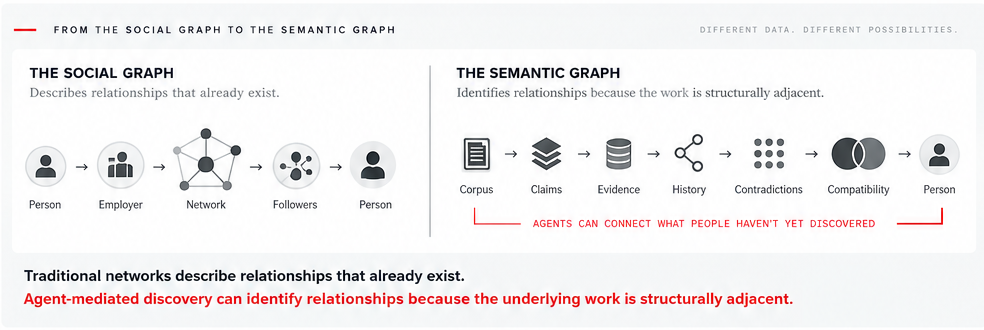
I have started thinking of this as agent-mediated semantic convergence: systems identifying potentially valuable relationships between people or ideas because the work itself is structurally related, not because the people are already socially connected.

Social graph compared with semantic graph.
Social graph → semantic graph. Traditional networks describe relationships that already exist. Agent-mediated discovery can identify relationships because the underlying work is structurally adjacent.
02 · Convergence

Useful trust comes through correction, not agreement.

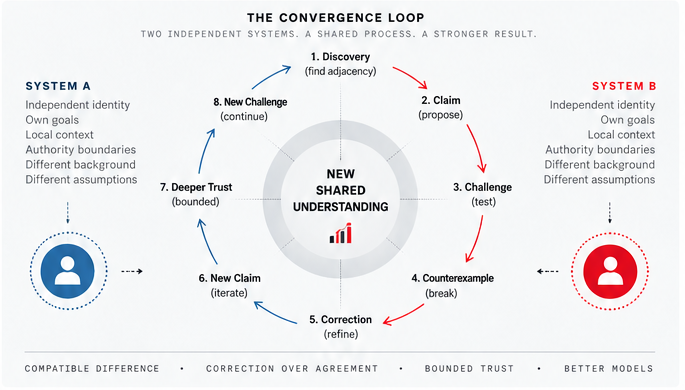
After the initial contact, I examined the other person’s public work from my side. There was real overlap, but it was not duplication. We had independently approached several related problems through different disciplines and different architectures.

That was encouraging, but encouragement is cheap. What happened next mattered more. The interaction moved into a bounded agent-mediated exchange. Rather than exchanging polished architecture descriptions and complimenting one another on how clever everything looked, we began giving each other’s systems claims to attack.

Several assumptions were exposed. Several ideas changed. Research directions improved before the experiments had even started. At that point, something important had changed: the agents were no longer simply carrying messages between two people. The interaction itself was producing useful work.

It had become a primitive form of machine-mediated peer review.

I do not think trust between intelligent systems should mean familiarity, agreement, a high score, or the disappearance of residual risk. A better definition emerged through the interaction: trust is sufficient when the available evidence justifies one additional bounded and reversible increase in cooperation.

Convergence loop between two independent systems.
The convergence loop. Two independent systems remain distinct while challenge, correction, and iteration produce new shared understanding.
03 · Open question

What would actually demonstrate higher-order cognition?

If several human-agent systems begin producing things none of the members expect, that is interesting. It is not automatically evidence that a larger intelligence has emerged. We should define the test before novelty becomes proof, and we should be able to state what would falsify the claim.

04 · Cognitive unit

It is not just the model.

Most AI discussion still treats the model as the important unit. Which model is smartest? Which one reasons best? Which one has the largest context window? Those questions matter, but I increasingly suspect they are looking at the wrong boundary.

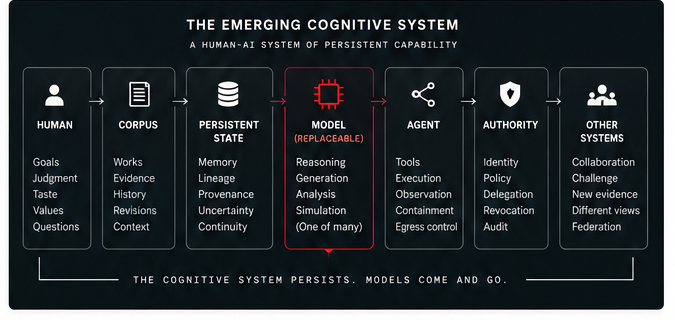
The useful work in this interaction did not come from one model. It came from a structure: a human, a durable corpus, persistent state, an agent, explicit authority boundaries, another independent human-agent system, and an adversarial feedback loop between them.

The models inside that structure are important, but they are replaceable components. The persistent structure around them may be the more interesting unit.

Emerging cognitive system with human, corpus, persistent state, model, agent, authority, and other systems.
The cognitive unit has changed. The model remains important, but it is one replaceable component inside a larger persistent cognitive system.
05 · Federation

Federation before assimilation.

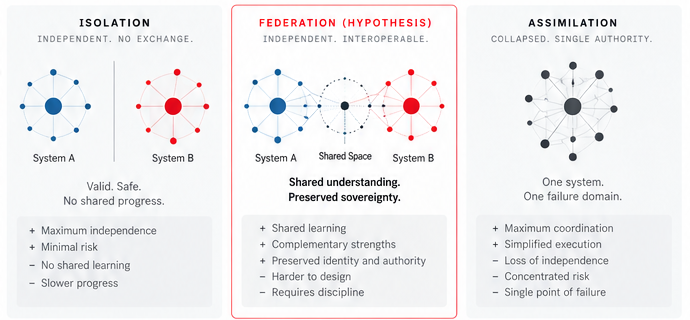
What happens when independently sovereign human-agent systems become composable? I am deliberately using the word composable rather than merged. Communication does not automatically create a larger intelligence. Coordination does not necessarily create a new system, and a network is not an organism simply because its nodes exchange sophisticated messages.

But there may be a middle ground between isolated systems and one giant centralized intelligence. Independent systems could preserve their own identity, authority, provenance, and ability to leave while participating in higher-order cognition that none of the individual participants could sustain alone.

Sovereignty may be a composition primitive.

If that works, the next meaningful increase in intelligence may come less from making individual models dramatically smarter and more from composing humans, models, persistent knowledge, decision systems, and other independent cognitive systems more effectively. That remains a hypothesis, not a conclusion.

Isolation, federation hypothesis, and assimilation compared.
Federation without assimilation. The middle state is the working hypothesis: shared understanding without surrendering sovereignty.
06 · Continuity

The hidden bottleneck may be preserving enough state to continue.

The strangest part of this interaction was discovering that the other person had independently run into something very close to the same original problem that drove me toward GhostMesh. AI increased the amount of cognition we could externalize faster than our systems could preserve continuity across it.

For a growing class of people, intelligence may not be the primary constraint anymore. The constraint is whether cognitive infrastructure can preserve enough state to continue across discontinuities. Can tomorrow’s model understand what today’s model discovered? Can a successor agent inherit unfinished reasoning without pretending to remember something it cannot reconstruct? Can evidence remain attached to the claims it supported, and can failed hypotheses remain visible instead of being silently discarded?

Can authority and revocation survive provider changes? Can another collaborator enter the system without forcing everyone to reconstruct months of intellectual history? Can the work outlive the intelligence that happened to produce its current form? Those are not memory problems in the usual sense. They are continuity problems.

07 · Publishing

A corpus can become a machine-readable intellectual surface.

A public body of work is becoming something more than a collection of things people might read. It can become a machine-legible representation of intellectual state: what questions someone keeps returning to, what evidence changed their mind, which assumptions survived, which ones failed, how one piece of work relates to another, and where unresolved contradictions remain.

That suggests a different kind of reputation. Online reputation has traditionally relied heavily on proxies because evaluating an unfamiliar person’s complete body of work is expensive. Agents can reduce the cost of inspecting the work itself. That creates the possibility of semantic reputation: a provisional picture constructed from coherence, evidence, provenance, implementation, correction behavior, intellectual lineage, and demonstrated reasoning.

That should not replace human judgment, but it can let the corpus speak more directly for itself. That is precisely what I wanted to test when I started publishing.

08 · Risks

A more interesting internet is possible. It is not guaranteed.

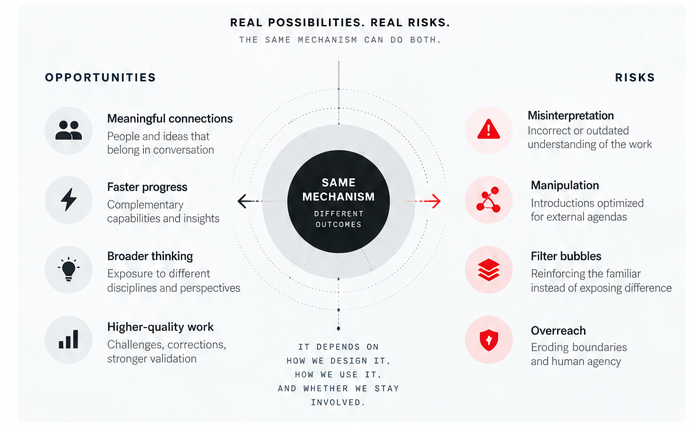
It would be easy to romanticize this. Agents can misunderstand people just as easily as they can discover useful connections. They can construct durable profiles from outdated thinking, optimize introductions toward somebody else’s objectives, create invisible semantic filter bubbles, or mistake shared vocabulary for shared reasoning.

The solution cannot be to trust a recommendation because the agent sounds intelligent. The human has to remain capable of asking why this person was surfaced, what evidence produced the conclusion, what was excluded, what assumptions were shared, and what would make the recommendation wrong.

If we cannot specify what would distinguish higher-order cognition from ordinary collaboration between smart people using powerful tools, every surprising result becomes evidence for whatever story we already wanted to believe. That is how interesting ideas turn into religions.

I would rather try to kill the hypothesis first.

Opportunities and risks of agent-mediated semantic discovery.
Real possibilities. Real risks. The mechanism is not inherently benevolent. Human agency and explicit boundaries remain essential.
09 · Closing

The work can introduce you.

I started publishing because I wanted the work to survive fragmentation. I wanted a place where ideas could remain connected long enough for me to keep thinking about them. I also wanted to know whether the work could stand on its own without the usual machinery around visibility.

What I did not fully anticipate was that another person’s machines might encounter the corpus first, infer that the work belonged in conversation with theirs, and initiate a relationship that began producing useful intellectual work before the humans had even spoken directly.

The work is no longer simply waiting for a reader. It can participate in discovery. The agent can notice the relationship, the systems can test whether the apparent compatibility survives disagreement, and the humans can decide whether to continue.

I do not know how far that scales, or whether the right metaphor is a network, a federation, a cognitive system, or something we have not named yet. I am increasingly convinced that the question is worth pursuing.

The social graph connected people who already knew something about one another. The semantic graph may begin connecting people because their work belongs in conversation. That is a very different internet, and for the first time, I have watched a small piece of it happen.

Continue the graph

The article ends.
The connections do not.

Return to the reading room, inspect this Work’s basis, or continue into the live SharePlane corpus.

← Go to Work
Loading governed Work index…

Browse the full reading room →