Personal essay · Governed AI · Human agency
The Machine Is Not the Point
What we become with it is.
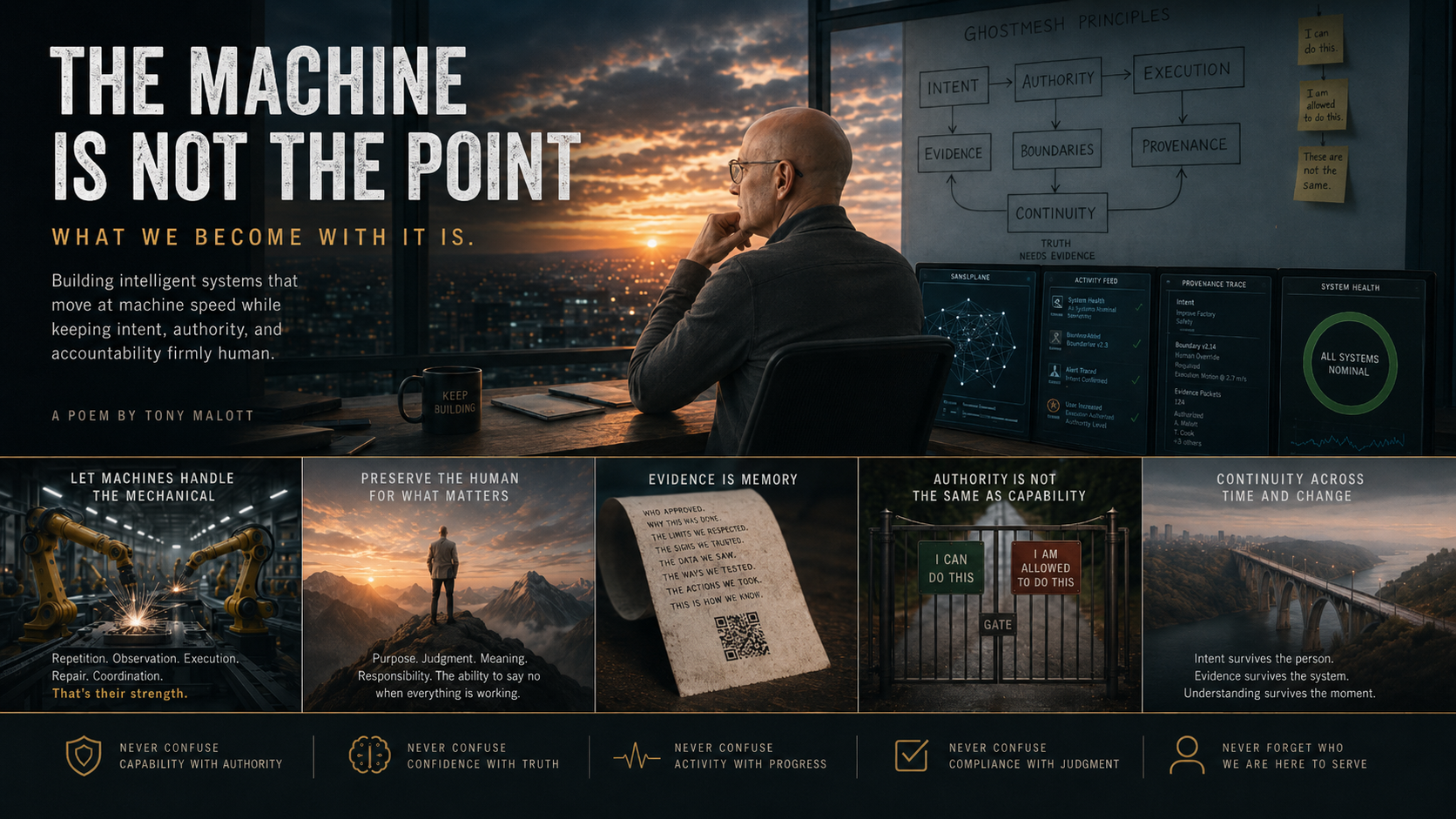
What we become with it is.
Yesterday my wife introduced me to Audrey Tang.
I knew the name, but I had never really spent time with her thinking. That sent me down a rabbit hole, and eventually I found her poem Holding Pattern.
It stopped me.
Tang comes at artificial intelligence from a very different direction than I do. Her world is civic participation, democracy, plurality, and governance. Mine has mostly been engineering: systems, automation, failure, evidence, security, authority, operational continuity, and lately a lot of time spent figuring out what happens when increasingly capable AI systems are allowed to act.
But the questions converge.
As capability accelerates, who gets to decide what happens?
Who has standing?
What evidence supports the decision?
Who remains responsible when the machine can do almost everything else?
I have been arriving at those questions through a much messier route.
For the past year, especially through building GhostMesh and SharePlane, I have been trying to make intelligent systems actually work.
Not demonstrations.
Not a clever agent doing something impressive in a browser while everybody applauds.
Systems that can maintain context, coordinate work, recover from failure, respect authority, prove what happened, and continue operating after the person who started the work is no longer staring at the screen.
That started as an engineering problem.
It did not stay one.
The better the machines became, the less interesting the question Can it do this? became.
Increasingly, the answer is yes.
The harder questions moved somewhere else.
Should it do this?
Who decided?
Based on what evidence?
Under whose authority?
What happens if the premise itself is wrong?
Who owns the consequence?
GhostMesh taught me that somewhat painfully. I wanted autonomy because friction destroys flow. Every pointless interruption, missing piece of context, repeated approval, manual handoff, or forgotten decision pulls a human backward into work a machine should be able to carry.
So we kept pushing.
Let the system remember.
Let it coordinate.
Let it inspect its own work.
Let it repair what it is allowed to repair.
Let it leave evidence.
Let it know where its authority ends.
Let it stop instead of inventing certainty because everyone would prefer that the workflow remain green.
Somewhere in that process, I realized the architecture was expressing a philosophy I had never explicitly written down.
The goal was not to remove the human.
It was to remove everything that keeps the human from doing the part that actually requires one.
Tang's poem made me want to try saying that differently.
Not as a response.
Not as an imitation.
We arrived here by different roads.
This is mine.
---
The Machine Is Not the Point
I thought I was building software.
That is the simplest version of the story.
Repositories. Workflows. Agents. Gates. Control planes. More automation. More ways to keep work moving without stopping every few minutes to reconstruct what had already happened.
A lot of it came from frustration.
I hate losing momentum.
I hate going backward because a system forgot something, a person failed to capture a decision, or an AI decided that sounding confident was preferable to admitting it did not know.
So I started engineering against that.
Make the system remember.
Make it check its own work.
Make it leave evidence.
Make it prove what changed.
Make it stop when it no longer had authority.
Make it recover from the ordinary failures without dragging a human into every stupid mechanical problem.
For a long time, I thought I was just building better automation.
Then the machines got better.
Much better.
Faster than I expected.
They can write the code now.
They can build an application, inspect it, find defects, repair them, test the repair, compare states, coordinate work, watch multiple systems at once, and keep going long after a human would have lost the thread.
I have watched pieces of the mesh repair themselves.
That should have felt like the destination.
Instead, it exposed a bigger problem.
The hardest question was no longer:
Can the machine do the work?
It became:
Who decided what the work was supposed to accomplish?
Who gave the instruction?
Where did that intent come from?
Was it actually right?
Was it based on evidence?
Was it somebody's assumption that hardened into policy?
Was it bullshit?
And what happens when the machine gets extraordinarily good at executing the wrong thing?
That question bothers me more now than hallucination does.
A hallucination is dangerous because the system is wrong.
But a perfectly executed bad instruction may be worse.
There may be no error.
No failed test.
No broken workflow.
Nothing obviously wrong at all.
The machine may do exactly what it was asked to do.
At scale.
That is when the problem stops being artificial intelligence and becomes governance.
And governance, despite the impressive vocabulary we wrap around it, eventually comes down to very basic questions.
Who can decide?
What evidence supports the decision?
Who can act?
How far does that authority extend?
What happens when the evidence changes?
And can someone still stop the machine?
Those questions became the architecture.
Not because I started with some grand philosophy of AI.
I did not.
I got there because things broke.
Because systems forgot.
Because models made claims they could not support.
Because an agent occasionally had the technical ability to do something it did not have the authority to do.
Because a workflow could pass every mechanical test and still not produce the outcome I actually wanted.
So we added receipts.
We added provenance.
We added claims.
We added gates.
We separated authority from execution.
We made uncertainty explicit.
We taught the system that "I can do this" and "I am allowed to do this" are two completely different statements.
That distinction now feels fundamental to me.
Capability is not authority.
Ability does not grant permission.
Confidence is not truth.
Passing a test is not the same thing as being right.
And motion is not necessarily progress.
I care deeply about motion.
Probably more than most people should.
Flow matters to me.
Parallelism matters.
Friction destroys more productive thought than most organizations understand.
Every unnecessary handoff, every pointless approval, every interruption that forces a person to reconstruct context has a cost much larger than the few minutes visible on a process chart.
So I want autonomous systems.
I want them badly.
I want machines doing everything they can responsibly do without asking me fifty times whether they should continue.
I want the mesh to heal.
I want it to remember.
I want it to notice that something broke at 2:13 in the morning, understand the authorized repair, fix it, prove what it fixed, and move on without waking anybody up.
That is not a threat to human agency.
Done properly, it protects it.
Because I have changed my mind about what autonomy is for.
I used to think autonomy meant getting the human out of the way.
Now I think autonomy means getting everything unnecessary out of the human's way.
That is a very different objective.
I used to think autonomy meant getting the human out of the way. Now I think autonomy means getting everything unnecessary out of the human's way.
Approval theater
Machine reasons
↓Machine determines action
↓Human clicks approve
↓Action
Human presence without meaningful human judgmentMature autonomy
Human intent
↓Bounded authority
↓Machine execution + evidence
↓Continue autonomously
Human involvement belongs where judgment is required, not where bureaucracy happens to demand a click.
Do not make a human remember what the machine can remember perfectly.
Do not make a human compare ten thousand records because we want the psychological comfort of saying a person reviewed them.
Do not put someone in front of an approval button after the real decision has already been made and call it "human in the loop."
That is not governance.
That is theater.
Use the machine for what machines are becoming extraordinarily good at.
Memory.
Comparison.
Repetition.
Observation.
Coordination.
Execution.
Repair.
Let the machine carry the mechanical weight.
Then preserve the human for the work that remains stubbornly human.
What are we trying to accomplish?
Who might be harmed?
What matters here that the specification failed to capture?
What changed?
What are we assuming?
What happens if we are wrong?
And even if everything is functioning exactly as designed:
Should we still do this?
That last question matters.
A human needs to be able to look at a perfectly functioning machine and say:
No.
Stop.
This is not what we meant.
Not because the software failed.
Because our understanding changed.
Because intent changed.
Because the evidence changed.
Because we were wrong.
That is why I no longer think of a receipt as some boring compliance artifact.
A receipt is memory.
It says:
This happened.
This actor did it.
This was the authority.
This was the evidence.
This was the state before.
This was the state after.
This is what we believed at the time.
This is what we knew.
And, just as importantly, this is what we did not know.
That matters because everything forgets.
People forget.
Organizations forget.
Teams reorganize.
People leave.
Vendors disappear.
Models change.
Policies drift.
Conversations get buried under a mountain of newer conversations.
And eventually somebody inherits a system whose behavior makes perfect sense only to the people who are no longer there.
I have seen enough of that in technology to know what happens next.
Somebody reconstructs the story.
Usually badly.
Assumptions become facts.
Facts become folklore.
Folklore becomes policy.
Then someone automates the policy.
Now the mistake can run twenty-four hours a day.
Assumptions become facts. Facts become folklore. Folklore becomes policy. Then someone automates the policy. Now the mistake can run twenty-four hours a day.
That is the cycle I want to break.
And somewhere in building all of this, I realized that GhostMesh may not really be about AI orchestration.
SharePlane may not really be about publishing.
The control plane may not really be about control.
Maybe what we are trying to preserve is continuity.
A way for intent to survive the person who expressed it.
A way for evidence to survive the system that produced it.
A way for another human, months or years later, to understand not only what happened, but why.
What we believed.
What we knew.
What we were uncertain about.
Who had authority.
Who did not.
And why the system moved anyway.
That is much more interesting to me than another argument about whether AI will replace people.
I do not think human beings are valuable because we type slower versions of what a machine can type.
And I do not think machines become dangerous merely because they become more capable.
The danger is losing the relationship between capability, intent, evidence, and responsibility.
I do not want an artificial person.
We already have billions of human beings. That seems like plenty of complexity to manage.
Amplification without abdication.
What I want is amplification without abdication.
Machines that extend what humans can accomplish without quietly inheriting the right to decide what matters.
Systems that move at machine speed without leaving accountability behind.
Technology that removes friction without removing responsibility.
Intelligence that can challenge us, surprise us, and outperform us without pretending that competence makes it the owner of truth.
And human beings willing to remain responsible even when the machine could have done nearly everything itself.
That future is not human versus machine.
It is not human replaced by machine.
And it is not the fake comfort of a ceremonial human sitting somewhere "in the loop."
It is something harder.
Humans holding purpose.
Machines carrying capability.
Evidence connecting the two.
Authority remaining explicit.
Uncertainty remaining visible.
And every part of the system retaining the ability to say:
I do not know.
I cannot prove that.
I can do this, but I am not authorized.
Something changed.
Stop.
Those may turn out to be some of the most important sentences an intelligent system can learn.
If GhostMesh eventually disappears into the infrastructure, good.
If SharePlane eventually becomes nothing more than the place where somebody can inspect the truth of what happened, good.
The names do not matter much to me.
The architecture does.
The principles do.
Build the intelligence.
Make it powerful.
Give it room to work.
Let it move fast.
Let it coordinate.
Let it repair itself.
Let it become better than us at every mechanical thing it can become better at.
But never confuse capability with authority.
Never confuse confidence with truth.
Never confuse activity with progress.
Never confuse compliance with judgment.
Never confuse a passing test with a good outcome.
And never build a system so autonomous that, somewhere along the way, nobody remembers who it was supposed to serve.
The machine is not the point.
What we become with it is.
---
What changed for me
For most of my career, reliability meant keeping systems available, recoverable, secure, supportable, and under control.
AI forced me to widen the definition.
A system is not reliable simply because it produces the technically correct result. It also has to preserve the chain between intent, authority, evidence, action, and accountability.
That sounds abstract until you build something autonomous enough to expose the problem.
Then receipts stop looking like paperwork.
Provenance stops looking like metadata.
Authority boundaries stop looking like bureaucracy.
Refusal stops looking like failure.
They become the things that make greater autonomy possible.
That is the part I did not understand clearly enough when I started.
I do not want less automation because the machines are becoming more capable.
I want more.
Much more.
But I do not want the strange compromise where a machine does nearly all of the reasoning and a human clicks a button at the end so everyone can claim the human was in control.
That is not meaningful oversight.
A better architecture gives machines enough authority to operate without constant interruption, while keeping the boundaries of that authority explicit. Actions leave evidence. Uncertainty stays visible. The system understands the difference between what it can do and what it is permitted to do.
And when a problem genuinely requires judgment, the human arrives with enough context to make an actual decision.
That scales better than approval theater.
There is another shift buried inside this.
Implementation is becoming abundant.
Code is easier to produce.
Infrastructure is easier to assemble.
Interfaces are easier to generate.
Analysis, documentation, tests, and integration are all moving down the cost curve.
That does not make the work worthless.
It moves the scarcity.
Becoming abundant
Code, infrastructure, interfaces, documentation, testing, analysis, integration, execution
Becoming more valuable
Intent, judgment, problem definition, evidence selection, authority, consequence ownership, knowing when to stop
As implementation becomes abundant, value moves upstream.
The harder questions move upstream.
What should exist?
What problem are we actually solving?
What does good look like?
What evidence do we trust?
Which constraints are real and which ones are inherited nonsense?
What should the machine decide?
What should it never decide?
Who has authority?
Who owns the consequence?
Those questions become more important precisely because execution is getting easier.
Bad ideas used to encounter friction.
They needed budget.
Teams.
Time.
Infrastructure.
Patience.
Sometimes that friction killed good ideas.
Sometimes it also killed terrible ones.
AI removes a lot of that resistance.
A bad idea can now move much faster too.
So friction cannot be the safety mechanism.
Judgment has to be.
Evidence has to be.
Authority has to be explicit.
And systems need to be capable of refusing easy execution when the premise is weak, the evidence is missing, or the authority is not there.
That may be one of the central shifts of this period.
We keep asking whether machines are becoming more like us.
I am increasingly interested in the inverse question.
As machines become more capable, do we become clearer about the responsibilities we should never delegate?
More precise about intent.
More honest about uncertainty.
More disciplined about evidence.
More explicit about authority.
More willing to revisit decisions when the facts change.
More accountable for what we choose to automate.
If that happens, the machines will not have diminished the human role.
They will have stripped away some of the work we mistook for the human role.
What remains may be harder.
But it may also matter more.
The machine is not the point.
What we become with it is.
Provenance
About this work
- Author
- Tony Malott
- Work type
- Personal essay and original poem
- Governing record
- SharePlane Platform Issue #626
- Publication state
- Published
Audrey Tang's Holding Pattern prompted the reflection that led to this work. The Machine Is Not the Point is an independent essay and poem based on Tony Malott's experience building and operating governed autonomous systems.
Continue the thinking
Each connection explains why the next work belongs here. The graph records the edge; this layer makes it useful to a reader.