Northeast Arkansas
I have always been suspicious of people who do not like dogs. That is probably unfair. I have kept the suspicion anyway.
Dogs have been present at nearly every meaningful stage of my life. They waited at roadsides, slept on apartment floors, crossed an ocean, claimed furniture, rearranged schedules, and left houses feeling physically wrong when they were gone.
This is not a breed guide or a claim that every other dog comes second. I have loved very different dogs for very different reasons. This is about how dogs became part of the structure of my life, and how one small white dog changed what home meant to Tomoko and me.
The dog who waited
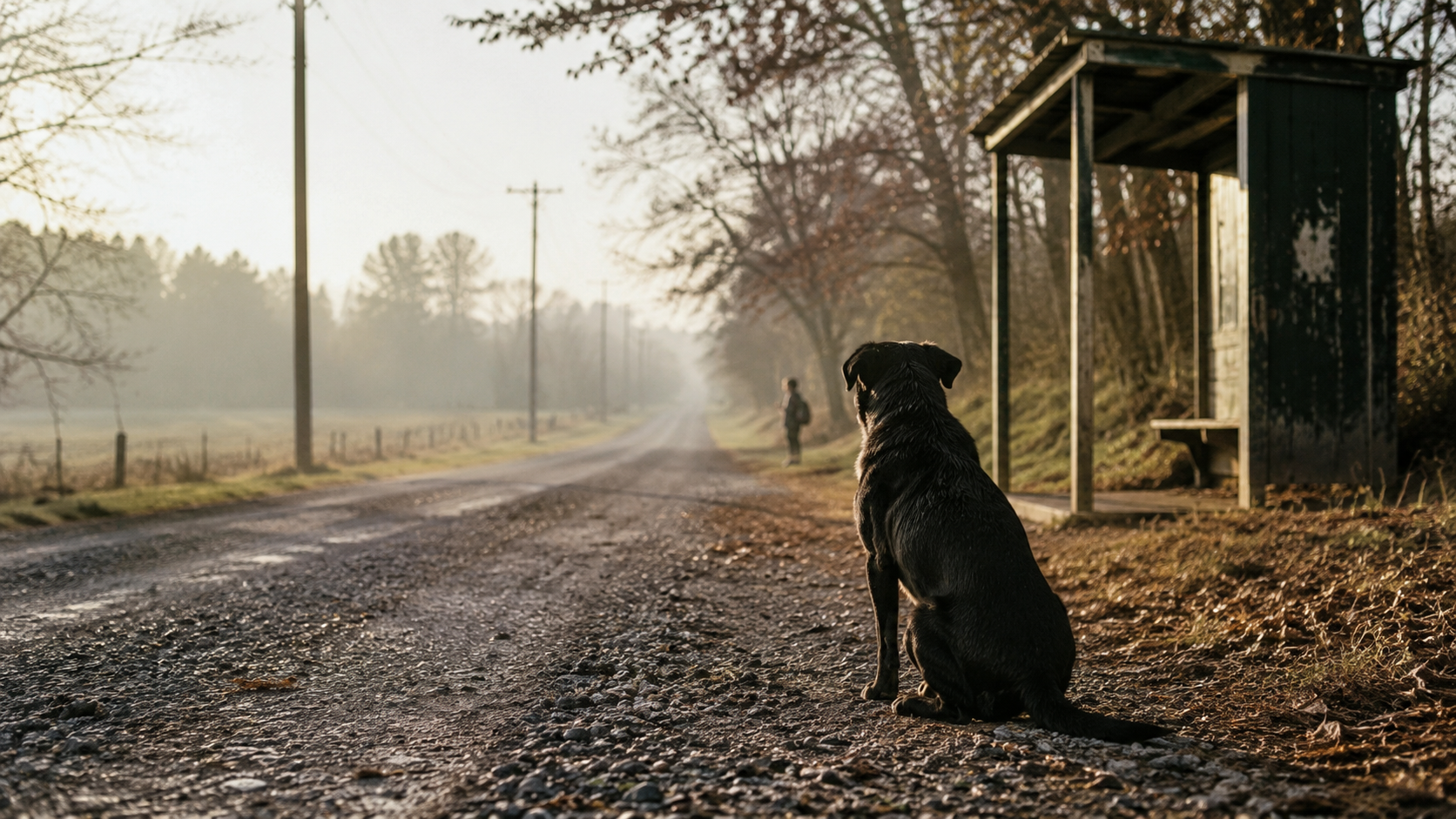
My first dog was Blackie, a hound from my childhood in northeast Arkansas.
He knew the school-bus schedule. He waited with me in the morning and returned when the bus brought me home. I treated that as ordinary because children often mistake devotion for infrastructure.
Only later did I understand what it means for another living creature to organize part of its day around your return.
Blackie taught me the first thing dogs know better than people: presence matters.
They do not need a theory of loyalty. They show up.
Germany
.png)
.png)
Dogs are not cargo
Years later, Tomoko and I were living in Germany during my Air Force assignment when an old high-school friend stationed there could no longer keep his dog, Lady. We took her in.
Lady was a hound mix, nothing fancy, and almost immediately part of our young marriage. Then she had puppies on the floor of our apartment. We were already flat broke, living carefully, and in no position to expand the household. Life did not request a financial review.
We kept one of the puppies.
At the time, I was working my way through Indiana Jones and the Last Crusade, the Lucasfilm adventure game, on an Amiga 500 I had somehow justified buying while we had almost no money for anything else. The machine made little practical sense and therefore became extremely important to me.
The puppy became Indy.
The name was not selected through careful family deliberation. It came from the world occupying my attention at the time: Germany, the Amiga glowing in our apartment, Indiana Jones searching for the Holy Grail, and a new puppy now sleeping somewhere nearby.
Tomoko and I were young, broke, far from both of our original homes, and still discovering what our own home was supposed to be. Lady and Indy became part of the answer.
When we returned to the United States, they crossed the Atlantic with us. We flew into St. Louis. My parents collected the four of us and drove us back to northeast Arkansas for a visit. Then Tomoko and I packed our life into a new Ford Escort station wagon and headed west to California for my next assignment. Lady and Indy came with us, because by then any plan that excluded them was not our plan.
Dogs are not cargo moved from one chapter to the next. They become part of the continuity between chapters. Germany, Arkansas, California. One apartment, another house. An Amiga 500, a Ford Escort, and two young people improvising a life with more dogs than money.
Lady and Indy carried the old home into the new one.
St. Louis · Arkansas · California
.png)
.png)
.png)
Germany, St. Louis, northeast Arkansas, California. The dogs moved with the family because they were the family.
Sophie
.png)
.png)
.png)
Then came Sophie
Sophie was our first Bichon Frisé, and she changed the scale of the relationship.
That is not a demotion of Blackie, Lady, or Indy. Each belonged to a different era of our life. Sophie simply arrived with an emotional intensity none of us had budgeted for.
She was affectionate beyond reason, funny, attentive, dependent, demanding, and completely woven into the atmosphere of the house.
A Bichon does not merely live in a room. A Bichon administers it.
Sophie wanted to know where we were, what we were doing, why anyone had moved without consulting her, and whether the arrangement could be improved by placing her directly beside us. Preferably touching. Better yet, occupying the chair we intended to use.
She was needy and high maintenance. She complicated simple plans. She also gave affection so constantly and without embarrassment that inconvenience became a weak argument against her.
Sophie lived nearly seventeen years. That is long enough for a dog to stop feeling like an addition to the household and become part of its operating system. Our routines formed around her. Our idea of the house included her.
When she died, nothing in the house had moved, yet every room was wrong.
Tomoko and I waited two years before bringing another Bichon home. Grief is not a vacancy, and another dog is not a replacement.
Eventually, we met Peko.
We named her after Peko-chan, the familiar Japanese character and mascot. The name carried a private joke and a great deal of affection, which suited her.
Peko did not replace Sophie. No dog does that. She entered the space Sophie had made visible and showed us that love after grief is not betrayal. It is continuity without erasure.
Later, Peko’s half-sister Sachi joined us from the same breeder. Two Bichons now move through the house, track our location, renegotiate the furniture, and treat every schedule as a draft.
The work
.png)
.png)
The work behind the cloud
Bichons are usually photographed after the labor is finished: white coat, dark eyes, round face, all cloud.
The photograph is true. It is also incomplete.
Bichons do not look effortless because they are effortless. They look effortless because somebody did the work.
Their coats require frequent brushing and combing. A small tangle can tighten into a mat close to the skin. Professional grooming matters, but it does not replace the maintenance between appointments.
The work is shared in our house, although not evenly and not in the same ways.
Tomoko carries most of the daily maintenance. She works through Peko’s and Sachi’s coats with a brush and comb before tangles become mats. She brushes their teeth in the morning and again at night. She notices small problems while they are still small. Their care shapes the rhythm of her day more than anyone else’s.
Our son Joshua gives them baths every week between professional grooming appointments. Bathing two Bichons is not a symbolic contribution. It is wet, repetitive work involving towels, drying, cleanup, and two small dogs whose opinions about the process are rarely subtle.
I contribute where I can, and everybody participates in keeping the household running around them. The work is distributed by routine rather than ceremony. Someone brushes. Someone bathes. Someone schedules. Someone drives. Someone notices that supplies are running low or that an appointment needs to be made.
Tom and Jen of Jadorable Bichons groom Peko and Sachi about every four to six weeks. That professional care matters, but it complements rather than replaces what happens at home.
A good breeder can remain part of a dog’s life long after the puppy leaves. We are fortunate that Tom and Jen have.
Any honest account of how wonderful these dogs are has to include the people who keep them healthy, comfortable, clean, and looking like the little clouds everyone admires.
Love is easy to photograph. Maintenance is where it proves itself.
The dogs shape travel too. Leaving requires planning. The household bends around feeding, brushing, dental care, grooming appointments, and the simple fact that two deeply attached dogs expect us to remain available for consultation.
None of this is an argument against having a Bichon.
It is the honest cost of the experience.
Their beauty is inseparable from the care behind it. Their devotion creates obligations. Their dependence requires consistency. Their affection is not decoration. It changes how the home operates.
Now
.png)
.png)
The shape they leave behind
A Bichon changes the emotional geometry of a house.
Rooms acquire expectations. The day develops rituals. A chair is no longer just a chair once a dog decides it is where you sit together. Coming home becomes an event. Leaving becomes a negotiation. Silence feels peaceful when they are sleeping nearby and wrong when they are gone.
Blackie taught me that someone could organize a day around my return.
Lady and Indy taught me that home can travel.
Sophie taught me that one small animal can become structural.
Peko and Sachi keep teaching us that devotion is mostly repetition: another brushing, another meal, another appointment, another day arranged partly around their needs.
Dogs do not care about promotions, addresses, purchases, or milestones. Their questions are simpler.
Were you there?
Did you come home?
Did you sit down beside them?
Did you notice what they needed?
Did you care for them when the work was repetitive and nobody was taking a picture?
I have lived with dogs across countries and across versions of myself. I remember each partly by the place they occupied: Blackie by the school bus, Lady and Indy in Germany and on the road west, Sophie filling a house for nearly seventeen years, and Peko and Sachi moving through the routines our family has built around them now.
A life can be measured in many ways.
Part of mine is measured in dogs.
Once you have had a Bichon, home without one does not merely feel empty. It feels as though a dimension is missing.