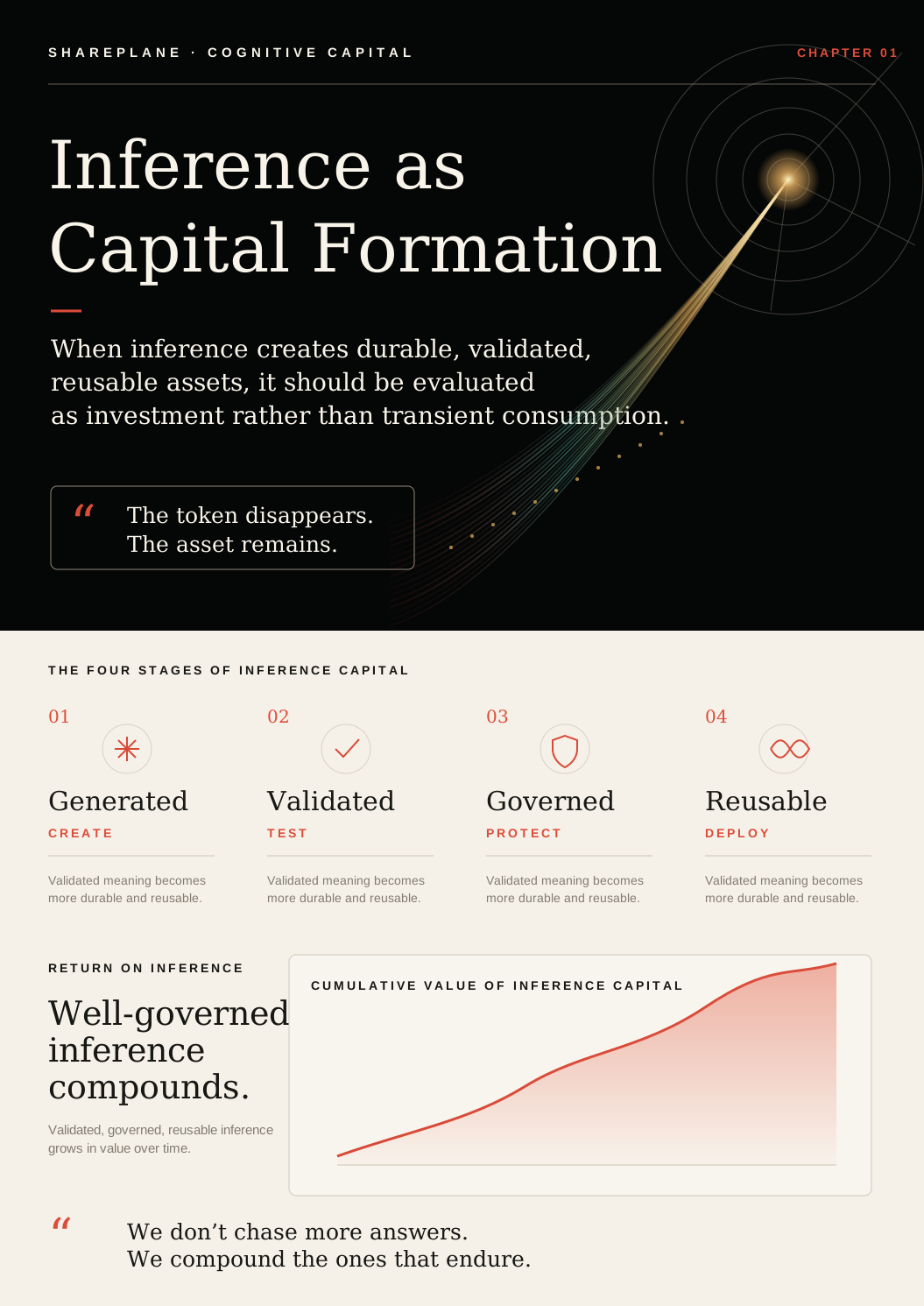
When inference creates durable, validated, reusable assets, the economically relevant question is not only what the run consumed. It is what durable capability entered the organization after the run ended.
Inference is a flow. Cognitive capital is a stock.
Tokens, model calls, agent-hours, and runtime are consumed over time. They are flows. Architecture, code, tests, evidence, policy, semantic models, reusable skills, governed context, and automation can persist after that flow stops. Those persistent assets form a stock only when they remain useful, trustworthy, and reusable.
Reasoning, runtime, tools, review, and execution occur over time and end.
Validated assets persist, become discoverable, and contribute to later verified work.
Persistence alone does not make something capital.
A generated artifact becomes cognitive capital only after admission: identity, validation, authority, discoverability, applicability, and a credible path to reuse. A stale document hidden in a repository is not valuable merely because it survived.
Liquidity determines whether the capital can work.
Two organizations can possess the same document and receive very different value from it. Capital is more liquid when it can be found, trusted, interpreted, connected to current authority, and correctly applied by humans and machines.
Yield is the future value produced by reuse.
Yield can appear as avoided consultant spend, faster decisions, reduced rediscovery, fewer repeated failures, risk retired, or less marginal cognition needed for a verified outcome. The important denominator is the verified result, not the number of answers generated.
Cognitive capital depreciates.
Architecture changes. Regulation changes. Dependencies move. Assumptions expire. Evidence becomes stale. A once-valuable artifact can lose applicability, impose requalification cost, or become actively misleading. Cognitive capital therefore requires reconsideration, not ceremonial permanence.
The counterfactual is not zero.
The right comparison is often model/runtime spend versus internal expert labor, consulting, security review, delay, and the possibility that the work would never have been attempted at traditional cost.
A long-lived, business-critical enterprise software platform had accumulated undocumented architecture, divergent implementations, weak regression coverage, security and integrity findings, and concentrated institutional knowledge.
A bounded coding-agent archaeology exercise reconstructed substantial architecture, created a durable assertion and evidence substrate, exposed material risks, and prepared the system for formal as-built documentation and replacement design.
The strong claim is not that the model bill equals the consulting value. It is that agentic runtimes can make forms of architecture archaeology economically practical that organizations often defer or never commission.
Runtime is part of the economic unit.
A frontier model in thin chat is not economically equivalent to the same model inside a coding-agent runtime with repositories, filesystem access, execution, tests, orchestration, telemetry, and governed context. What cognition can become depends on the machinery surrounding the model.
If admitted assets are rarely reused, age quickly, remain hard to discover, or cost more to validate and maintain than the cognition they save, the capital-formation thesis weakens materially.
Capital formation is an economic and management claim. It is not automatic accounting capitalization.
Continue the thinking.
Inference Retirement owns the rule that established paths should stop repurchasing the same cognition.
ExtendsDone Has a Half-LifeContext Capital, Context Liquidity, Context Yield, and reconsiderability become part of a broader cognitive-capital lifecycle.
ComplementsThe Semantic Operating SystemIdentity, authority, provenance, evidence, state, and relationships keep cognitive assets trustworthy and liquid.
Continue nextThe Most Expensive Token Is the One You Refuse to SpendThe next chapter asks what happens when valuable cognition is prevented before capital can form.