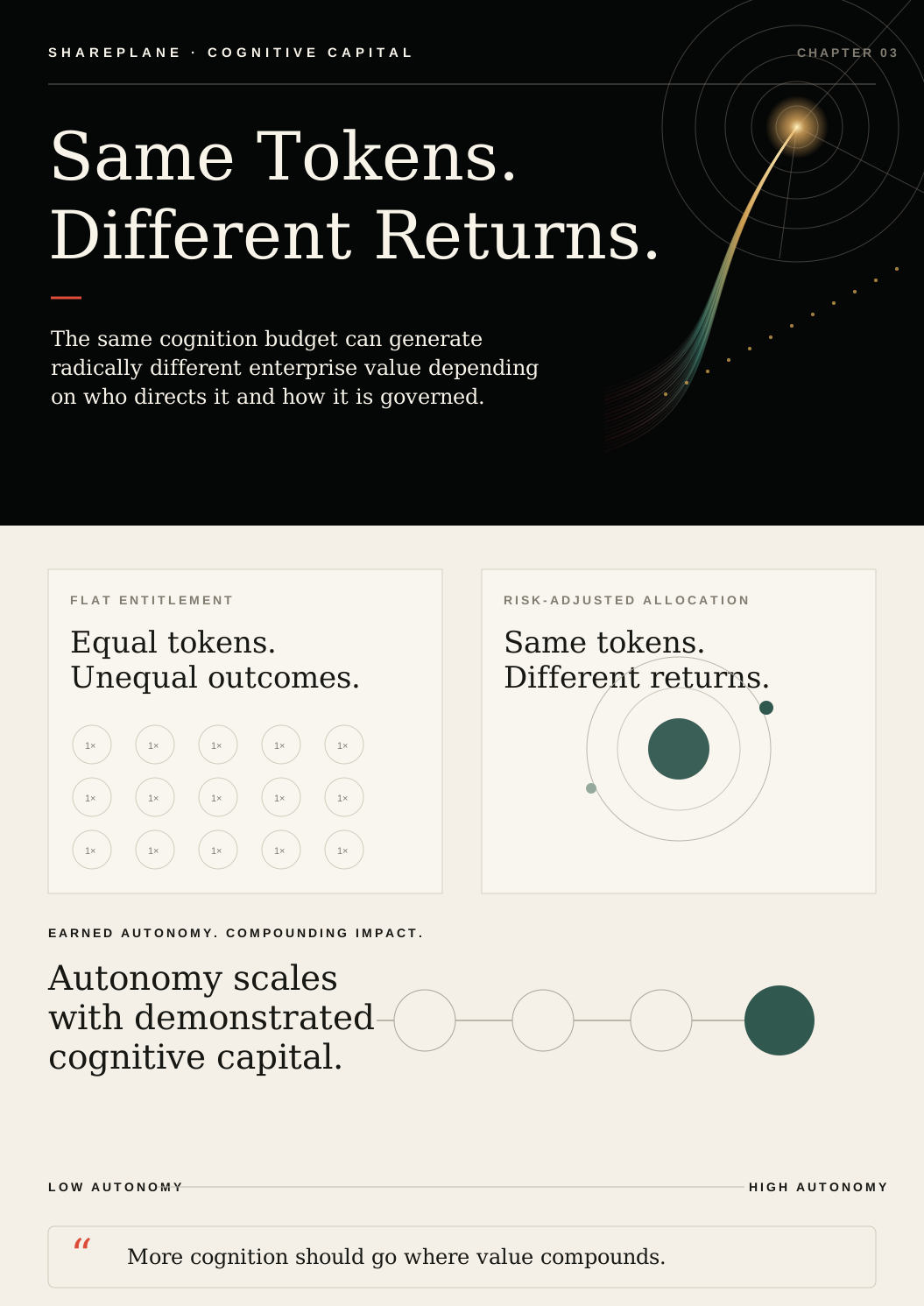
The operator is not outside the AI system. The operator is one of the production factors that determine whether inference becomes disposable output or durable organizational capability.
Same inputs can produce radically different capital.
Give two people the same model, budget, runtime, tools, and context. One may create transient drafts. Another may create architecture, tests, security findings, reusable harnesses, and a method that improves later work.
Operator leverage is multiplicative.
Operator leverage ≈ problem selection × domain knowledge × decomposition × runtime fluency × judgment × verification discipline × learning captureProblem selection
High-value operators spend cognition on work worth solving. They recognize where an architecture decision, security gap, or reusable automation has nonlinear consequences.
Domain knowledge
Generation becomes cheaper. Knowing which generated answer is wrong, incomplete, unsafe, or strategically irrelevant becomes more valuable.
Decomposition
Strong operators turn a vague objective into bounded work, explicit evidence requirements, independent checks, and stopping conditions.
Runtime fluency
They know when to use repositories, agents, deterministic tests, code execution, telemetry, and controlled tool access instead of simply requesting another answer.
Judgment
Rejecting plausible garbage is economic work. So is recognizing which outputs deserve promotion into durable context, code, tests, policy, or architecture.
Verification discipline
High-return operators do not confuse a persuasive result with a trustworthy result. They use red teams, frozen baselines, independent adjudication, and deterministic validation when the work warrants it.
Learning capture
This is the multiplier that makes the return organizational rather than personal. Techniques become harnesses, tests, templates, skills, context, and operating methods that other people can inherit.
High return must not create a new key-person dependency.
The goal is not an aristocracy of indispensable AI whisperers. If a technique reliably creates value, the technique itself should be captured so the organization owns it.
The quantitative claim is not yet proven.
Practical evidence strongly suggests operator variance matters, but a controlled experiment is still required before claiming a stable quantitative distribution. Same task, source bundle, model/runtime, budget, tools, permissions, and independent scoring should isolate operator or operating-procedure effects.
If operator outcome variance largely disappears after controlling task, runtime, tools, context, and budget, or if learning capture does not improve later team performance, operator-leverage claims should be reduced.
Same model. Same tokens. Completely different durable outcomes.
Continue the thinking.
Judgment is a core return multiplier and determines what deserves persistence.
ComplementsThe Code Is No Longer the Hard PartAs generation gets cheaper, architecture, judgment, evidence, integration, and operating quality explain more of the value difference.
Continue nextCognitive Capital AllocationUnequal returns create the allocation problem.