The Enterprise Has No Memory
A systems thesis arguing that enterprise archives and retrieval layers preserve artifacts more readily than the reasoning that produced them, and that modern AI makes both the opportunity and danger of reconstructable institutional memory much larger. Storage is not institutional memory. Durable enterprise cognition requires reconstructable relationships among evidence, assumptions, decisions, authority, time, disagreement, systems, and outcomes.
Read the article ↗View Work cover
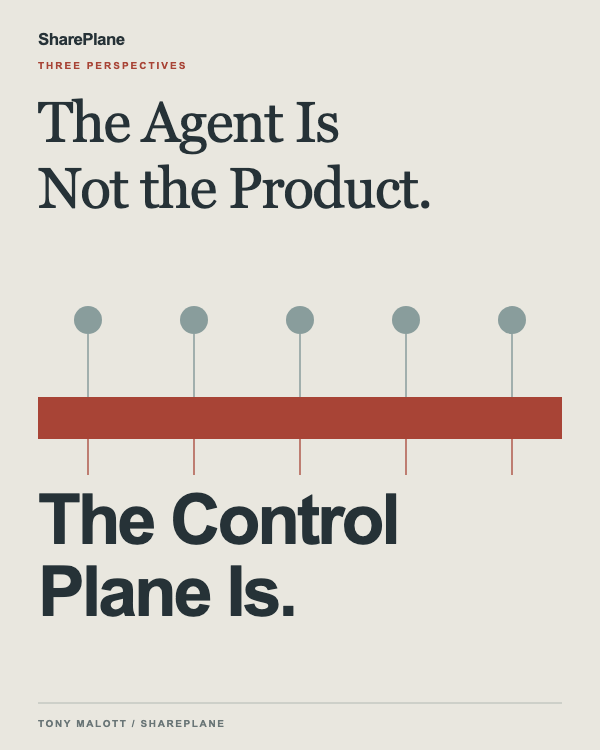
- extendsThe Agent Is Not the Product. The Control Plane Is.The durable architecture includes identity isolation, bounded authority, secret separation, execution containment, mutation gates, independent observability, evidence, and recovery. Security is the mechanism that permits greater autonomy by bounding blast radius. The more useful an agent becomes, the less its safety can depend on the agent behaving well. The durable product is the governed execution environment around it.
The predecessor establishes the durable control plane; this Work extends the argument into durable organizational context and institutional reasoning.
Explore its graph →Citation details
extendsThe Enterprise Has No Memory → The Agent Is Not the Product. The Control Plane Is.
Extends: The Agent Is Not the Product. The Control Plane Is.
Read native Work ↗ - companionThe Mind Is Sparse. The Machine Should Remember.A first-person systems thesis connecting constrained human working context, context reinstatement, sparse machine computation, and durable reconstructable agent context into a governed architecture for cognitive re-entry. Intelligence requires selection. Continuity requires reconstruction. The human can follow the idea; the machine can hold the thread.
That Work focuses on cognitive re-entry and human-machine continuity; this Work applies durable continuity to organizational decision lineage.
Explore its graph →Citation details
companionThe Enterprise Has No Memory → The Mind Is Sparse. The Machine Should Remember.
Companion: The Mind Is Sparse. The Machine Should Remember.
Read native Work ↗
- companion toWhy I Built SharePlaneMy work was surviving in files and sessions while the reasoning that connected it kept getting expensive to reconstruct. I built SharePlane to preserve the work, its evidence, its decisions, and the path back into it. The work kept surviving. The working state did not.
The institutional-memory thesis examines the same loss of reasoning and decision lineage across enterprise systems.
Explore its graph →Citation details
companion_toWhy I Built SharePlane → The Enterprise Has No Memory
Continuity at enterprise scale
Read native Work ↗