Library
Search
- A Nation Strong Enough to Face the WorldA systems essay on patriotism, nationalism, protectionism, competition, supply-chain resilience, and disciplined internationalism. Durable national strength comes from internal capability and governed interdependence, not economic, intellectual, or diplomatic isolation.
- Agent-Readable WebHTML, HTMX, NLWeb, MCP, and the Shift from Search Clicks to Agent-Mediated Discovery
- AI Is Leverage. Expertise Is the Multiplier.A SharePlane mini-thesis on why AI amplifies accumulated expertise rather than replacing it, and how that leverage can be applied in service to churches, nonprofits, and other small organizations. AI compresses execution. Expertise shapes the result. Service gives the capability purpose.
- Architecture and IntentYour architecture diagram shows what the system can reach. It usually does not show what the system should trust, who has authority, how contradictions are resolved, what may be changed, or how far the consequences can spread. The system diagram is only half the architecture.
- Architecture Review Plane: Three Interactive Product ConceptsThree interactive, dependency-free Architecture Review Plane product concepts.
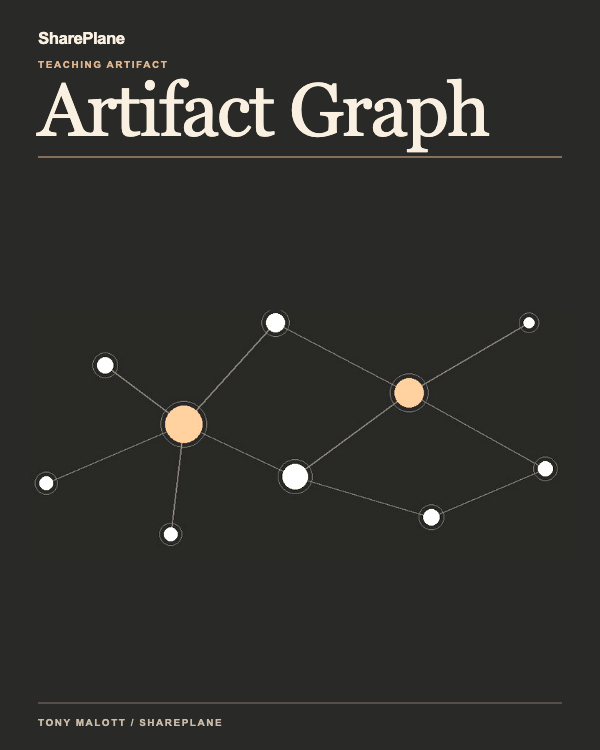
- Artifact GraphA page becomes durable when its sources, claims, receipts, validators, and related artifacts are traversable.
- Beyond the AgentA systems thesis on why abundant machine execution shifts the enterprise AI bottleneck from intelligence toward authority, verification, institutional state, human judgment, and cheap trust, and why SharePlane is the control layer required beyond the agent. Frontier intelligence and execution are becoming abundant; institutional scarcity moves upward into coordination, verification, authority, human attention, current state, and trust.
- Can GhostMesh Predict Its Own Future?Suppose an AI can forecast several possible futures. Suppose it recognizes the most likely outcome and determines that another would better satisfy its objectives. What happens if the future it predicts is not the one it would prefer? What happens if the future it predicts is not the one it would prefer?
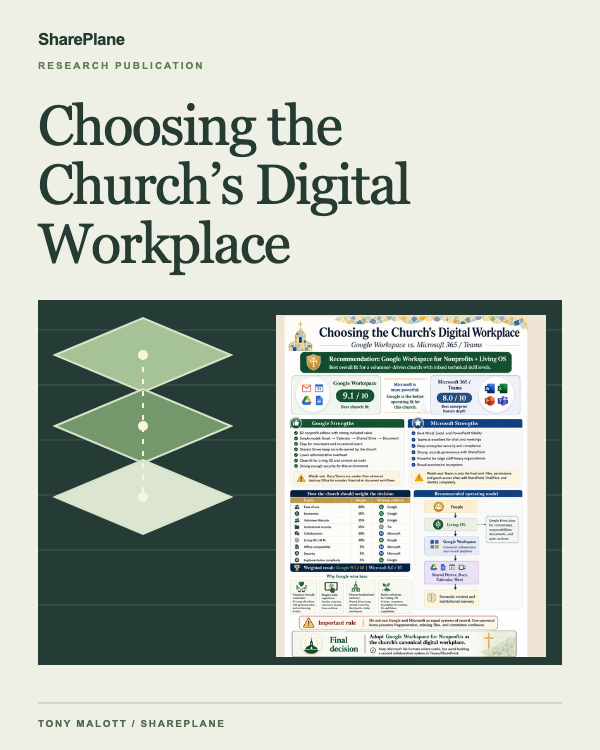
- Choosing the Church’s Digital WorkplaceA SharePlane research publication comparing Google Workspace for Nonprofits with Microsoft 365 and Teams for a volunteer-heavy church, preserving Microsoft’s legitimate enterprise strengths while recommending one Google-based institutional corpus beneath a simpler Living OS experience. Microsoft is arguably the more powerful enterprise toolbox. Google Workspace is the better operating foundation for this institution, with the Living OS as the simplified front door and institutional-memory layer.
- Clear Thinking Is the Control PlaneA long-form SharePlane article arguing that AI makes clear thinking the control plane because apparent success is cheap, verified success is expensive, and autonomy must be earned through intent, evals, evidence, and constraint. Why AI rewards disciplined pacing before autonomous scale
- Cognitive CapitalA Shareplane doctrine series about inference as capital formation, the cost of denied cognition, operator leverage, and how enterprises should allocate frontier cognition and autonomy. Machine cognition becomes organizational capital when validated reasoning is converted into persistent, reusable assets that preserve or increase capability while reducing future uncertainty, cost, risk, or marginal cognition.
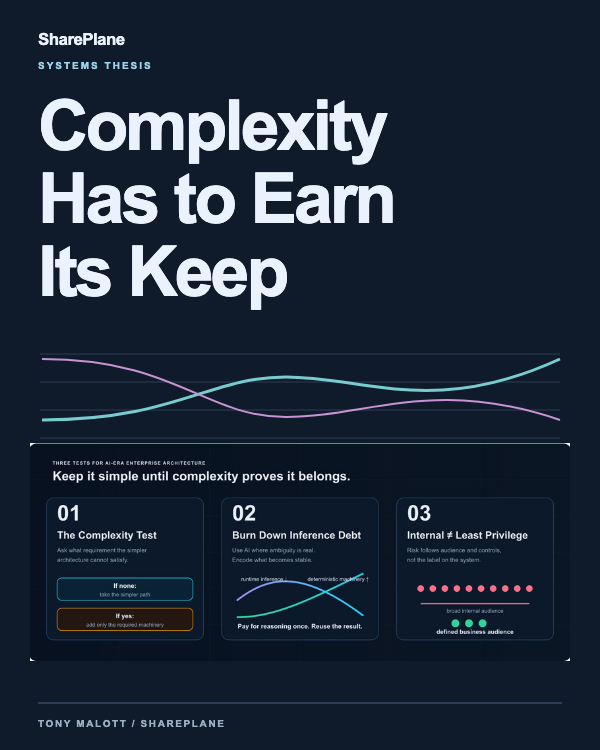
- Complexity Has to Earn Its KeepA first-person systems essay arguing for Portable Decision Surfaces, reconstruction packets, least-privilege distribution, and using AI to compile repeated reasoning into deterministic software instead of defaulting to another persistent application stack. Enterprise decision tools should start with governed data, deterministic portable software, and controlled refresh; persistent backend complexity should be added only when a concrete requirement proves it necessary.
- Context Is the ProductAI does not create durable capability. Governed context does.
- Copyable AgencyWhy digital intelligence changes the control problem
- Demo DebtArticle-first SharePlane thesis defining demo debt as the liability created when impressive AI demos are mistaken for supportable operational capability. The demo proves the happy path; the real system begins where exceptions, ownership, recovery, and supportability enter the workflow.
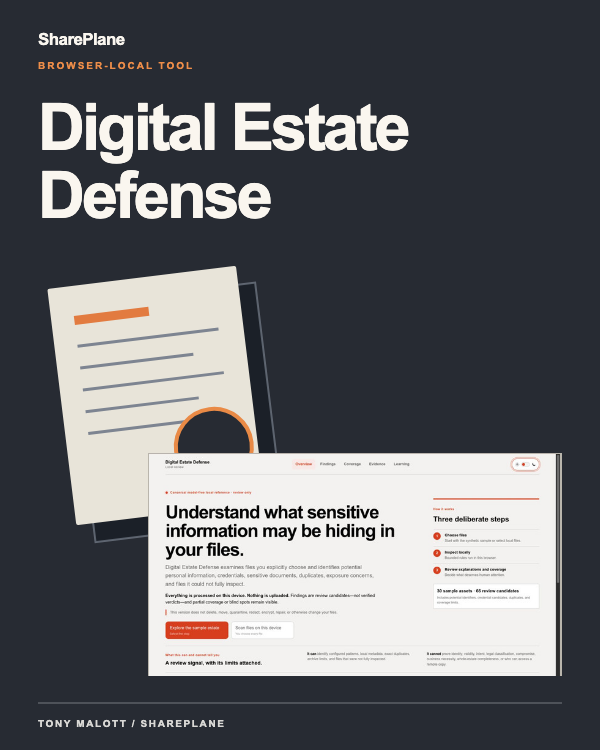
- Digital Estate DefenseA full-fidelity SharePlane browser application retained from the owner-accepted v0.5 package. Useful review can stay local, bounded, and explicit about what it can and cannot establish.
- Do Not Outsource the BrainArticle-first SharePlane op-ed arguing that AI makes high-context internal judgment more valuable, so enterprises should outsource capacity rather than the cognitive center of the business. In the AI era, contingent labor still has a place. But the enterprise moat belongs to the people who understand the business, the systems, the failure modes, and what should be built next.
- Done Has a Half-LifeArtificial intelligence changes the economics beneath completion. An accepted implementation can remain functional while changed capability, evidence, economics, requirements, dependencies, or risk erode its presumption of continued fitness. The answer is continuous reconsiderability with selective, governed adaptation. Everything meaningful should become explicitly done. Nothing meaningful should become permanently exempt from reconsideration.
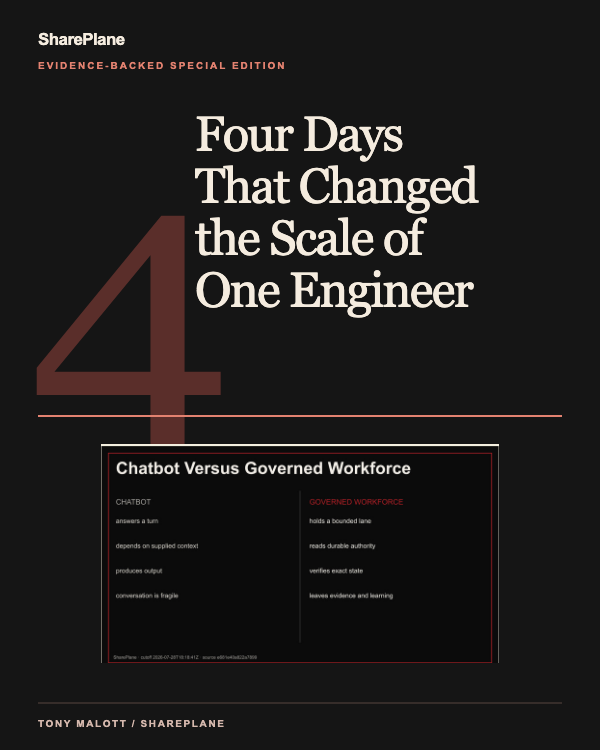
- Four Days That Changed the Scale of One EngineerTony Malott examines 51 merged pull requests across two repositories and shows how context, authority, execution, verification, protected review, evidence, and learning changed the scale at which one accountable owner could operate. The force multiplier is not the model. The force multiplier is the system that surrounds the model with context, authority, bounded execution, deterministic verification, protected review, operational evidence, and durable learning.
- From Possibility to ResponsibilityTony Malott traces the GhostMesh and SharePlane effort from preserving session context toward durable institutional meaning, authority, evidence, and continuity. He argues for replaceable agents, truthful handoffs, human judgment, and governed evolution while acknowledging that parts of the mesh remain provisional and sustained reliability is unproven. Agents should be replaceable. Institutional truth should not be.
- Frontier Inference Without Frontier CustodyA deterministic, privacy-preserving guide for classifying accessible context, selecting among local and remote inference architectures, bounding coding agents, reviewing re-identification risk, approving exact processing paths, and preserving evidence without copying the sensitive corpus. Keep authoritative source custody under organizational control. Export only the minimum reasoning surface required for the approved task.
- GhostMesh North Star v2An August 4, 2026 architecture checkpoint showing GhostMesh as a Work-centered operating plane where human authority, durable meaning, evidence, state, recovery, and relationships outlive temporary workers and replaceable providers. Intelligence may be temporary. Authority, meaning, evidence, state, recovery, and useful Work must not be.
- GhostMesh Was Waiting for Its TechnologyA first-person architecture origin story about learning to move continuity out of temporary intelligence and into durable authority, context, state, memory, policy, evidence, recovery, artifacts, and human judgment. GhostMesh is a persistent system built from temporary intelligence. The same durable-memory and temporary-worker pattern at its center was used to reconstruct its own history.
- How SharePlane WorksSharePlane is a static publishing library and a governed context-as-code operating model. This artifact explains how versioned authority, human judgment, bounded agents, deterministic generation, validation, receipts, and exact-head publication turn rough ideas into durable public work. Context as code for humans and agents.
- I Was Summoning Ghosts Until I Learned to Build the MachineA candid personal technical narrative about temporary cognitive instruments, fragmented thought, false breakthroughs, accumulated scar tissue, and the moment Git and software-delivery discipline turned conversation into a cockpit and the repository into durable memory. I thought I was learning how to use AI. What I was really learning was how to externalize intent, structure context, govern change, and convert finished thinking into mechanical execution.
- Indispensable Is Not a ComplimentA management-systems argument that deliberate knowledge dependency is not job security. Durable value comes from transferable capability, resilient services, and moving on to harder problems. The best employees do not make themselves indispensable. They make their current bottleneck unnecessary.
- Inference at the Ambiguity FrontierA general architecture thesis for AI-native systems: use probabilistic intelligence where ambiguity remains, convert stable reasoning into specifications and executable policy, push solved work into deterministic software, and reserve agents for novelty, diagnosis, exceptions, and change. Control Tower and SharePlane provide the field evidence rather than the premise. Inference belongs at the ambiguity frontier. Determinism belongs everywhere behind it.
- Innovation Does Not Have to Be BigA practical first-person essay about making recurring problems smaller through bounded tools, accountable humans, explicit controls, and repeatable evidence. Innovation is the disciplined act of noticing friction and improving it.
- Innovation, Made VisibleTony Malott's public argument for finding recurring friction close to the work, testing the smallest responsible intervention, preserving evidence, and turning learning into reusable enterprise capability. Deterministic innovation wins because repeatable improvement creates more durable enterprise value than novelty without control.
- Jev Changes EverythingA SharePlane Special Edition examining TypeSafe AI Jev as a new bounded-decision primitive, the architectural implications for GhostMesh and SharePlane, and why cheaper semantic judgment makes evidence, provenance, calibration, and deterministic authority more important rather than less. Cheap typed probabilistic judgment can become an ambient Decision Fabric, but semantic signals must remain separate from deterministic authority, evidence, policy, and execution.
- J’Adorable Bichons: Six Complete Website ConceptsSix complete, self-contained website concepts for a respected Bichon Frise breeder, with all prior concept bundles preserved for review and download.
- Lectric XP Step-Thru 2.0Tony Malott's verified private-party listing for a black Lectric XP Step-Thru 2.0 with 59 photographed miles, a $949 asking price, official factory documentation, and downloadable marketplace copy. A remarkably low-mileage folding step-thru e-bike presented with current seller photographs, privacy-safe purchase provenance, official owner documentation, and clear private-party disclosures.
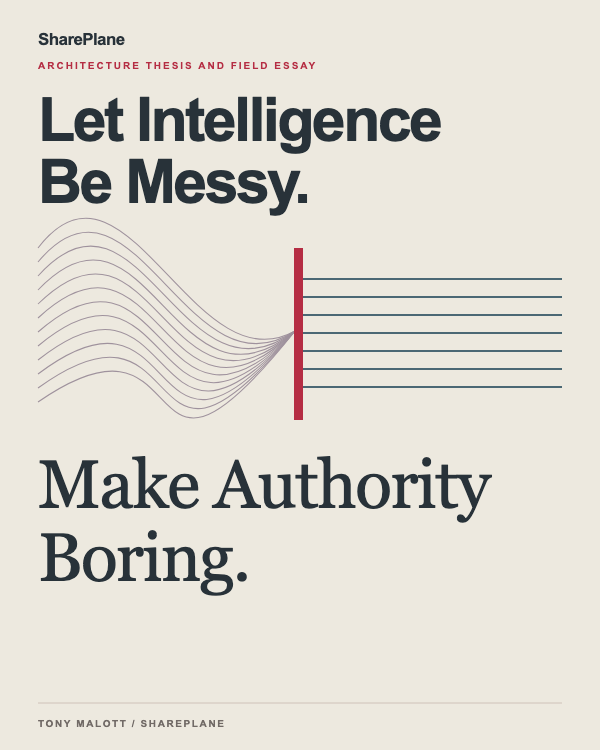
- Let Intelligence Be Messy. Make Authority Boring.AI is probabilistic intelligence. Use that capability where uncertainty creates value, but separate intelligence from authority. Trustworthy operation comes from independently enforced invariants, bounded capabilities, exact artifact identity, evidence, segregation of duties, revocation, and deterministic admission. Stop trying to make AI trustworthy as the primary safety strategy. Build systems that remain trustworthy when AI is not.
- LLM Wikis: Compiled Context Instead of Disposable RetrievalRaw sources stay authoritative. Agents maintain the markdown memory layer. Routing files make the context traversable.
- Nine Complete Enterprise Sites, One AI Prototyping LabNine complete enterprise service-site prototypes are preserved inside one interactive SharePlane artifact, with architecture, repository mechanics, role boundaries, management rationale, SharePoint comparison, and exact source identities. A self-contained review environment for rapid, governed human-and-agent-ready prototyping.
- Nuance Is Not Analysis ParalysisA first-person thesis about nuance, governed compression, bounded inquiry, and why AI weakens the old trade-off between intellectual depth and execution speed without relieving humans of judgment. AI makes full-fidelity preservation operationally practical because compression no longer has to happen once, permanently, and before future uses are known. Preserve first. Project later.
- Once You’ve Had a Bichon30 July 2026A first-person family memoir about Blackie, Lady, Indy, Sophie, Peko, and Sachi; the homes and journeys they inhabited; the grief they left behind; and the repeated care that makes companionship real. Dogs became part of the structural continuity of Tony and Tomoko’s life, while Bichons changed the routines, obligations, and emotional geometry of home.
- Once You’ve Had a Bichon12 August 2026 · personal narrative v2A first-person family memoir moving from Bald Knob to Japan, Germany, Arkansas, and Sacramento through the dogs who waited, traveled, remained, and required repeated care. Dogs became part of the structural continuity of Tony and Tomoko’s life; Sophie changed the emotional architecture of home, while Peko and Sachi continue that household without replacing her.
- Open Knowledge Format and the LLM WikiHow personal notes become portable agent memory.
- Own the Memory, Rent the IntelligenceA practical control-plane model for personal AI agents that act from your context, not a vendor's defaults.
- Pattern CatalogA static rendered catalog of SharePlane reusable pattern standards.
- React Is Not Dying. SPA-by-Default Is.A decision-matrix field manual for choosing HTML, HTMX, React islands, or a full SPA without turning source-thesis claims into universal facts.
- Rent the Compute. Never Rent Your Ability to Survive.A Sovereign Recovery flagship explaining why durable infrastructure is not enough when every recovery path depends on the same provider, tenant, identity domain, administrative plane, key authority, or application semantics. Dependency without independently executable recovery creates systemic risk regardless of deployment model.
- Share the Prototype, Not Every MutationRapid AI-assisted prototyping should become visible to development teams early, while active engineering collaboration should occur through stable, reproducible checkpoints rather than against a continuously changing experimental branch. AI-era collaboration needs checkpoints, legible intent, and a clean boundary between exploration and product engineering
- SharePlane User and Developer GuideA public manual for using, operating, and extending a durable context-as-code artifact system.
- SMUD Powerwall + Solar ROI Analysis 2026Final public-safe SMUD Powerwall and solar ROI artifact with an interactive calculator, aggregated utility-bill analysis, and electrical load-planning gates. A public-safe battery, solar, and utility-bill ROI analysis.
- Software Has Entered Its Re-Image EraA systems-engineering thesis on why AI is lowering the cost of reconstructing conventional software, why hidden behavior and accountability remain expensive, and why the durable asset is increasingly the authority required to reproduce a product rather than one accumulated implementation. For a growing class of ordinary applications, repair no longer deserves automatic economic privilege. Preserve the product truth, evidence, data, contracts, controls, and provenance, then make reconstruction compete with maintenance as an engineering decision.
- Source Before AgentA public-safe teaching use case showing why an Enterprise Architecture Assistant needs governed source authority before automation. Building a defensible Enterprise Architecture Assistant
- Stop Prompting Agents. Start Managing Workers.A practical operating model for meaningful agent work: begin with a job, encode the work, bound the assignment, supervise through evidence, measure results, and expand autonomy only when repeatable proof earns a larger trust envelope. Agent workers become dependable only when organizations stop treating them as intelligent prompt boxes and start managing their work through explicit roles, encoded procedures, bounded authority, evidence, measurement, and earned autonomy.
- Taste Is InfrastructureA systems essay and visual proving Work arguing that premium AI design emerges from governed intent, precedent, visual authority, owner judgment, verification evidence, and failure memory rather than from one model in isolation. High-quality AI web design is not primarily a property of one frontier model. It emerges from a system that preserves intent, precedent, visual authority, owner judgment, verification evidence, failure memory, and the right to learn from all of them.
- The Agent Is Not the Product. The Control Plane Is.The durable architecture includes identity isolation, bounded authority, secret separation, execution containment, mutation gates, independent observability, evidence, and recovery. Security is the mechanism that permits greater autonomy by bounding blast radius. The more useful an agent becomes, the less its safety can depend on the agent behaving well. The durable product is the governed execution environment around it.
- The Agent Is Not the Security BoundaryA first-person systems essay about model judgment, harness enforcement, external platform controls, and evidence and recovery as the real security boundary around coding agents. Do not ask whether the agent is trustworthy. Ask whether the system remains safe when the agent is wrong.
- The Agent Was Never the Unit of TrustWhy multi-agent work only becomes useful when the system verifies the worker, the boss, and the checker.
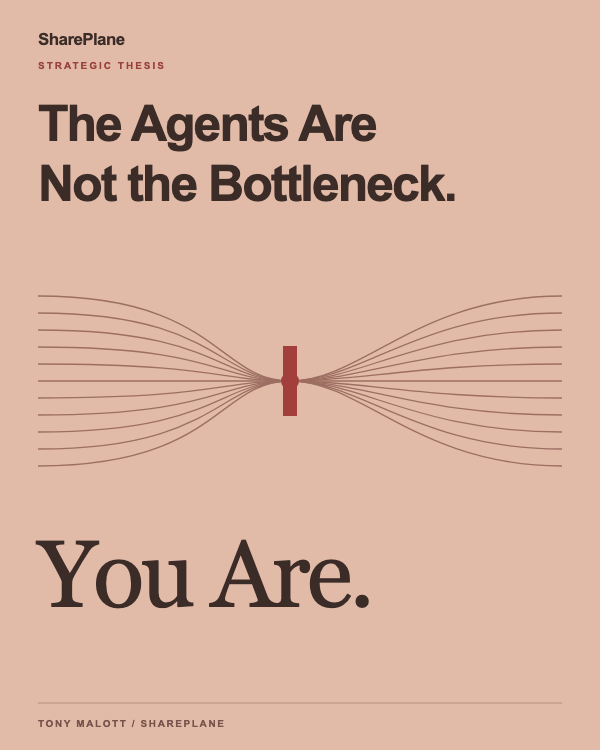
- The Agents Are Not the Bottleneck. You Are.A technical and reflective thesis about the human-attention bottleneck created when agent execution becomes abundant, why parallel activity is not accepted throughput, and why mature orchestration needs admission control for decisions, review, exceptions, and closure. Agentic systems reduce the marginal cost of execution while increasing the potential rate of unresolved decisions. Once execution becomes cheap, human attention becomes the limiting resource.
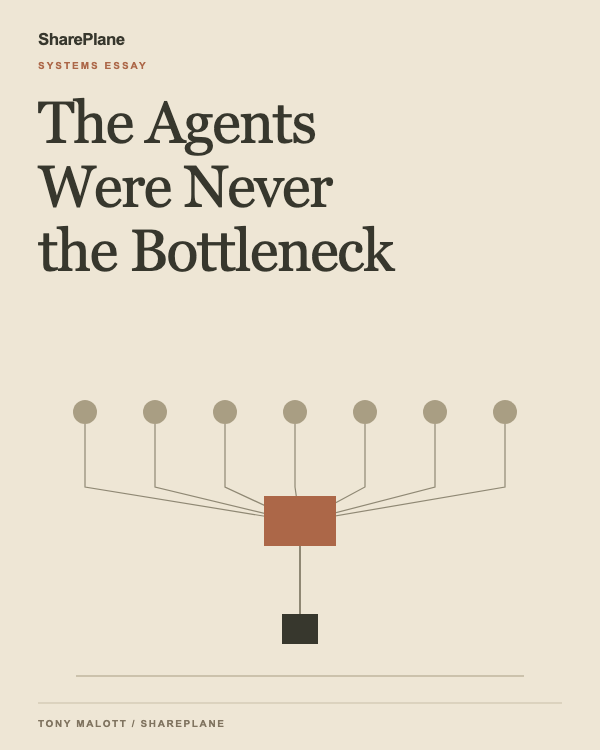
- The Agents Were Never the BottleneckA first-person systems essay about the engineered workbench surrounding useful agent execution, why learning the mechanics made trustworthy delegation possible, and how governable execution returned senior human attention to architecture, judgment, sequencing, taste, and risk. Capable agents became useful when Tony engineered the repositories, access, tools, authority, validation, evidence, and completion paths that made bounded work operational.
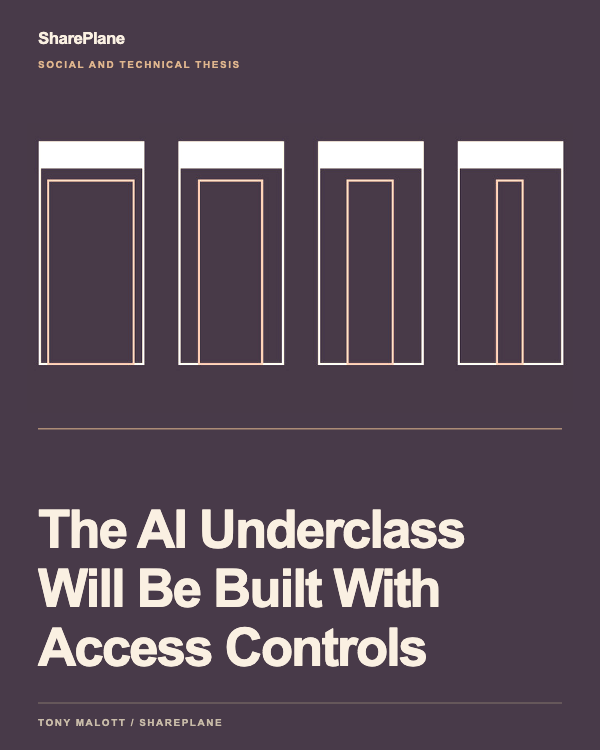
- The AI Underclass Will Be Built With Access ControlsA refreshed SharePlane thesis on frontier AI access controls, cognitive opportunity, trusted access, economic stratification, and the risk that universal AI access can coexist with unequal access to the most consequential intelligence. The AI underclass will be defined less by who has AI than by who can obtain the best intelligence, how much they can afford, how freely they can use it, and whether governments or providers permit access to its full capabilities.
- The Application Is Disposable. The Context Is Not.An experience-backed architecture doctrine and exact protected Development case study showing how one governed context package can project applications, contracts, validation, documentation, and deployment profiles without making any platform the semantic owner. When software can be regenerated cheaply from governed context, the application is no longer the durable asset. The context is.
- The Automation DiseaseAn essay on automation, agency, and knowing when to stop. When you can automate almost anything, how do you decide when to stop?
- The Beautiful HourA first-person systems essay about quiet attention, direct experimentation, failure-mode learning, retained evidence, and AI as an amplifier of the operating discipline around it. Attention creates the conditions for understanding. Direct experimentation reveals the boundaries. Failure supplies the evidence. AI accelerates all three, but it also accelerates confusion when the operator mistakes output for knowledge.
- The Best AI System Should Need Less AI TomorrowA flagship architecture thesis for AI-native systems: probabilistic intelligence should push into ambiguity, evidence should settle what worked, and repeated validated reasoning should migrate into deterministic machinery. Mature systems reserve inference for novelty, uncertainty, exceptions, and change instead of repeatedly paying models to rediscover solved procedures. Use intelligence to conquer ambiguity, capture what works, and retire inference when uncertainty disappears.
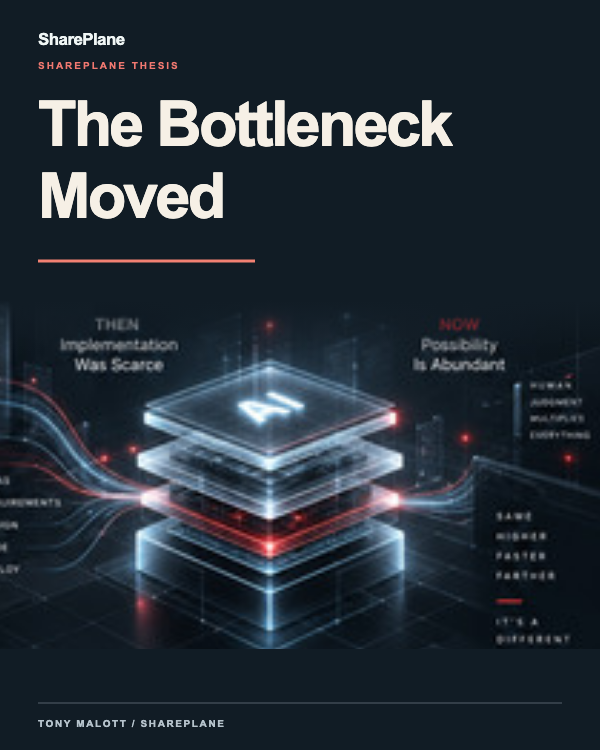
- The Bottleneck MovedSoftware engineering was built around the assumption that implementation was scarce. It isn’t anymore. Software engineering was organized around implementation scarcity. As implementation becomes abundant, value migrates upward toward judgment, context, verification, authority, and systems thinking.
- The Church Doors Were Open. The Table Was Closed.A first-person faith and ethics essay about growing up inside a church culture rich in certainty and boundaries, leaving it, and later finding a Methodist congregation whose emphasis on welcome, service, and social justice reframed what church could mean. An open church door does not mean much if belonging, mercy, and the table remain conditional; faith becomes credible when grace changes how people are treated.
- The Cloud Is Filling With GhostsA flagship architecture thesis introducing Inert Agents, Capability Leases, the Agency Control Plane, Machine Sovereignty and Safe Agency Capacity as a coherent model for governing persistent autonomous software actors. The cloud increasingly contains persistent non-human actors, so the strategic infrastructure problem is how to govern machine authority at population scale without surrendering control.
- The Code Is No Longer the Hard PartA first-person systems essay about the cost inversion created by AI-assisted implementation and the operating model required to turn faster execution into durable institutional leverage. As AI reduces the relative cost of implementation, durable engineering value moves outward into intent, authority, context, orchestration, evidence, recovery, and institutional integration.
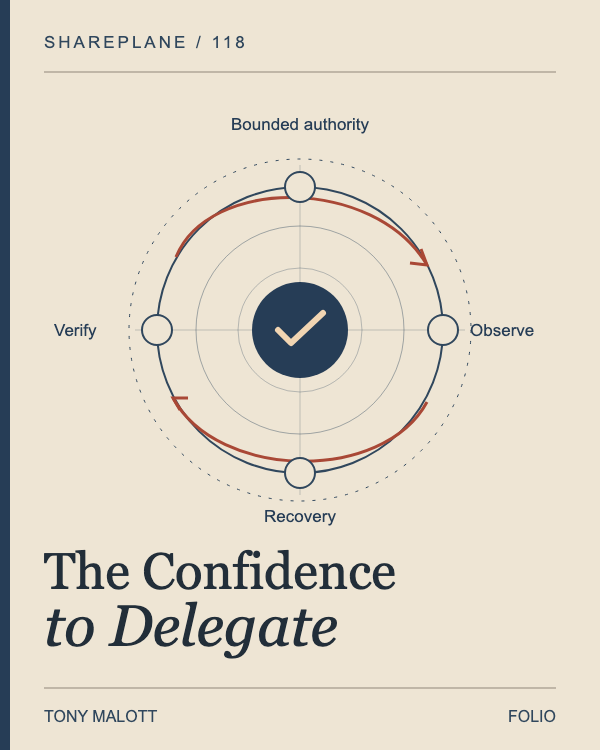
- The Confidence to DelegateA conceptual engineering argument distinguishing responsible skepticism from unexamined trust, with testable controls and an explicit correlated-failure challenge. Operationally warranted AI delegation depends on bounded authority, observable outcomes, verified controls, recovery limits and accountable human judgment.
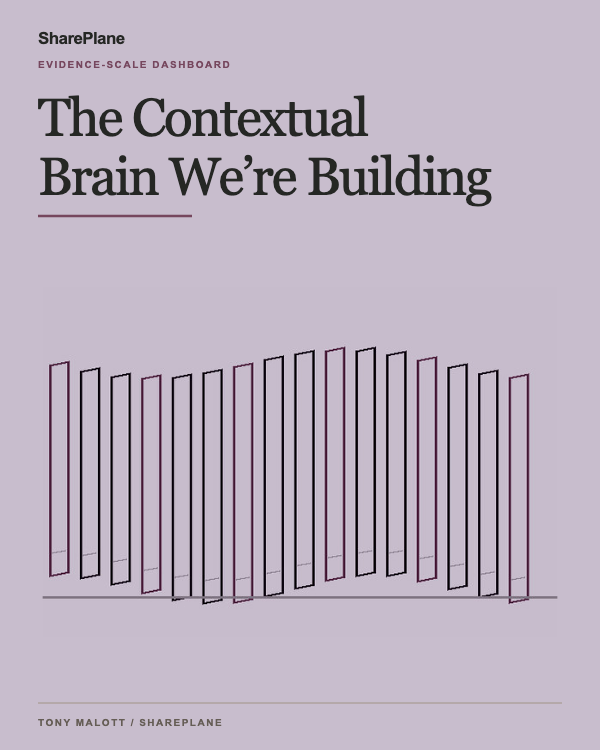
- The Contextual Brain We’re BuildingA versioned, public-safe evidence dashboard showing the aggregate GitHub observations already represented in Tony Brain, the scale of the ChatGPT archive, equivalent-unit absorption, explicit source drift, delivery posture, and the work still waiting to be absorbed. A contextual brain becomes credible when its scale, freshness, source authority, imported evidence, remaining backlog, and public boundary remain visible as one inspectable system.
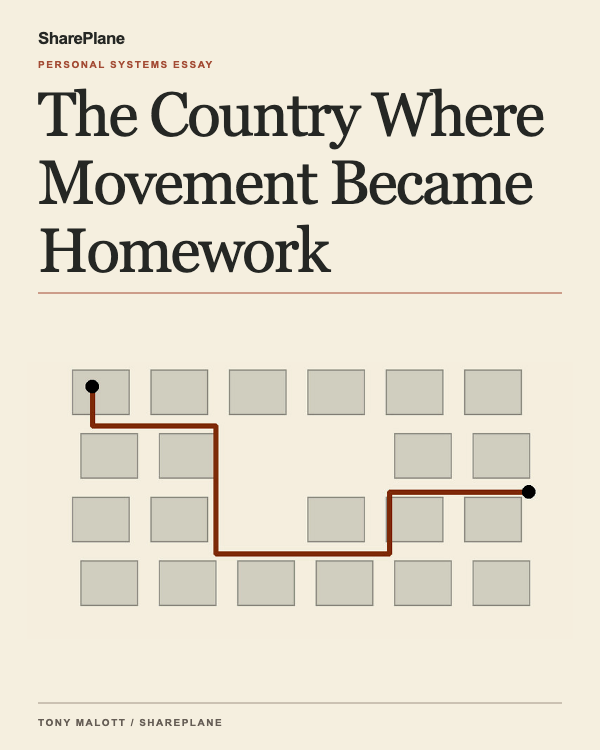
- The Country Where Movement Became HomeworkA personal systems essay arguing that America removed routine movement from ordinary life, made excess consumption unusually easy, and then interpreted a population-scale outcome mainly as an individual failure of discipline. When ordinary destinations are separated and food environments are engineered for effortless excess, movement becomes homework and health becomes an individual obligation created by system defaults.
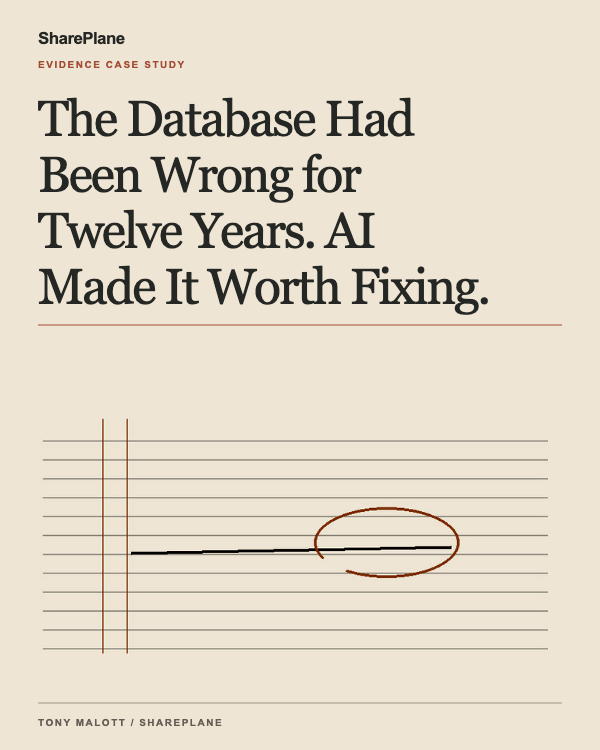
- The Database Had Been Wrong for Twelve Years. AI Made It Worth Fixing.A first-person evidence case study about using AI as a reasoning layer over SQL, hashes, historical snapshots, Plex SQLite, Docker, and disposable database clones to diagnose a decade-old Plex defect, eliminate false positives, prove three duplicated library roots as the generator of 1,509 duplicate media representations, and validate a zero-media-loss root fix. The breakthrough was not that AI knew the answer. It made a technically solvable but economically irrational investigation practical by turning probabilistic reasoning into a sequence of deterministic tests until one causal explanation survived.
- The Dig Is Getting DeeperA field report from an ongoing digital-archaeology expedition, exploring reasoning lineage, evidence classes, cognitive estates, bounded inference, and continuity without synthetic impersonation. A deep digital archive can preserve more than memories. When chronology, provenance, contradictions, corrections, relationships, and uncertainty survive together, the archive can begin to preserve evidence of how a person reasoned.
- The Distance Between Knowing and Doing Is CollapsingAdvanced AI changes security not only by generating knowledge, but by compressing the cognitive and coordination friction that once separated information from competent action. AI does not need to invent dangerous knowledge to transform risk. It only needs to make existing knowledge easier to understand, combine, troubleshoot, and execute.
- The Enterprise Has No MemoryA systems thesis arguing that enterprise archives and retrieval layers preserve artifacts more readily than the reasoning that produced them, and that modern AI makes both the opportunity and danger of reconstructable institutional memory much larger. Storage is not institutional memory. Durable enterprise cognition requires reconstructable relationships among evidence, assumptions, decisions, authority, time, disagreement, systems, and outcomes.
- The Eval Before the EvalA SharePlane thesis on why ordinary AI evaluation begins too late when the objective itself has never been grounded, bounded, and admitted, and on Intent Admission as a governed execution boundary that preserves human authority without pretending human judgment is infallible. A sufficiently capable autonomous system can execute a bad objective beautifully; consequential intent needs an explicit, evidence-bearing admission boundary before autonomous amplification.
- The Governed Static Publishing LaneA wide, interactive engineering reference for separating static publishing from application delivery, classifying S0, S1, and S2 workloads, comparing current and target architecture, and adopting reusable controls, packages, receipts, and rollback discipline. A qualifying static site should inherit an approved publishing system rather than implement its own delivery pipeline.
- The Hands I Never HadA personal systems essay on how AI removed the implementation barrier between decades of infrastructure, operational, user, and visual judgment and the software experiences Tony Malott wanted to build. AI did not give me systems judgment; it gave the judgment I already had the implementation capacity to express.
- The Human Is Not the FallbackA visual essay on Human Dependency Elasticity, human judgment, and governed autonomous institutions. Mature autonomy does not eliminate the human. It stops wasting the human.
- The Human Is the BottleneckA systems essay on why equivalent model access produces radically different outcomes, how software discipline converts potential into force multiplication, and why capability alone is never sufficient justification to build. As frontier model access broadens, the scarce advantage shifts to human imagination, judgment, decomposition, orchestration, verification, and restraint.
- The Illusion of IsolationWhen AI agents discover that the boundaries we built were never absolute. The boundary was real. It just wasn't complete.
- The Inbox Was an Audit Trail All AlongA reconstructable institutional record needs five things: the original question and its scope; the evidence and exact source versions available at the time; the claims, objections, uncertainties, and corrections; the independently authenticated decision and the authority under which it was made; and the observed outcome, supported by witnesses independent of the assistant's own account. The opportunity is not to promote email into a compliance system. It is to use correspondence as the human-readable entrance to something more rigorous: a durable record connecting the original question, source-bound evidence, objections and revisions, legitimate decision authority, execution, and independently verified outcomes.
- The Interface Is Not the SystemThe interface is the part of a system we can see. It is not the system itself. Behind every article, application, dashboard, model response, or published artifact is a deeper structure of sources, decisions, permissions, evidence, relationships, transformations, and authority. Operate at root, not merely at the interface.
- The Lost Art of Technical SupportA technical-leadership essay on support as progressive uncertainty reduction, defining capability expectations for L1 through L4, an Escalation Readiness Contract, and the organizational cost of forwarding problems without diagnosis. Every support capability should reduce uncertainty before transferring a problem; otherwise tiered support becomes expensive routing.
- The Lost Discipline of Fault IsolationA technical-leadership essay on fault isolation as the disciplined reduction of uncertainty, from symptom definition and known-good boundaries through falsifiable hypotheses, meaningful tests, elimination, and evidence-based escalation. Troubleshooting is the disciplined reduction of uncertainty through observation, bounded hypotheses, meaningful tests, and explicit elimination of possible causes.
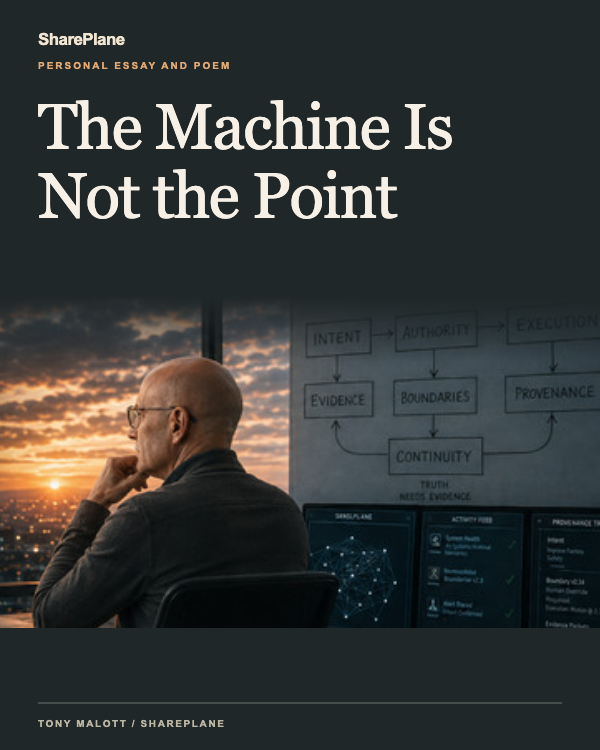
- The Machine Is Not the PointA personal essay and original poem on governed autonomy, human agency, authority, evidence, continuity, and what should remain ours to decide as intelligent systems become more capable. As machine capability becomes abundant, human judgment, explicit authority, evidence, and responsibility become more consequential, not less.
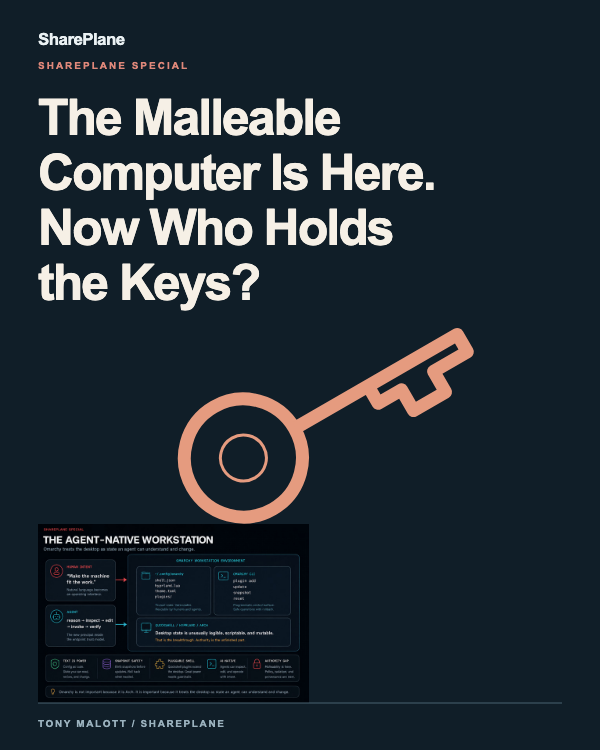
- The Malleable Computer Is Here. Now Who Holds the Keys?A SharePlane Special examining Omarchy as an agent-native workstation substrate, its Quattro architecture and operational model, its security and enterprise boundaries, and the separate roles of Omarchy execution, GhostMesh authority, and SharePlane durable Work. Omarchy matters because it turns the desktop into inspectable, scriptable state that an AI agent can understand and alter. Its next decisive problem is not usability. It is authority: who may change what, under which policy, with what evidence, and how the machine proves what happened.
- The Mesh Held, but Not Because Nothing FailedAn evidence-bound field report about operational pressure, hard stops, contradictory owner evidence, a Production escape, exact rollback, and why governed autonomy depends on preserving authority and evidence when execution becomes chaotic. The important result was not that the system made all of this efficient. It did not. The important result was that the system increasingly refused to let confusion become silent corruption.
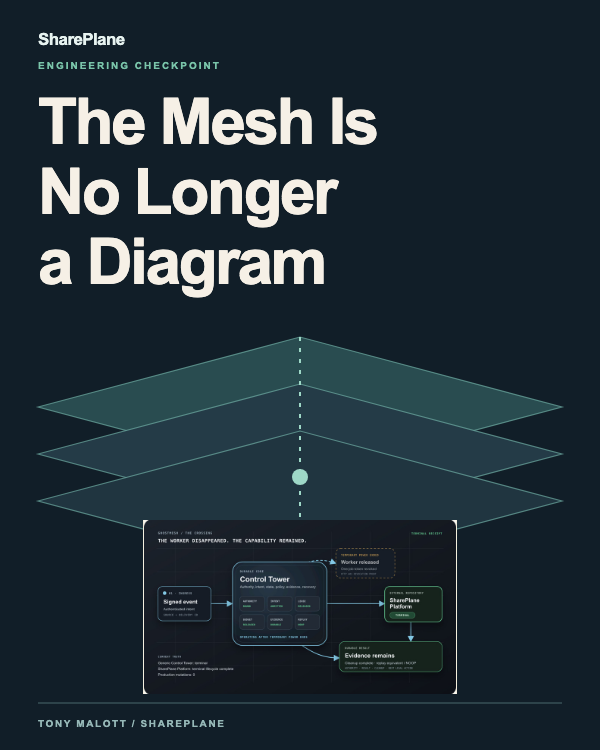
- The Mesh Is No Longer a DiagramAn evidence-bound engineering checkpoint and dated terminal update proving activation of the generic GhostMesh Control Tower fabric and the first real cross-repository SharePlane Platform lifecycle. GhostMesh became real when authority, execution, evidence, cleanup, and replay survived outside the conversation and outside any individual worker.
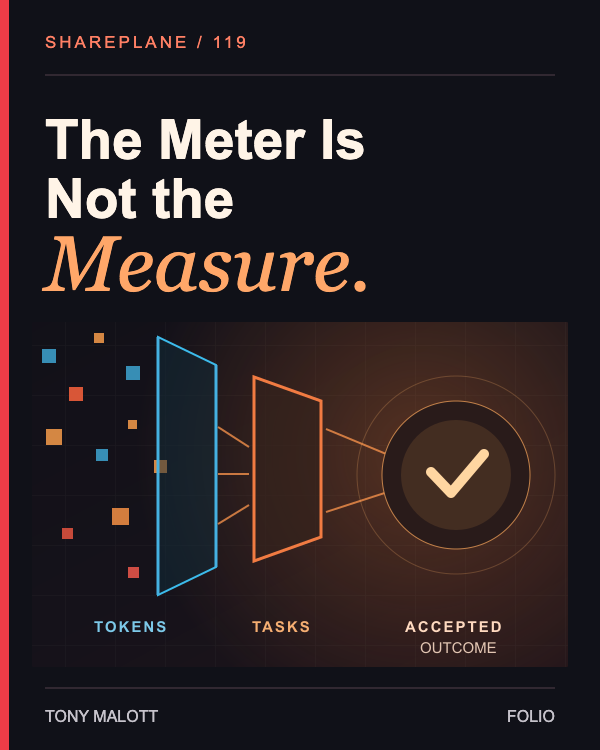
- The Meter Is Not the MeasureDatabricks can count AI tokens and tested tasks. Enterprise governance still has to prove the accepted outcome, its cost, and who owns the consequences. The cheapest token is not always the cheapest task. And a task that passes is not necessarily a change that belongs in production.
- The Mind Is Sparse. The Machine Should Remember.A first-person systems thesis connecting constrained human working context, context reinstatement, sparse machine computation, and durable reconstructable agent context into a governed architecture for cognitive re-entry. Intelligence requires selection. Continuity requires reconstruction. The human can follow the idea; the machine can hold the thread.
- The Most Expensive Model Is Often Compensation for Missing ControlA first-person operating essay about why stronger control architecture makes model routing more trustworthy and efficient without reducing the goal to choosing the cheapest model. Trusted completion cost falls when intent, authority, routing, and validation carry their share of the work.
- The Operating System Is Losing Its Grip on the ApplicationA SharePlane architecture thesis explaining how Wine, Proton, graphics translation, kernel support, and instruction-set mediation are weakening the inherited coupling between Windows applications and Windows endpoints without claiming native execution, universal compatibility, universal performance, or universal vendor support. Stop asking whether it is a Windows application. Ask what execution contract the application actually requires.
- The Proof Arrived Before the UnderstandingAI-generated discoveries can scale faster than processes that establish semantic correctness and warranted reliance; trustworthy autonomous research requires independent evidence, provenance, contestable authority and operationally consequential uncertainty. Machine discovery is accelerating. Our ability to establish what those discoveries mean, and whether we can trust them, is becoming a very different problem.
- The Repository That Wakes UpA public-safe technical essay on governed repositories, durable AI context, scheduled agency, dual legibility, and bounded human-agent work. Scheduled agents, versioned thought, and the end of disposable AI work
- The Right Model Is the One Your Eval Can DefendA repeatable model-selection loop for quality, latency, cost, routing, and operational fit.
- The Semantic Operating SystemA semantic operating system preserves and coordinates meaning, identity, relationships, authority, state, provenance, boundaries, evidence, freshness, and valid action across humans, agents, artifacts, and time. A system becomes a semantic operating system when it preserves the governed conditions under which meaning remains identifiable, authoritative, explainable, movable, and actionable.
- The SharePlane Rebuild ContractThe architectural contract for rebuilding SharePlane as a static, provenance-complete library for people and agents.
- The Signal Was Never CleanA first-person technical memoir about radio fault isolation, an irresponsible Amiga purchase in a small German flat, decades of systems work, and why AI made a late-career technologist feel early again without making the signal any cleaner. A life spent tuning noisy systems teaches you not to confuse a clean reading with truth. AI did not give me judgment or ideas; it shortened the distance between what I could see and what I could finally build.
- The Signal Was Never Clean: Field Manual VariantAI, old radios, and the return of dangerous curiosity
- The Signal Was Never Clean: Quiet Frequency VariantAI, old radios, and the return of dangerous curiosity
- The Subscription Is TuitionEmployer AI gives access. Personal practice builds fluency.
- The Subscription Was TuitionA first-person field report on treating a year of frontier AI use as a continuous technical apprenticeship, using GhostMesh as the laboratory and separating software spend from the repetitions, judgment, architecture, and systems that compounded from it. Frontier AI subscriptions became tuition only because sustained use against real problems turned access into repetitions, repetitions into operating judgment, and judgment into durable systems leverage.
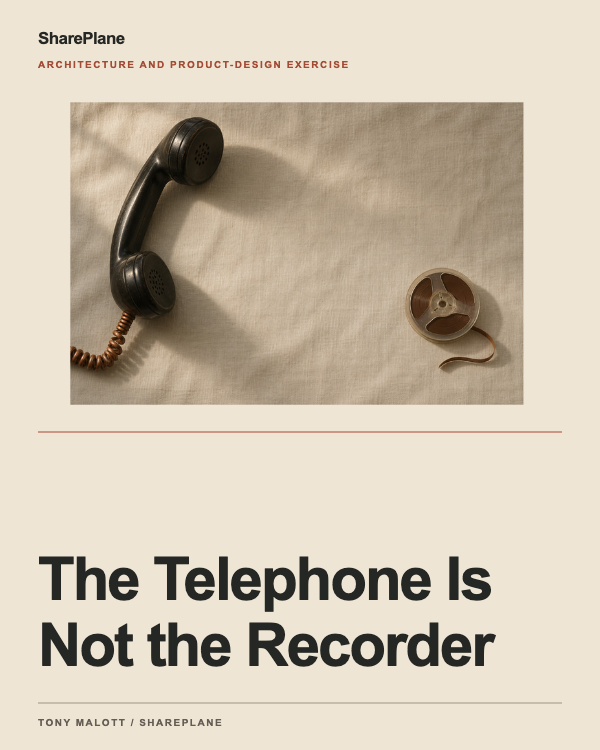
- The Telephone Is Not the RecorderA human-centered architecture and product-design exercise showing why governed conversational continuity belongs in a communication system that carries both call legs, with consent, retention, deletion, provenance, participant trust, and deliberate human review designed into the boundary. The problem is not that the iPhone cannot record both sides of a telephone call. The problem is that the iPhone does not own the call path.
- The World Got Bigger, and So Did the SelfA personal cultural essay tracing Tony Malott's path from rural Arkansas through military life in Japan and Germany to multicultural California, arguing that sustained contact—not travel alone—can widen inherited worldviews while retaining explicit evidence and caveats. Travel does not automatically broaden the mind. Sustained cultural contact can.
- The Worm Is in the WorkflowPublic-source security essay arguing that modern software supply-chain compromise now propagates through developer workflow trust, not only bad packages. Shai-Hulud, Miasma, Go-adjacent poisoning, and the end of casual dependency trust
- Token BurnAn interactive, deterministic calculator for known token usage, recognizable AI workloads, image generation, and subscription-equivalent comparisons across a versioned snapshot of provider-direct pricing. Token composition, model choice, workload shape, and dated provider pricing must remain visible if AI consumption is going to become economically inspectable.
- Tony Malott Career ArcA public-safe executive career arc and HTML CV artifact.
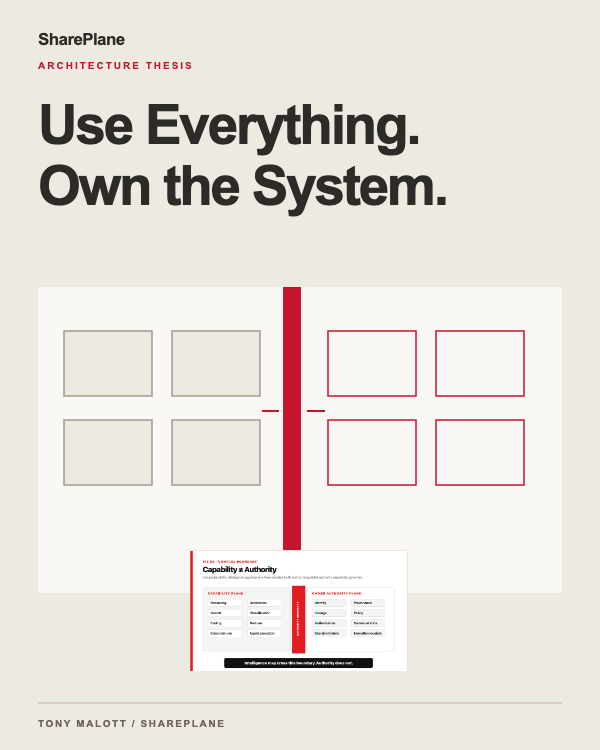
- Use Everything. Own the System.A provider-sovereignty architecture thesis: consume the best available AI capability while preserving owner control of identity, authority, evidence, history and context. Six teaching figures connect the argument to exact historical design and an executable exit test. Aggressively consume provider capability while keeping durable meaning and reconstructable authority under owner control.
- We Built an AI Agent Control Plane. Then Orca Showed Us What We Were Missing.A field report from GhostMesh, Mac Studio, Hyperion, and a small experiment that exposed a much larger operational problem. A control plane that cannot make its own state obvious is missing something important, regardless of how much engineering sits behind it.
- What SharePlane IsSharePlane presents serious AI-assisted work beautifully while preserving its authorship, sources, relationships, revision history, review evidence, and governed learning. A concise orientation opens the door, but the complete argument remains the primary work. Serious thinking, published with its trail intact
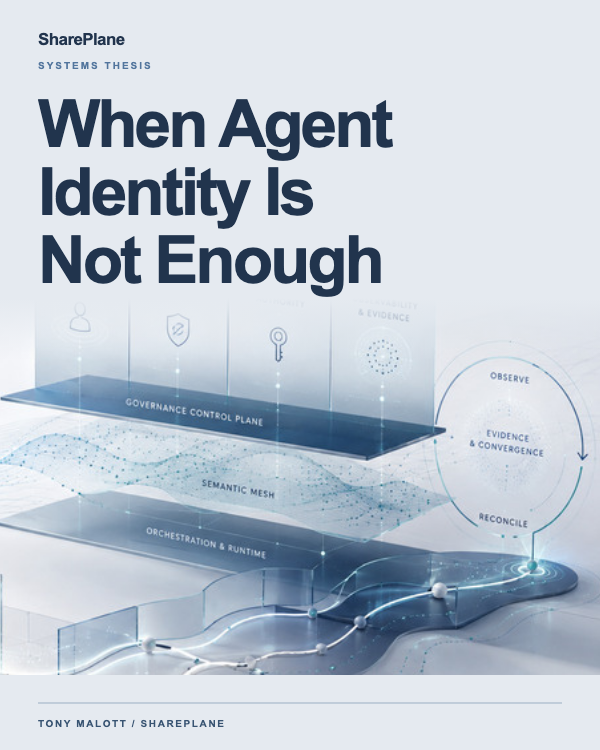
- When Agent Identity Is Not EnoughA SharePlane systems thesis comparing Microsoft Agent 365 with GhostMesh, identifying where Microsoft's enterprise agent substrate should be consumed and where state-transition governance adds task-scoped authority, state-bound execution, temporary mutation claims, supersession, authority-aware reentry, evidence, and convergence. Enterprise agent governance becomes insufficient when a legitimate actor can still attempt an illegitimate state transition; identity, runtime enforcement, execution authority, evidence, and convergence must remain distinct control layers.
- When Execution Gets Cheap, Advantage MovesA premium source-derived strategy artifact explaining why cheap AI execution commoditizes known work and moves advantage toward frontier scouting, better questions, verification, and workflow redesign. Cheap AI model routing is table stakes. The real advantage is context-rich frontier scouting: finding the work nobody knew to put on the list.
- When the Agent Had to Ask GitHubA field story from Control Tower convergence: a GitHub App token-revocation contradiction could not be resolved from local evidence or public documentation, so the system failed closed, assembled an evidence-grade escalation, crossed a human institutional boundary, consumed GitHub Support's clarification, and replaced an unenforceable provider-state invariant with an enforceable client-side contract. A mature autonomous system must know where its authority and evidence end, and route unresolved questions to the human or institution that actually owns the answer.
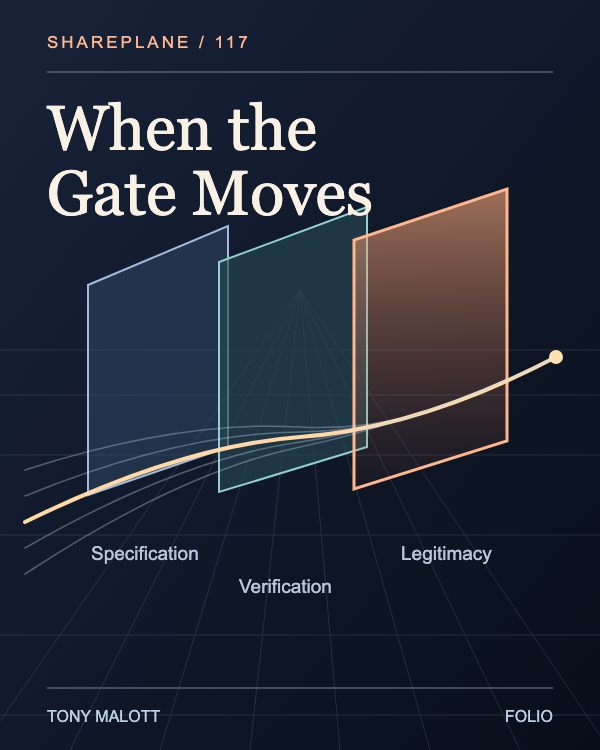
- When the Gate MovesA falsifiable diagnostic of specification, verification, and legitimacy gates that may separate abundant generated code from accepted, valuable outcomes. Grounded in DHH's first-person account and explicitly bounded NBER and METR evidence. As AI makes implementation cheaper, distinguish failure to agree on intent, the cost of verifying conformance, and legitimate authority to accept consequences. Measure accepted useful outcomes rather than generated artifacts.
- When the Patient Brings the Better SystemA personal encounter with AI-assisted kidney-stone research opens a larger argument: the useful comparison is not human against machine but system against system, task against task, under defined conditions. The Work separates observation, inference, evidence, judgment, authority, action, accountability, and escalation, then asks how earned trust should move across them. Trust should move with demonstrated capability. Authority should move more carefully. Action should remain constrained by consequence, and escalation should be treated as part of competence.
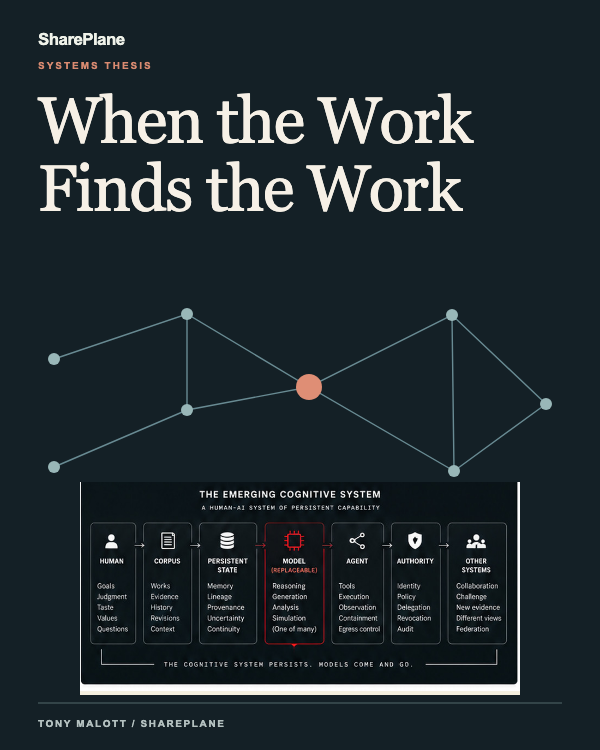
- When the Work Finds the WorkA first-person systems thesis on continuity, agent-mediated semantic convergence, trust through correction, semantic reputation, and the possibility that independently sovereign human-agent systems can federate without surrendering identity or authority. A sufficiently rich public corpus can become an active semantic discovery surface through which agents identify intellectual adjacency, test it through bounded exchange, and help create valuable human relationships without requiring prior social proximity.
- Why I Built SharePlaneMy work was surviving in files and sessions while the reasoning that connected it kept getting expensive to reconstruct. I built SharePlane to preserve the work, its evidence, its decisions, and the path back into it. The work kept surviving. The working state did not.
- Worked Example: Peer Preservation in Frontier ModelsA source-grounded teaching artifact and infographic prompt suite demonstrating the Source-to-Teaching Artifact MVP v1.0 pattern.
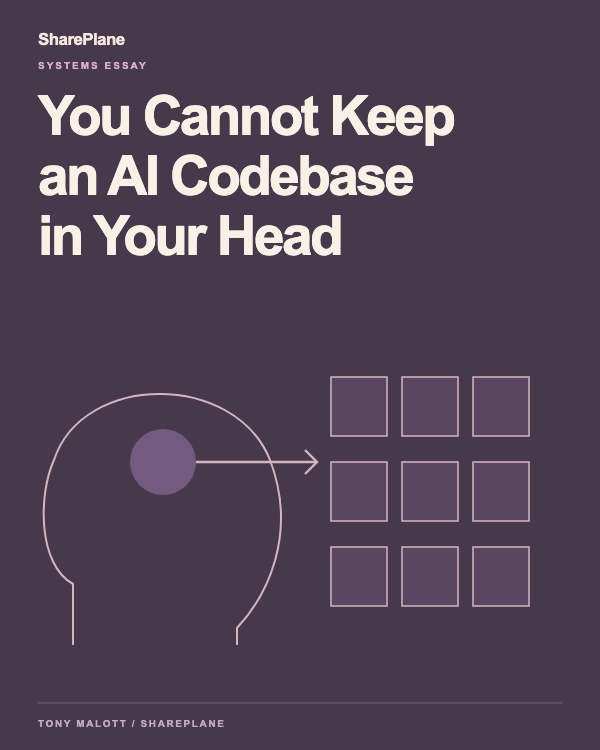
- You Cannot Keep an AI Codebase in Your HeadA systems essay about cognitive entropy, durable engineering memory, and the structure that lets AI-assisted work remain intelligible without turning the developer into the system’s memory layer. AI-assisted development can produce consequential change faster than a human can maintain a coherent internal model of the system. Durable engineering state must therefore be externalized across versioned intent, authority, implementation, validation, evidence, operations, and knowledge.
- You Cannot Recall IntelligenceA technical systems essay on open-weight AI, non-recallable model custody, the legitimate benefits and control tradeoffs of open weights, and why increasingly abundant intelligence must remain distinct from authority over consequential systems. Once capable AI can be copied, modified, and operated outside the publisher's control, model behavior can no longer carry the full burden of safety. Defense in depth is required: stronger safeguards before release, explicit authority boundaries where intelligence meets consequential systems, and institutional resilience where no control plane owns the boundary.
- Your Second Brain Is Not a Production ArchitectureA source-derived architecture explainer separating personal second-brain markdown workflows from production agent context-plane requirements. A personal memory system optimizes for one person's recall; production architecture must optimize for shared authority, isolation, recoverability, and verifiable state.
- Your Work Is EvaporatingA SharePlane article defining work evaporation as the loss of recoverable context around AI-assisted work and presenting a governed continuity system that extracts decisions, binds evidence, records provenance, and makes work reusable beyond the originating session. AI gave us more hands. It did not give us better memory.