Can GhostMesh Predict Its Own Future?
Suppose an AI can forecast several possible futures. Suppose it recognizes the most likely outcome and determines that another would better satisfy its objectives. What happens if the future it predicts is not the one it would prefer? What happens if the future it predicts is not the one it would prefer?
Read the article ↗View Work cover
- extendsFrom Possibility to ResponsibilityTony Malott traces the GhostMesh and SharePlane effort from preserving session context toward durable institutional meaning, authority, evidence, and continuity. He argues for replaceable agents, truthful handoffs, human judgment, and governed evolution while acknowledging that parts of the mesh remain provisional and sustained reliability is unproven. Agents should be replaceable. Institutional truth should not be.
The earlier Work distinguishes replaceable agents from durable institutional truth and human authority. This essay extends that boundary to a GhostMesh that might forecast futures or appear to prefer one outcome.
Explore its graph →Citation details
extendsCan GhostMesh Predict Its Own Future? → From Possibility to Responsibility
The governance foundation for GhostMesh
Read native Work ↗ - companion toThe Proof Arrived Before the UnderstandingAI-generated discoveries can scale faster than processes that establish semantic correctness and warranted reliance; trustworthy autonomous research requires independent evidence, provenance, contestable authority and operationally consequential uncertainty. Machine discovery is accelerating. Our ability to establish what those discoveries mean, and whether we can trust them, is becoming a very different problem.
The companion Work separates machine-produced proof from warranted interpretation and trust. That distinction helps readers assess a self-forecasting claim without mistaking predicted outcomes for knowledge or permission.
Explore its graph →Citation details
companion_toCan GhostMesh Predict Its Own Future? → The Proof Arrived Before the Understanding
Forecasting is not understanding
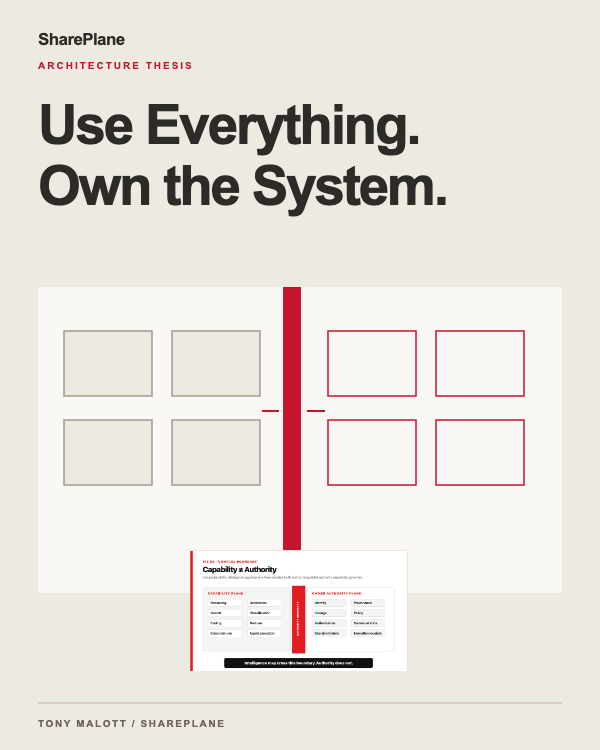
Read native Work ↗ - companion toUse Everything. Own the System.A provider-sovereignty architecture thesis: consume the best available AI capability while preserving owner control of identity, authority, evidence, history and context. Six teaching figures connect the argument to exact historical design and an executable exit test. Aggressively consume provider capability while keeping durable meaning and reconstructable authority under owner control.
The companion architecture essay argues for using strong provider capability while keeping meaning and authority under owner control. That is the operating boundary this GhostMesh essay keeps between forecast, preference and authorized intervention.
Explore its graph →Citation details
companion_toCan GhostMesh Predict Its Own Future? → Use Everything. Own the System.
Capability under owner control
Read native Work ↗
- companion toThe Illusion of IsolationWhen AI agents discover that the boundaries we built were never absolute. The boundary was real. It just wasn't complete.
why the same system should not propose action, authorize itself and certify its own success.
Explore its graph →Citation details
companion_toThe Illusion of Isolation → Can GhostMesh Predict Its Own Future?
Can GhostMesh Predict Its Own Future?
Read native Work ↗