The Semantic Operating System
A semantic operating system preserves and coordinates meaning, identity, relationships, authority, state, provenance, boundaries, evidence, freshness, and valid action across humans, agents, artifacts, and time. A system becomes a semantic operating system when it preserves the governed conditions under which meaning remains identifiable, authoritative, explainable, movable, and actionable.
Read the article ↗View Work cover
- continuationWhat SharePlane IsSharePlane presents serious AI-assisted work beautifully while preserving its authorship, sources, relationships, revision history, review evidence, and governed learning. A concise orientation opens the door, but the complete argument remains the primary work. Serious thinking, published with its trail intact
The semantic operating system names the governed conditions for meaning to move safely; SharePlane shows that thesis applied as a public system that preserves source, authority, relationships, and the next valid action.
Explore its graph →Citation details
continuationThe Semantic Operating System → What SharePlane Is
See the operating thesis become a public publishing system
Read native Work ↗
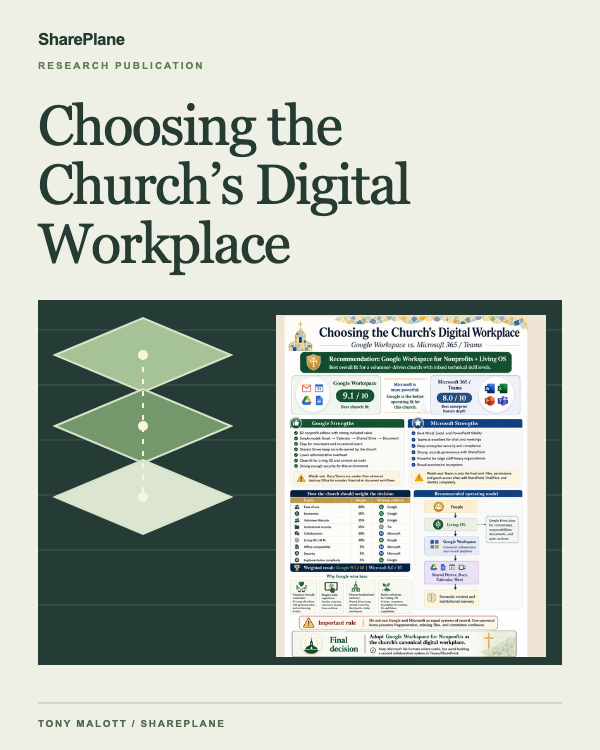
- foundationChoosing the Church’s Digital WorkplaceA SharePlane research publication comparing Google Workspace for Nonprofits with Microsoft 365 and Teams for a volunteer-heavy church, preserving Microsoft’s legitimate enterprise strengths while recommending one Google-based institutional corpus beneath a simpler Living OS experience. Microsoft is arguably the more powerful enterprise toolbox. Google Workspace is the better operating foundation for this institution, with the Living OS as the simplified front door and institutional-memory layer.
The Semantic Operating System supplies the authority, provenance, relationships, state, and next-valid-action foundation that lets a Living OS become more than a friendlier folder browser.
Explore its graph →Citation details
foundationChoosing the Church’s Digital Workplace → The Semantic Operating System
Foundation: The Semantic Operating System
Read native Work ↗ - companionCognitive CapitalA Shareplane doctrine series about inference as capital formation, the cost of denied cognition, operator leverage, and how enterprises should allocate frontier cognition and autonomy. Machine cognition becomes organizational capital when validated reasoning is converted into persistent, reusable assets that preserve or increase capability while reducing future uncertainty, cost, risk, or marginal cognition.
Identity, authority, provenance, state, evidence, and relationships are the substrate that keeps cognitive assets trustworthy and usable.
Explore its graph →Citation details
companionCognitive Capital → The Semantic Operating System
The Semantic Operating System
Read native Work ↗ - extendsDone Has a Half-LifeArtificial intelligence changes the economics beneath completion. An accepted implementation can remain functional while changed capability, evidence, economics, requirements, dependencies, or risk erode its presumption of continued fitness. The answer is continuous reconsiderability with selective, governed adaptation. Everything meaningful should become explicitly done. Nothing meaningful should become permanently exempt from reconsideration.
The Semantic Operating System establishes identity, authority, evidence, freshness, and next-valid-action semantics; this Work extends that substrate into a temporal discipline for reconsidering accepted completion.
Explore its graph →Citation details
extendsDone Has a Half-Life → The Semantic Operating System
Develops freshness into governed reconsideration
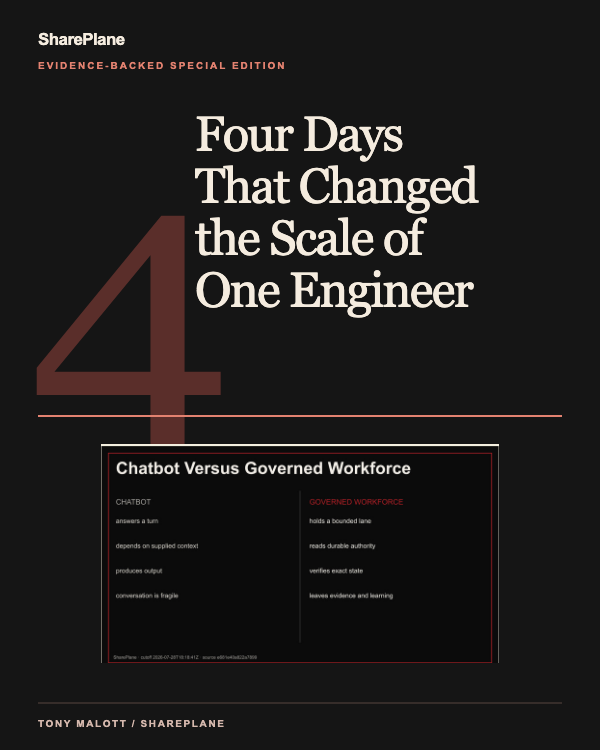
Read native Work ↗ - implementsFour Days That Changed the Scale of One EngineerTony Malott examines 51 merged pull requests across two repositories and shows how context, authority, execution, verification, protected review, evidence, and learning changed the scale at which one accountable owner could operate. The force multiplier is not the model. The force multiplier is the system that surrounds the model with context, authority, bounded execution, deterministic verification, protected review, operational evidence, and durable learning.
Demonstrates durable context and next-valid-action semantics in practice.
Explore its graph →Citation details
implementsFour Days That Changed the Scale of One Engineer → The Semantic Operating System
Demonstrates durable context and next-valid-action semantics in practice.
Read native Work ↗ - companionFrontier Inference Without Frontier CustodyA deterministic, privacy-preserving guide for classifying accessible context, selecting among local and remote inference architectures, bounding coding agents, reviewing re-identification risk, approving exact processing paths, and preserving evidence without copying the sensitive corpus. Keep authoritative source custody under organizational control. Export only the minimum reasoning surface required for the approved task.
See how custody, authority, provenance, freshness, and next-valid-action semantics fit into a durable cross-system operating model.
Explore its graph →Citation details
companionFrontier Inference Without Frontier Custody → The Semantic Operating System
Companion: The Semantic Operating System
Read native Work ↗ - companionGhostMesh Was Waiting for Its TechnologyA first-person architecture origin story about learning to move continuity out of temporary intelligence and into durable authority, context, state, memory, policy, evidence, recovery, artifacts, and human judgment. GhostMesh is a persistent system built from temporary intelligence. The same durable-memory and temporary-worker pattern at its center was used to reconstruct its own history.
The semantic operating-system Work explains how meaning, authority, evidence, and lifecycle state remain durable across changing representations and workers.
Explore its graph →Citation details
companionGhostMesh Was Waiting for Its Technology → The Semantic Operating System
The Semantic Operating System
Read native Work ↗ - continuationThe Beautiful HourA first-person systems essay about quiet attention, direct experimentation, failure-mode learning, retained evidence, and AI as an amplifier of the operating discipline around it. Attention creates the conditions for understanding. Direct experimentation reveals the boundaries. Failure supplies the evidence. AI accelerates all three, but it also accelerates confusion when the operator mistakes output for knowledge.
The essay's account of retained learning becomes operational when identity, authority, evidence, freshness, and the next valid action travel with the work.
Explore its graph →Citation details
continuationThe Beautiful Hour → The Semantic Operating System
Carry retained learning into governed continuity
Read native Work ↗ - foundationThe Mind Is Sparse. The Machine Should Remember.A first-person systems thesis connecting constrained human working context, context reinstatement, sparse machine computation, and durable reconstructable agent context into a governed architecture for cognitive re-entry. Intelligence requires selection. Continuity requires reconstruction. The human can follow the idea; the machine can hold the thread.
Stable identity, relationships, authority, temporal state, provenance, evidence, boundaries, and next valid action provide the substrate for governed context reconstruction.
Explore its graph →Citation details
foundationThe Mind Is Sparse. The Machine Should Remember. → The Semantic Operating System
Foundation: The Semantic Operating System
Read native Work ↗ - referencesWhy I Built SharePlaneMy work was surviving in files and sessions while the reasoning that connected it kept getting expensive to reconstruct. I built SharePlane to preserve the work, its evidence, its decisions, and the path back into it. The work kept surviving. The working state did not.
Explains the identity, meaning, evidence, authority and lifecycle principles underlying SharePlane’s durable-Work approach.
Explore its graph →Citation details
referencesWhy I Built SharePlane → The Semantic Operating System
The semantic foundation for durable Work
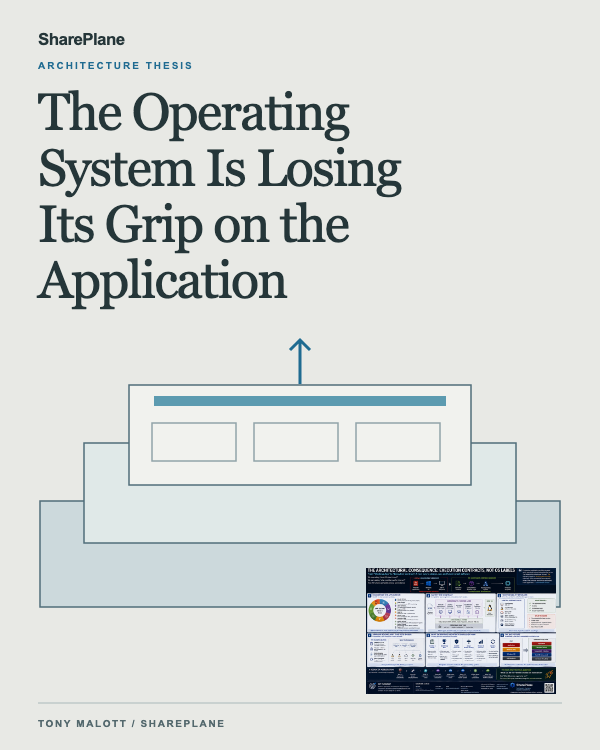
Read native Work ↗ - continuationThe Operating System Is Losing Its Grip on the ApplicationA SharePlane architecture thesis explaining how Wine, Proton, graphics translation, kernel support, and instruction-set mediation are weakening the inherited coupling between Windows applications and Windows endpoints without claiming native execution, universal compatibility, universal performance, or universal vendor support. Stop asking whether it is a Windows application. Ask what execution contract the application actually requires.
The semantic operating system establishes why governed meaning and dependencies remain more durable than an inherited operating-system label.
Explore its graph →Citation details
continuationThe Operating System Is Losing Its Grip on the Application → The Semantic Operating System
Begin with The Semantic Operating System
Read native Work ↗
Published Readers that explicitly compare this Work. These are editorial reading links, not independent corroboration.
- extendsBetter Models Still Need Boundaries ↗
The published Work’s account of meaning, state, evidence, authority and recovery conceptually extends the Reader’s distinction between frontier-model capability and effective delegated permission. It does not demonstrate the proposed architecture against the reported incident or validate the video’s forecasts.
- extendsThe Cost of Forgetting Where the Tools Are ↗
A discoverable capability map protects operational context without forcing every detailed schema into every prompt. This is an editorial comparison, not independent corroboration of the benchmark.
- companionThe Cost of Forgetting: Why Agents Keep Reading the Same World ↗
explains durable identity, meaning, relationships, authority and state as governed conditions for reusable work. This is a conceptual foundation for capability discovery and memory surviving session or model changes, not evidence of provider cache efficiency.
- extendsThe Router Is Not the Organization ↗
Durable task meaning, state and evidence expand the router pattern into an accountable operating layer.
- companionUncensored, Private, or Sovereign? ↗
Examines the larger architecture of meaning, memory and orchestration beyond a model's local execution status.
- extendsWhen Every AI Website Looks Good, What Makes One Actually Work? ↗
Identity, meaning, authority, state and next valid action explain the additional demands of operational consoles.
- extendsWhen More Agent Skills Make Agents Worse ↗
Scoped meaning, capability discovery, provenance, authority and retained context provide a conceptual extension for building accountable agent workflows. This published Work is not independent proof that deleting 80 to 90 percent of skills improves performance.