Done Has a Half-Life
Artificial intelligence changes the economics beneath completion. An accepted implementation can remain functional while changed capability, evidence, economics, requirements, dependencies, or risk erode its presumption of continued fitness. The answer is continuous reconsiderability with selective, governed adaptation. Everything meaningful should become explicitly done. Nothing meaningful should become permanently exempt from reconsideration.
Read the article ↗View Work cover
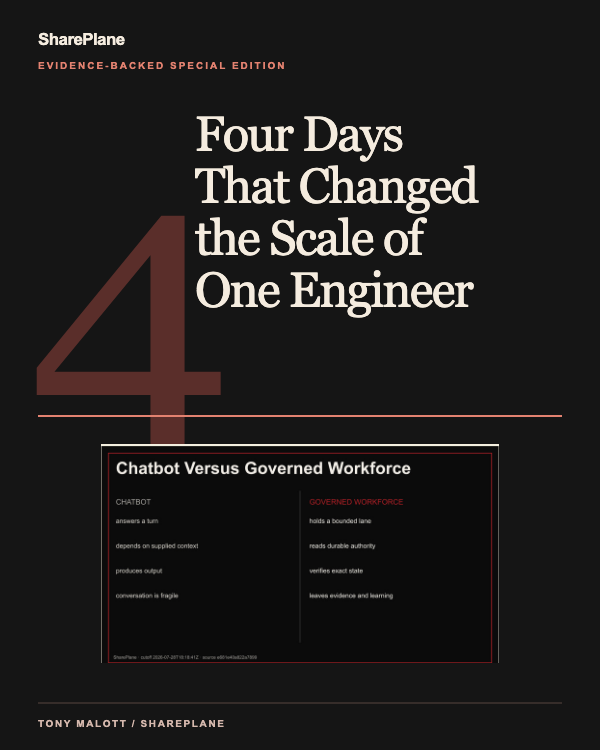
- companion toFour Days That Changed the Scale of One EngineerTony Malott examines 51 merged pull requests across two repositories and shows how context, authority, execution, verification, protected review, evidence, and learning changed the scale at which one accountable owner could operate. The force multiplier is not the model. The force multiplier is the system that surrounds the model with context, authority, bounded execution, deterministic verification, protected review, operational evidence, and durable learning.
The field report measures one accountable operating system built from context, authority, verification, protected review, and durable learning; it is a bounded operational companion, not empirical proof of the thesis constructs.
Explore its graph →Citation details
companion_toDone Has a Half-Life → Four Days That Changed the Scale of One Engineer
See bounded field evidence for context, control, and durable learning
Read native Work ↗ - extendsSoftware Has Entered Its Re-Image EraA systems-engineering thesis on why AI is lowering the cost of reconstructing conventional software, why hidden behavior and accountability remain expensive, and why the durable asset is increasingly the authority required to reproduce a product rather than one accumulated implementation. For a growing class of ordinary applications, repair no longer deserves automatic economic privilege. Preserve the product truth, evidence, data, contracts, controls, and provenance, then make reconstruction compete with maintenance as an engineering decision.
The Re-Image Work makes maintenance compete with reconstruction once product truth is durable; this Work adds a governed trigger and economic vocabulary for deciding when an accepted implementation deserves another look.
Explore its graph →Citation details
extendsDone Has a Half-Life → Software Has Entered Its Re-Image Era
Continue from repair-versus-reconstruction into reconsideration
Read native Work ↗ - companion toThe Application Is Disposable. The Context Is Not.An experience-backed architecture doctrine and exact protected Development case study showing how one governed context package can project applications, contracts, validation, documentation, and deployment profiles without making any platform the semantic owner. When software can be regenerated cheaply from governed context, the application is no longer the durable asset. The context is.
The companion Work explains why governed context outlives a replaceable implementation; this Work explains how context liquidity makes later reconsideration and adaptation safer and more economical.
Explore its graph →Citation details
companion_toDone Has a Half-Life → The Application Is Disposable. The Context Is Not.
Pair reconsiderability with durable governed context
Read native Work ↗ - extendsThe Code Is No Longer the Hard PartA first-person systems essay about the cost inversion created by AI-assisted implementation and the operating model required to turn faster execution into durable institutional leverage. As AI reduces the relative cost of implementation, durable engineering value moves outward into intent, authority, context, orchestration, evidence, recovery, and institutional integration.
The earlier Work explains how cheaper implementation moves value into intent, context, evidence, and integration; this Work carries that inversion forward by treating continued fitness and safe improvement as lifecycle concerns.
Explore its graph →Citation details
extendsDone Has a Half-Life → The Code Is No Longer the Hard Part
Extends the engineering cost inversion beyond first completion
Read native Work ↗ - companion toThe Most Expensive Model Is Often Compensation for Missing ControlA first-person operating essay about why stronger control architecture makes model routing more trustworthy and efficient without reducing the goal to choosing the cheapest model. Trusted completion cost falls when intent, authority, routing, and validation carry their share of the work.
The control Work shows how intent, routing, authority, and validation reduce trusted completion cost; this Work applies the same discipline to the marginal cost of safe improvement after acceptance.
Explore its graph →Citation details
companion_toDone Has a Half-Life → The Most Expensive Model Is Often Compensation for Missing Control
Connect MCSI to the control architecture around completion
Read native Work ↗ - extendsThe Semantic Operating SystemA semantic operating system preserves and coordinates meaning, identity, relationships, authority, state, provenance, boundaries, evidence, freshness, and valid action across humans, agents, artifacts, and time. A system becomes a semantic operating system when it preserves the governed conditions under which meaning remains identifiable, authoritative, explainable, movable, and actionable.
The Semantic Operating System establishes identity, authority, evidence, freshness, and next-valid-action semantics; this Work extends that substrate into a temporal discipline for reconsidering accepted completion.
Explore its graph →Citation details
extendsDone Has a Half-Life → The Semantic Operating System
Develops freshness into governed reconsideration
Read native Work ↗
- foundationCognitive CapitalA Shareplane doctrine series about inference as capital formation, the cost of denied cognition, operator leverage, and how enterprises should allocate frontier cognition and autonomy. Machine cognition becomes organizational capital when validated reasoning is converted into persistent, reusable assets that preserve or increase capability while reducing future uncertainty, cost, risk, or marginal cognition.
Context Capital, Context Liquidity, Context Yield, and reconsiderability supply the lifecycle logic that Cognitive Capital generalizes.
Explore its graph →Citation details
foundationCognitive Capital → Done Has a Half-Life
Done Has a Half-Life
Read native Work ↗
Published Readers that explicitly compare this Work. These are editorial reading links, not independent corroboration.
- companionThe Cheap Answer Can Be an Expensive Job ↗
The published SharePlane Work carries completion economics into the ongoing cost of safely reconsidering an accepted result. This is a conceptual companion, not independent evidence about Astra or the video's claims.
- companionThe Cost of Forgetting: Why Agents Keep Reading the Same World ↗
gives a complementary treatment of the ongoing cost of reconsidering completed work. A cached observation must be revisitable and eventually requalified when the world changes. Again, this is an editorial connection, not an independent validation of the video's claims.