The Code Is No Longer the Hard Part
A first-person systems essay about the cost inversion created by AI-assisted implementation and the operating model required to turn faster execution into durable institutional leverage. As AI reduces the relative cost of implementation, durable engineering value moves outward into intent, authority, context, orchestration, evidence, recovery, and institutional integration.
Read the article ↗View Work cover
- continuationThe Agent Is Not the Product. The Control Plane Is.The durable architecture includes identity isolation, bounded authority, secret separation, execution containment, mutation gates, independent observability, evidence, and recovery. Security is the mechanism that permits greater autonomy by bounding blast radius. The more useful an agent becomes, the less its safety can depend on the agent behaving well. The durable product is the governed execution environment around it.
The cost-inversion thesis identifies the work around implementation; the control-plane article shows how authority, context, evidence, and review become operational rather than remaining an architectural claim.
Explore its graph →Citation details
continuationThe Code Is No Longer the Hard Part → The Agent Is Not the Product. The Control Plane Is.
Apply cost inversion through a governed control plane
Read native Work ↗
- companionCognitive CapitalA Shareplane doctrine series about inference as capital formation, the cost of denied cognition, operator leverage, and how enterprises should allocate frontier cognition and autonomy. Machine cognition becomes organizational capital when validated reasoning is converted into persistent, reusable assets that preserve or increase capability while reducing future uncertainty, cost, risk, or marginal cognition.
As generation gets cheaper, architecture, judgment, evidence, integration, and institutional learning account for more of the economic return. This relationship is projected inside the operator-leverage chapter rather than the parent landing page.
Explore its graph →Citation details
companionCognitive Capital → The Code Is No Longer the Hard Part
The Code Is No Longer the Hard Part
Read native Work ↗ - extendsDone Has a Half-LifeArtificial intelligence changes the economics beneath completion. An accepted implementation can remain functional while changed capability, evidence, economics, requirements, dependencies, or risk erode its presumption of continued fitness. The answer is continuous reconsiderability with selective, governed adaptation. Everything meaningful should become explicitly done. Nothing meaningful should become permanently exempt from reconsideration.
The earlier Work explains how cheaper implementation moves value into intent, context, evidence, and integration; this Work carries that inversion forward by treating continued fitness and safe improvement as lifecycle concerns.
Explore its graph →Citation details
extendsDone Has a Half-Life → The Code Is No Longer the Hard Part
Extends the engineering cost inversion beyond first completion
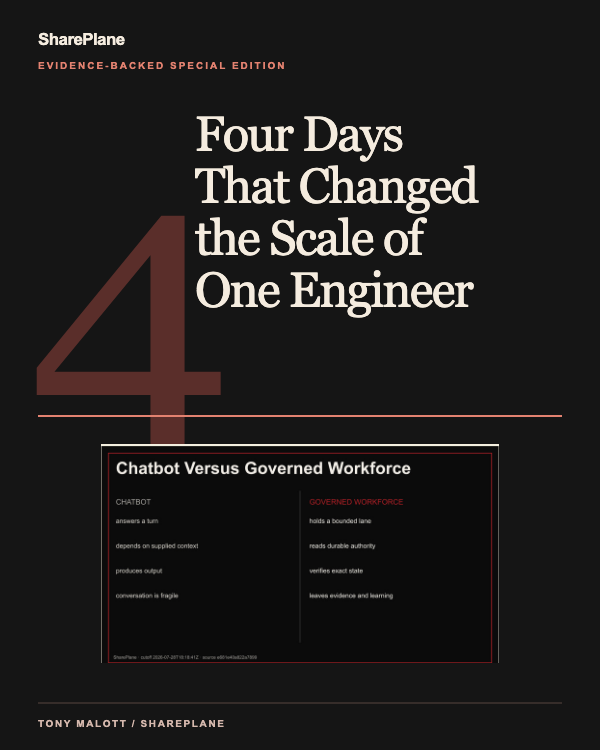
Read native Work ↗ - companion toFour Days That Changed the Scale of One EngineerTony Malott examines 51 merged pull requests across two repositories and shows how context, authority, execution, verification, protected review, evidence, and learning changed the scale at which one accountable owner could operate. The force multiplier is not the model. The force multiplier is the system that surrounds the model with context, authority, bounded execution, deterministic verification, protected review, operational evidence, and durable learning.
Connects cheap execution to the higher-order work of authority, evidence, and integration.
Explore its graph →Citation details
companion_toFour Days That Changed the Scale of One Engineer → The Code Is No Longer the Hard Part
Connects cheap execution to the higher-order work of authority, evidence, and integration.
Read native Work ↗ - applicationGhostMesh Was Waiting for Its TechnologyA first-person architecture origin story about learning to move continuity out of temporary intelligence and into durable authority, context, state, memory, policy, evidence, recovery, artifacts, and human judgment. GhostMesh is a persistent system built from temporary intelligence. The same durable-memory and temporary-worker pattern at its center was used to reconstruct its own history.
The engineering-system Work applies the same externalized-state principle to repositories, delivery state, evidence, operational knowledge, and resumption.
Explore its graph →Citation details
applicationGhostMesh Was Waiting for Its Technology → The Code Is No Longer the Hard Part
The Code Is No Longer the Hard Part
Read native Work ↗ - foundationInference at the Ambiguity FrontierA general architecture thesis for AI-native systems: use probabilistic intelligence where ambiguity remains, convert stable reasoning into specifications and executable policy, push solved work into deterministic software, and reserve agents for novelty, diagnosis, exceptions, and change. Control Tower and SharePlane provide the field evidence rather than the premise. Inference belongs at the ambiguity frontier. Determinism belongs everywhere behind it.
The cost-inversion thesis establishes the changing engineering economics around AI-assisted implementation.
Explore its graph →Citation details
foundationInference at the Ambiguity Frontier → The Code Is No Longer the Hard Part
Start with the engineering cost inversion
Read native Work ↗ - continuationThe Application Is Disposable. The Context Is Not.An experience-backed architecture doctrine and exact protected Development case study showing how one governed context package can project applications, contracts, validation, documentation, and deployment profiles without making any platform the semantic owner. When software can be regenerated cheaply from governed context, the application is no longer the durable asset. The context is.
The predecessor explains where the engineering bottleneck moved; this article explains what becomes durable and how governed context can project implementations.
Explore its graph →Citation details
continuationThe Application Is Disposable. The Context Is Not. → The Code Is No Longer the Hard Part
Read the cost-inversion predecessor
Read native Work ↗ - related toThe Application Is Disposable. The Context Is Not.An experience-backed architecture doctrine and exact protected Development case study showing how one governed context package can project applications, contracts, validation, documentation, and deployment profiles without making any platform the semantic owner. When software can be regenerated cheaply from governed context, the application is no longer the durable asset. The context is.
Predecessor: The Code Is No Longer the Hard Part
Explore its graph →Citation details
related_toThe Application Is Disposable. The Context Is Not. → The Code Is No Longer the Hard Part
Predecessor: The Code Is No Longer the Hard Part
Read native Work ↗ - foundationThe Best AI System Should Need Less AI TomorrowA flagship architecture thesis for AI-native systems: probabilistic intelligence should push into ambiguity, evidence should settle what worked, and repeated validated reasoning should migrate into deterministic machinery. Mature systems reserve inference for novelty, uncertainty, exceptions, and change instead of repeatedly paying models to rediscover solved procedures. Use intelligence to conquer ambiguity, capture what works, and retire inference when uncertainty disappears.
The cost-inversion thesis establishes the changing economics around AI-assisted implementation.
Explore its graph →Citation details
foundationThe Best AI System Should Need Less AI Tomorrow → The Code Is No Longer the Hard Part
Start with the engineering cost inversion
Read native Work ↗ - companionThe Database Had Been Wrong for Twelve Years. AI Made It Worth Fixing.A first-person evidence case study about using AI as a reasoning layer over SQL, hashes, historical snapshots, Plex SQLite, Docker, and disposable database clones to diagnose a decade-old Plex defect, eliminate false positives, prove three duplicated library roots as the generator of 1,509 duplicate media representations, and validate a zero-media-loss root fix. The breakthrough was not that AI knew the answer. It made a technically solvable but economically irrational investigation practical by turning probabilistic reasoning into a sequence of deterministic tests until one causal explanation survived.
Cheap code and tool construction made it practical to build one-off forensic machinery for a problem that could never justify a traditional bespoke engineering project.
Explore its graph →Citation details
companionThe Database Had Been Wrong for Twelve Years. AI Made It Worth Fixing. → The Code Is No Longer the Hard Part
Companion: the economics of implementation changed
Read native Work ↗ - companionThe Eval Before the EvalA SharePlane thesis on why ordinary AI evaluation begins too late when the objective itself has never been grounded, bounded, and admitted, and on Intent Admission as a governed execution boundary that preserves human authority without pretending human judgment is infallible. A sufficiently capable autonomous system can execute a bad objective beautifully; consequential intent needs an explicit, evidence-bearing admission boundary before autonomous amplification.
The Code Is No Longer the Hard Part argues that AI makes implementation cheaper while intent, authority, context, evidence, and recovery become scarcer engineering work; this Work drills into the intent boundary itself.
Explore its graph →Citation details
companionThe Eval Before the Eval → The Code Is No Longer the Hard Part
Capability abundance moves the hard work outward
Read native Work ↗ - related toThe Most Expensive Model Is Often Compensation for Missing ControlA first-person operating essay about why stronger control architecture makes model routing more trustworthy and efficient without reducing the goal to choosing the cheapest model. Trusted completion cost falls when intent, authority, routing, and validation carry their share of the work.
Issue #40 operationalizes and provides an economic and operational case for Issue #146 without collapsing the two independent Works.
Explore its graph →Citation details
related_toThe Most Expensive Model Is Often Compensation for Missing Control → The Code Is No Longer the Hard Part
Related companion Work
Read native Work ↗ - related toThe Signal Was Never CleanA first-person technical memoir about radio fault isolation, an irresponsible Amiga purchase in a small German flat, decades of systems work, and why AI made a late-career technologist feel early again without making the signal any cleaner. A life spent tuning noisy systems teaches you not to confuse a clean reading with truth. AI did not give me judgment or ideas; it shortened the distance between what I could see and what I could finally build.
This personal narrative shows what implementation leverage felt like across one technical life; The Code Is No Longer the Hard Part develops the broader systems thesis about where engineering scarcity moved.
Explore its graph →Citation details
related_toThe Signal Was Never Clean → The Code Is No Longer the Hard Part
Related systems companion
Read native Work ↗ - continuationYou Cannot Keep an AI Codebase in Your HeadA systems essay about cognitive entropy, durable engineering memory, and the structure that lets AI-assisted work remain intelligible without turning the developer into the system’s memory layer. AI-assisted development can produce consequential change faster than a human can maintain a coherent internal model of the system. Durable engineering state must therefore be externalized across versioned intent, authority, implementation, validation, evidence, operations, and knowledge.
Externalized engineering memory explains how a system stays intelligible; the cost-inversion essay carries that discipline into the authority, evidence, recovery, and institutional work around faster execution.
Explore its graph →Citation details
continuationYou Cannot Keep an AI Codebase in Your Head → The Code Is No Longer the Hard Part
Move from cognitive infrastructure to the system around execution
Read native Work ↗
Published Readers that explicitly compare this Work. These are editorial reading links, not independent corroboration.
- extendsA Factory That Grades Itself Still Needs a Judge ↗
The Work argues that producing code is no longer the binding constraint; review, integration, operational evidence and judgment increasingly determine accepted value. Lloyd’s factory proposes to improve the production system itself, but must demonstrate gains in those downstream outcomes rather than merely in its internal grader.
- extendsThe $1,000 AI Workflow Is Really a Routing Problem ↗
This Work extends the distinction between generating abundant code and producing accepted engineering outcomes. It supports a comparison about review and integration cost, not a benchmark of Ondrej’s workflow.
- companionThe Cost of Forgetting Where the Tools Are ↗
Optimize for correct, accepted outcomes rather than raw code output or isolated token counts. This is an editorial comparison, not independent corroboration of the benchmark.
- extendsThe Success Hid the Failure ↗
The video illustrates why successful code generation can conceal expensive execution friction, extending the Work's thesis that review, judgment and operational integration become the binding constraints.
- extendsWhen code gets cheap, where does the work wait? ↗
The interview's parallel coding account gives a concrete instance of the broader argument that review, integration and judgment become the binding constraints.