Inference at the Ambiguity Frontier
A general architecture thesis for AI-native systems: use probabilistic intelligence where ambiguity remains, convert stable reasoning into specifications and executable policy, push solved work into deterministic software, and reserve agents for novelty, diagnosis, exceptions, and change. Control Tower and SharePlane provide the field evidence rather than the premise. Inference belongs at the ambiguity frontier. Determinism belongs everywhere behind it.
Read the article ↗View Work cover
- companionFrontier Inference Without Frontier CustodyA deterministic, privacy-preserving guide for classifying accessible context, selecting among local and remote inference architectures, bounding coding agents, reviewing re-identification risk, approving exact processing paths, and preserving evidence without copying the sensitive corpus. Keep authoritative source custody under organizational control. Export only the minimum reasoning surface required for the approved task.
The custody guide governs what information may cross into frontier reasoning.
Explore its graph →Citation details
companionInference at the Ambiguity Frontier → Frontier Inference Without Frontier Custody
Companion: control the inference boundary
Read native Work ↗ - applicationThe Governed Static Publishing LaneA wide, interactive engineering reference for separating static publishing from application delivery, classifying S0, S1, and S2 workloads, comparing current and target architecture, and adopting reusable controls, packages, receipts, and rollback discipline. A qualifying static site should inherit an approved publishing system rather than implement its own delivery pipeline.
The governed publishing lane shows stable publication decisions becoming deterministic infrastructure.
Explore its graph →Citation details
applicationInference at the Ambiguity Frontier → The Governed Static Publishing Lane
See the pattern applied to publishing
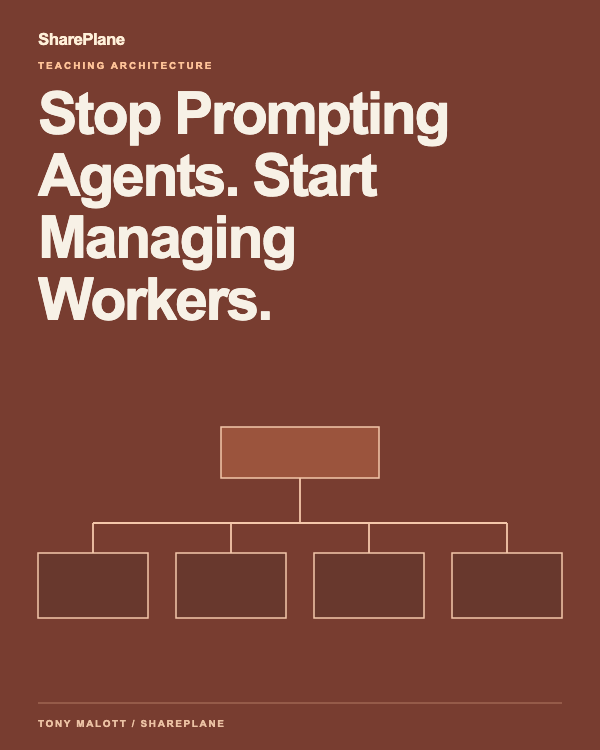
Read native Work ↗ - foundationStop Prompting Agents. Start Managing Workers.A practical operating model for meaningful agent work: begin with a job, encode the work, bound the assignment, supervise through evidence, measure results, and expand autonomy only when repeatable proof earns a larger trust envelope. Agent workers become dependable only when organizations stop treating them as intelligent prompt boxes and start managing their work through explicit roles, encoded procedures, bounded authority, evidence, measurement, and earned autonomy.
The worker-management thesis establishes roles, bounded authority, evidence, and earned autonomy.
Explore its graph →Citation details
foundationInference at the Ambiguity Frontier → Stop Prompting Agents. Start Managing Workers.
Start with the governed worker model
Read native Work ↗ - continuationThe Agents Are Not the Bottleneck. You Are.A technical and reflective thesis about the human-attention bottleneck created when agent execution becomes abundant, why parallel activity is not accepted throughput, and why mature orchestration needs admission control for decisions, review, exceptions, and closure. Agentic systems reduce the marginal cost of execution while increasing the potential rate of unresolved decisions. Once execution becomes cheap, human attention becomes the limiting resource.
Once execution becomes cheap and deterministic, the remaining constraint moves toward human specification and review.
Explore its graph →Citation details
continuationInference at the Ambiguity Frontier → The Agents Are Not the Bottleneck. You Are.
Continue into the human-attention bottleneck
Read native Work ↗ - continuationThe Best AI System Should Need Less AI TomorrowA flagship architecture thesis for AI-native systems: probabilistic intelligence should push into ambiguity, evidence should settle what worked, and repeated validated reasoning should migrate into deterministic machinery. Mature systems reserve inference for novelty, uncertainty, exceptions, and change instead of repeatedly paying models to rediscover solved procedures. Use intelligence to conquer ambiguity, capture what works, and retire inference when uncertainty disappears.
The later Work develops this boundary principle into an explicit lifecycle for retiring repeated inference after uncertainty has been resolved.
Explore its graph →Citation details
continuationInference at the Ambiguity Frontier → The Best AI System Should Need Less AI Tomorrow
Continues into the Inference Retirement Thesis
Read native Work ↗ - foundationThe Code Is No Longer the Hard PartA first-person systems essay about the cost inversion created by AI-assisted implementation and the operating model required to turn faster execution into durable institutional leverage. As AI reduces the relative cost of implementation, durable engineering value moves outward into intent, authority, context, orchestration, evidence, recovery, and institutional integration.
The cost-inversion thesis establishes the changing engineering economics around AI-assisted implementation.
Explore its graph →Citation details
foundationInference at the Ambiguity Frontier → The Code Is No Longer the Hard Part
Start with the engineering cost inversion
Read native Work ↗ - companionThe Most Expensive Model Is Often Compensation for Missing ControlA first-person operating essay about why stronger control architecture makes model routing more trustworthy and efficient without reducing the goal to choosing the cheapest model. Trusted completion cost falls when intent, authority, routing, and validation carry their share of the work.
Stronger intent, routing, validation, and control reduce compensatory model dependence.
Explore its graph →Citation details
companionInference at the Ambiguity Frontier → The Most Expensive Model Is Often Compensation for Missing Control
Companion: reduce model dependence through control
Read native Work ↗

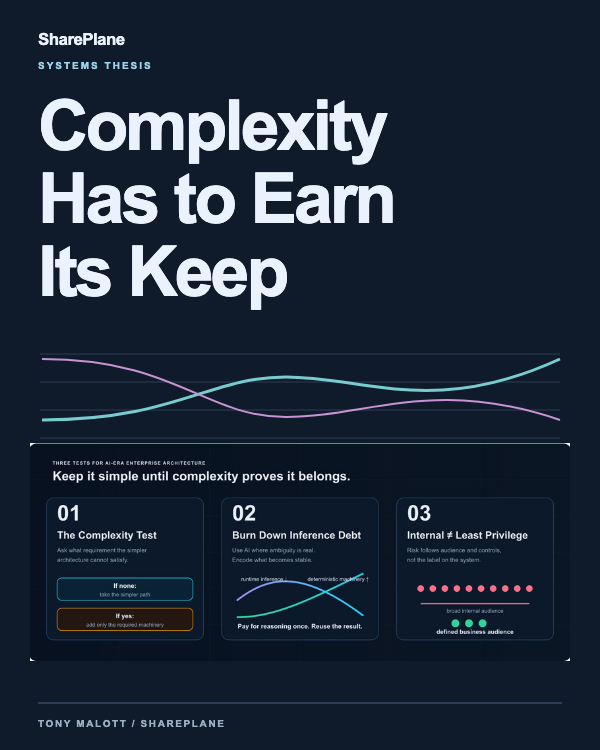
- companion toComplexity Has to Earn Its KeepA first-person systems essay arguing for Portable Decision Surfaces, reconstruction packets, least-privilege distribution, and using AI to compile repeated reasoning into deterministic software instead of defaulting to another persistent application stack. Enterprise decision tools should start with governed data, deterministic portable software, and controlled refresh; persistent backend complexity should be added only when a concrete requirement proves it necessary.
Both Works argue that stable reasoning should move toward deterministic machinery once ambiguity has been sufficiently reduced.
Explore its graph →Citation details
companion_toComplexity Has to Earn Its Keep → Inference at the Ambiguity Frontier
Inference at the Ambiguity Frontier
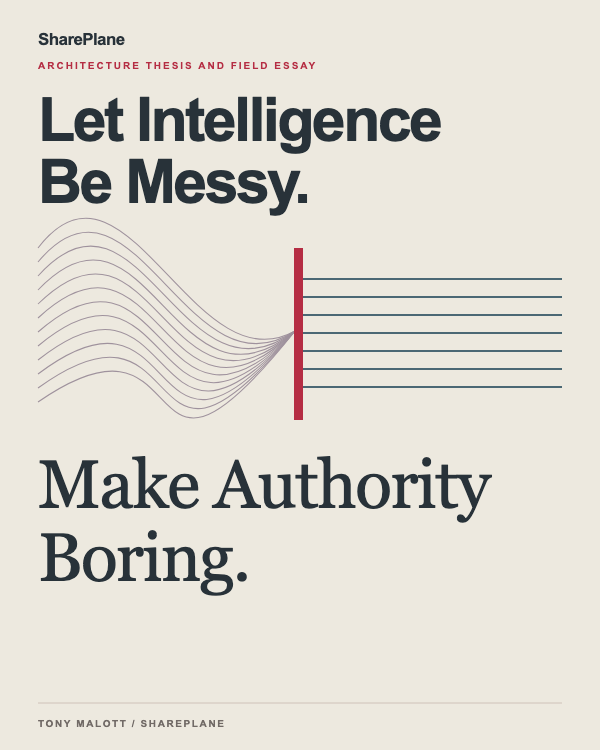
Read native Work ↗ - companion toLet Intelligence Be Messy. Make Authority Boring.AI is probabilistic intelligence. Use that capability where uncertainty creates value, but separate intelligence from authority. Trustworthy operation comes from independently enforced invariants, bounded capabilities, exact artifact identity, evidence, segregation of duties, revocation, and deterministic admission. Stop trying to make AI trustworthy as the primary safety strategy. Build systems that remain trustworthy when AI is not.
The ambiguity-frontier thesis explains where probabilistic inference belongs. This Work adds that deterministic machinery alone is not sufficient and separates intelligence from consequential authority.
Explore its graph →Citation details
companion_toLet Intelligence Be Messy. Make Authority Boring. → Inference at the Ambiguity Frontier
Companion: Inference at the Ambiguity Frontier
Read native Work ↗ - extendsJev Changes EverythingA SharePlane Special Edition examining TypeSafe AI Jev as a new bounded-decision primitive, the architectural implications for GhostMesh and SharePlane, and why cheaper semantic judgment makes evidence, provenance, calibration, and deterministic authority more important rather than less. Cheap typed probabilistic judgment can become an ambient Decision Fabric, but semantic signals must remain separate from deterministic authority, evidence, policy, and execution.
Connects cheap bounded judgment to the broader rule that expensive inference should concentrate where deterministic knowledge ends.
Explore its graph →Citation details
extendsJev Changes Everything → Inference at the Ambiguity Frontier
Inference at the Ambiguity Frontier
Read native Work ↗ - foundationThe Best AI System Should Need Less AI TomorrowA flagship architecture thesis for AI-native systems: probabilistic intelligence should push into ambiguity, evidence should settle what worked, and repeated validated reasoning should migrate into deterministic machinery. Mature systems reserve inference for novelty, uncertainty, exceptions, and change instead of repeatedly paying models to rediscover solved procedures. Use intelligence to conquer ambiguity, capture what works, and retire inference when uncertainty disappears.
The predecessor Work establishes the durable boundary principle this Work develops into an explicit inference-retirement lifecycle.
Explore its graph →Citation details
foundationThe Best AI System Should Need Less AI Tomorrow → Inference at the Ambiguity Frontier
Founded on Inference at the Ambiguity Frontier
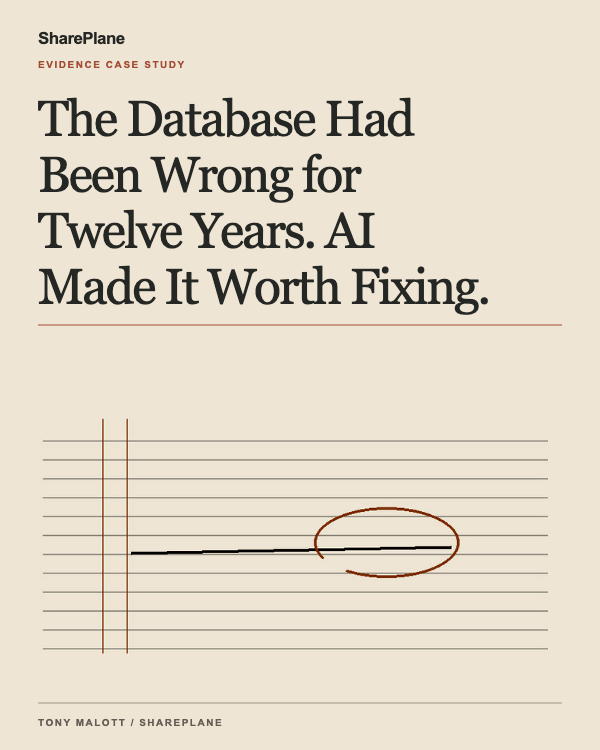
Read native Work ↗ - applicationThe Database Had Been Wrong for Twelve Years. AI Made It Worth Fixing.A first-person evidence case study about using AI as a reasoning layer over SQL, hashes, historical snapshots, Plex SQLite, Docker, and disposable database clones to diagnose a decade-old Plex defect, eliminate false positives, prove three duplicated library roots as the generator of 1,509 duplicate media representations, and validate a zero-media-loss root fix. The breakthrough was not that AI knew the answer. It made a technically solvable but economically irrational investigation practical by turning probabilistic reasoning into a sequence of deterministic tests until one causal explanation survived.
The model operated where the diagnosis was uncertain; deterministic mechanisms collapsed uncertainty as evidence accumulated.
Explore its graph →Citation details
applicationThe Database Had Been Wrong for Twelve Years. AI Made It Worth Fixing. → Inference at the Ambiguity Frontier
Inference at the ambiguity frontier, applied to database forensics
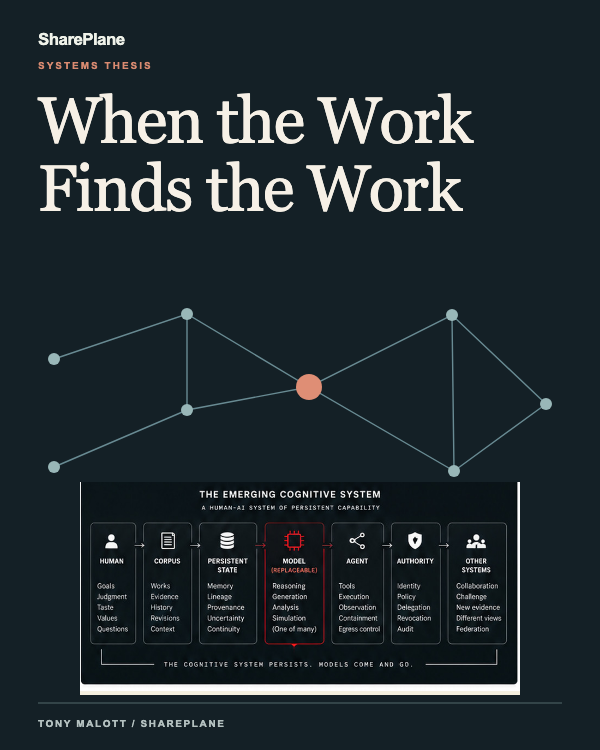
Read native Work ↗ - companion toWhen the Work Finds the WorkA first-person systems thesis on continuity, agent-mediated semantic convergence, trust through correction, semantic reputation, and the possibility that independently sovereign human-agent systems can federate without surrendering identity or authority. A sufficiently rich public corpus can become an active semantic discovery surface through which agents identify intellectual adjacency, test it through bounded exchange, and help create valuable human relationships without requiring prior social proximity.
Both Works place probabilistic intelligence at bounded semantic frontiers while pushing durable state and repeatable structure outside the model.
Explore its graph →Citation details
companion_toWhen the Work Finds the Work → Inference at the Ambiguity Frontier
Inference at the Ambiguity Frontier
Read native Work ↗