Stop Prompting Agents. Start Managing Workers.
A practical operating model for meaningful agent work: begin with a job, encode the work, bound the assignment, supervise through evidence, measure results, and expand autonomy only when repeatable proof earns a larger trust envelope. Agent workers become dependable only when organizations stop treating them as intelligent prompt boxes and start managing their work through explicit roles, encoded procedures, bounded authority, evidence, measurement, and earned autonomy.
Read the article ↗View Work cover
- applicationDemo DebtArticle-first SharePlane thesis defining demo debt as the liability created when impressive AI demos are mistaken for supportable operational capability. The demo proves the happy path; the real system begins where exceptions, ownership, recovery, and supportability enter the workflow.
Demo Debt shows why a compelling output is not dependable operation and why evidence, maintenance, failure behavior, and ownership must remain part of the evaluation.
Explore its graph →Citation details
applicationStop Prompting Agents. Start Managing Workers. → Demo Debt
Apply the scorecard beyond the polished demonstration
Read native Work ↗ - foundationI Was Summoning Ghosts Until I Learned to Build the MachineA candid personal technical narrative about temporary cognitive instruments, fragmented thought, false breakthroughs, accumulated scar tissue, and the moment Git and software-delivery discipline turned conversation into a cockpit and the repository into durable memory. I thought I was learning how to use AI. What I was really learning was how to externalize intent, structure context, govern change, and convert finished thinking into mechanical execution.
The memoir supplies the operational failures behind explicit context, authority, validation, receipts, and the shift from magical agents to governed workers.
Explore its graph →Citation details
foundationStop Prompting Agents. Start Managing Workers. → I Was Summoning Ghosts Until I Learned to Build the Machine
See why the worker model became necessary
Read native Work ↗ - continuationThe Agents Are Not the Bottleneck. You Are.A technical and reflective thesis about the human-attention bottleneck created when agent execution becomes abundant, why parallel activity is not accepted throughput, and why mature orchestration needs admission control for decisions, review, exceptions, and closure. Agentic systems reduce the marginal cost of execution while increasing the potential rate of unresolved decisions. Once execution becomes cheap, human attention becomes the limiting resource.
Once bounded agent workers execute reliably, the constraint moves upstream to human specification, supervision, validation, integration, memory, and closure.
Explore its graph →Citation details
continuationStop Prompting Agents. Start Managing Workers. → The Agents Are Not the Bottleneck. You Are.
What changes after worker execution accelerates
Read native Work ↗ - companionThe Agents Were Never the BottleneckA first-person systems essay about the engineered workbench surrounding useful agent execution, why learning the mechanics made trustworthy delegation possible, and how governable execution returned senior human attention to architecture, judgment, sequencing, taste, and risk. Capable agents became useful when Tony engineered the repositories, access, tools, authority, validation, evidence, and completion paths that made bounded work operational.
This companion locates useful agent execution in the repositories, access, tools, authority, validation, and completion paths that make the worker model operational.
Explore its graph →Citation details
companionStop Prompting Agents. Start Managing Workers. → The Agents Were Never the Bottleneck
Build the workbench around the worker
Read native Work ↗ - companionYour Second Brain Is Not a Production ArchitectureA source-derived architecture explainer separating personal second-brain markdown workflows from production agent context-plane requirements. A personal memory system optimizes for one person's recall; production architecture must optimize for shared authority, isolation, recoverability, and verifiable state.
The architecture essay reinforces the same boundary: useful model behavior does not replace durable state, observability, ownership, recovery, and explicit operating controls.
Explore its graph →Citation details
companionStop Prompting Agents. Start Managing Workers. → Your Second Brain Is Not a Production Architecture
Separate useful intelligence from production architecture
Read native Work ↗

- applicationDemo DebtArticle-first SharePlane thesis defining demo debt as the liability created when impressive AI demos are mistaken for supportable operational capability. The demo proves the happy path; the real system begins where exceptions, ownership, recovery, and supportability enter the workflow.
The worker-management model supplies the roles, evidence, bounded authority, supervision, and closure discipline that keep a successful demonstration from becoming unmanaged operational debt.
Explore its graph →Citation details
applicationDemo Debt → Stop Prompting Agents. Start Managing Workers.
Replace the demo with an operating contract
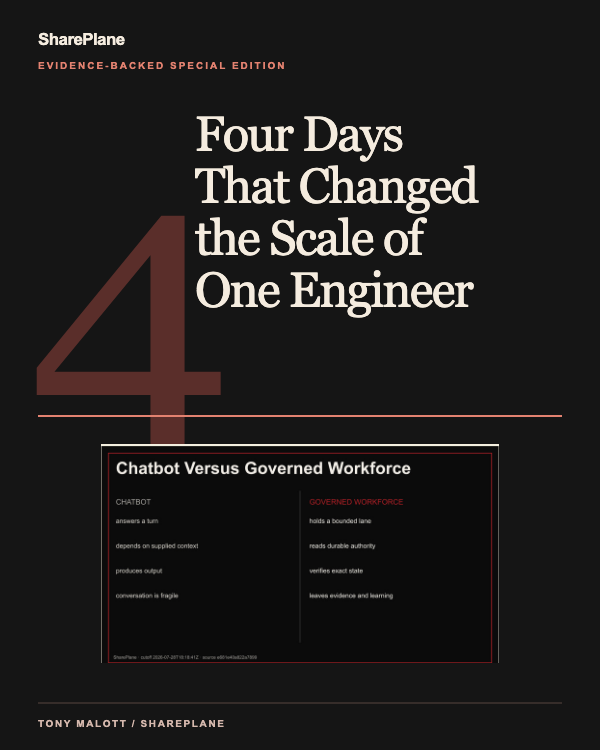
Read native Work ↗ - implementsFour Days That Changed the Scale of One EngineerTony Malott examines 51 merged pull requests across two repositories and shows how context, authority, execution, verification, protected review, evidence, and learning changed the scale at which one accountable owner could operate. The force multiplier is not the model. The force multiplier is the system that surrounds the model with context, authority, bounded execution, deterministic verification, protected review, operational evidence, and durable learning.
Shows the worker-management doctrine operating across two repositories.
Explore its graph →Citation details
implementsFour Days That Changed the Scale of One Engineer → Stop Prompting Agents. Start Managing Workers.
Shows the worker-management doctrine operating across two repositories.
Read native Work ↗ - applicationI Was Summoning Ghosts Until I Learned to Build the MachineA candid personal technical narrative about temporary cognitive instruments, fragmented thought, false breakthroughs, accumulated scar tissue, and the moment Git and software-delivery discipline turned conversation into a cockpit and the repository into durable memory. I thought I was learning how to use AI. What I was really learning was how to externalize intent, structure context, govern change, and convert finished thinking into mechanical execution.
The teaching work converts the memoir's lessons about context, tools, authority, validation, and evidence into a repeatable worker-management system.
Explore its graph →Citation details
applicationI Was Summoning Ghosts Until I Learned to Build the Machine → Stop Prompting Agents. Start Managing Workers.
Turn the scar tissue into an operating model
Read native Work ↗ - foundationInference at the Ambiguity FrontierA general architecture thesis for AI-native systems: use probabilistic intelligence where ambiguity remains, convert stable reasoning into specifications and executable policy, push solved work into deterministic software, and reserve agents for novelty, diagnosis, exceptions, and change. Control Tower and SharePlane provide the field evidence rather than the premise. Inference belongs at the ambiguity frontier. Determinism belongs everywhere behind it.
The worker-management thesis establishes roles, bounded authority, evidence, and earned autonomy.
Explore its graph →Citation details
foundationInference at the Ambiguity Frontier → Stop Prompting Agents. Start Managing Workers.
Start with the governed worker model
Read native Work ↗ - influenced byJev Changes EverythingA SharePlane Special Edition examining TypeSafe AI Jev as a new bounded-decision primitive, the architectural implications for GhostMesh and SharePlane, and why cheaper semantic judgment makes evidence, provenance, calibration, and deterministic authority more important rather than less. Cheap typed probabilistic judgment can become an ambient Decision Fabric, but semantic signals must remain separate from deterministic authority, evidence, policy, and execution.
Shows how bounded roles, supervision, evidence, and earned autonomy turn agents into governable workers.
Explore its graph →Citation details
influenced_byJev Changes Everything → Stop Prompting Agents. Start Managing Workers.
Stop Prompting Agents. Start Managing Workers.
Read native Work ↗ - companionThe Agent Is Not the Product. The Control Plane Is.The durable architecture includes identity isolation, bounded authority, secret separation, execution containment, mutation gates, independent observability, evidence, and recovery. Security is the mechanism that permits greater autonomy by bounding blast radius. The more useful an agent becomes, the less its safety can depend on the agent behaving well. The durable product is the governed execution environment around it.
Autonomy Is a Promotion, Not a Feature Toggle is the source phrase; the Platform target is Stop Prompting Agents. Start Managing Workers.
Explore its graph →Citation details
companionThe Agent Is Not the Product. The Control Plane Is. → Stop Prompting Agents. Start Managing Workers.
Stop Prompting Agents. Start Managing Workers.
Read native Work ↗ - applicationThe Agents Are Not the Bottleneck. You Are.A technical and reflective thesis about the human-attention bottleneck created when agent execution becomes abundant, why parallel activity is not accepted throughput, and why mature orchestration needs admission control for decisions, review, exceptions, and closure. Agentic systems reduce the marginal cost of execution while increasing the potential rate of unresolved decisions. Once execution becomes cheap, human attention becomes the limiting resource.
The teaching work turns the attention diagnosis into an operating model built from explicit roles, bounded assignments, evidence, measurement, and earned autonomy.
Explore its graph →Citation details
applicationThe Agents Are Not the Bottleneck. You Are. → Stop Prompting Agents. Start Managing Workers.
The worker-management response
Read native Work ↗ - applicationThe Agents Were Never the BottleneckA first-person systems essay about the engineered workbench surrounding useful agent execution, why learning the mechanics made trustworthy delegation possible, and how governable execution returned senior human attention to architecture, judgment, sequencing, taste, and risk. Capable agents became useful when Tony engineered the repositories, access, tools, authority, validation, evidence, and completion paths that made bounded work operational.
The teaching artifact turns the workbench into an operating model of explicit roles, bounded assignments, evidence, validation, and approval gates without surrendering human accountability.
Explore its graph →Citation details
applicationThe Agents Were Never the Bottleneck → Stop Prompting Agents. Start Managing Workers.
Apply the workbench through bounded worker management
Read native Work ↗ - foundationThe Best AI System Should Need Less AI TomorrowA flagship architecture thesis for AI-native systems: probabilistic intelligence should push into ambiguity, evidence should settle what worked, and repeated validated reasoning should migrate into deterministic machinery. Mature systems reserve inference for novelty, uncertainty, exceptions, and change instead of repeatedly paying models to rediscover solved procedures. Use intelligence to conquer ambiguity, capture what works, and retire inference when uncertainty disappears.
The worker-management thesis establishes roles, bounded authority, evidence, and earned autonomy.
Explore its graph →Citation details
foundationThe Best AI System Should Need Less AI Tomorrow → Stop Prompting Agents. Start Managing Workers.
Start with the governed worker model
Read native Work ↗ - applicationToken BurnAn interactive, deterministic calculator for known token usage, recognizable AI workloads, image generation, and subscription-equivalent comparisons across a versioned snapshot of provider-direct pricing. Token composition, model choice, workload shape, and dated provider pricing must remain visible if AI consumption is going to become economically inspectable.
The worker operating model requires explicit measurement and evidence. Token Burn turns token composition, model choice, workload shape, and inference pricing into an inspectable operational meter.
Explore its graph →Citation details
applicationToken Burn → Stop Prompting Agents. Start Managing Workers.
Measure the worker, not merely the output
Read native Work ↗ - foundationWhen the Agent Had to Ask GitHubA field story from Control Tower convergence: a GitHub App token-revocation contradiction could not be resolved from local evidence or public documentation, so the system failed closed, assembled an evidence-grade escalation, crossed a human institutional boundary, consumed GitHub Support's clarification, and replaced an unenforceable provider-state invariant with an enforceable client-side contract. A mature autonomous system must know where its authority and evidence end, and route unresolved questions to the human or institution that actually owns the answer.
The worker-management model establishes bounded roles, evidence, supervision, and earned autonomy; this Work extends the same logic to an external institutional authority boundary.
Explore its graph →Citation details
foundationWhen the Agent Had to Ask GitHub → Stop Prompting Agents. Start Managing Workers.
Start with bounded worker authority
Read native Work ↗
Published Readers that explicitly compare this Work. These are editorial reading links, not independent corroboration.
- companionThe Machine Is Learning to Improve the Machine ↗
Tony’s published Work frames agents as bounded workers whose authority grows only through measured outcomes and retained evidence. This is an operational companion to #68’s software loop, not independent corroboration of the creator or model claims.
- foundationThe Paper Is Not the Experiment ↗
Defines work contracts, evidence, measurement and earned autonomy; Reader #48 supplies an empirical research benchmark for those principles.
- foundationThe Router Is Not the Organization ↗
Worker contracts and orchestration provide architectural context for the routing demonstration; the Work gives explicit attention to managing workers beyond opening more agent sessions.