The Agents Were Never the Bottleneck
A first-person systems essay about the engineered workbench surrounding useful agent execution, why learning the mechanics made trustworthy delegation possible, and how governable execution returned senior human attention to architecture, judgment, sequencing, taste, and risk. Capable agents became useful when Tony engineered the repositories, access, tools, authority, validation, evidence, and completion paths that made bounded work operational.
Read the article ↗View Work cover
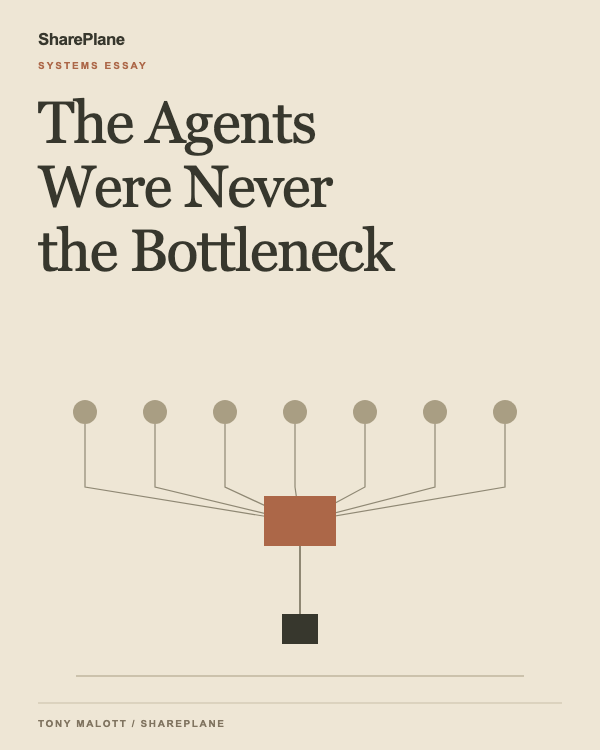
- applicationStop Prompting Agents. Start Managing Workers.A practical operating model for meaningful agent work: begin with a job, encode the work, bound the assignment, supervise through evidence, measure results, and expand autonomy only when repeatable proof earns a larger trust envelope. Agent workers become dependable only when organizations stop treating them as intelligent prompt boxes and start managing their work through explicit roles, encoded procedures, bounded authority, evidence, measurement, and earned autonomy.
The teaching artifact turns the workbench into an operating model of explicit roles, bounded assignments, evidence, validation, and approval gates without surrendering human accountability.
Explore its graph →Citation details
applicationThe Agents Were Never the Bottleneck → Stop Prompting Agents. Start Managing Workers.
Apply the workbench through bounded worker management
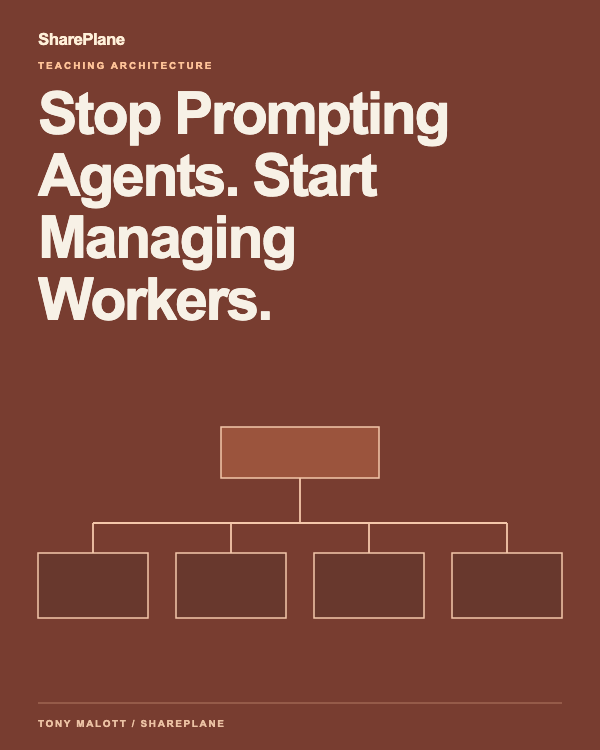
Read native Work ↗ - companionThe Human Is the BottleneckA systems essay on why equivalent model access produces radically different outcomes, how software discipline converts potential into force multiplication, and why capability alone is never sufficient justification to build. As frontier model access broadens, the scarce advantage shifts to human imagination, judgment, decomposition, orchestration, verification, and restraint.
The companion essay examines imagination, judgment, execution discipline, and restraint as human constraints; this essay locates the prerequisite for delegated execution in the engineered workbench around the agent.
Explore its graph →Citation details
companionThe Agents Were Never the Bottleneck → The Human Is the Bottleneck
Move from human constraint to operational substrate
Read native Work ↗
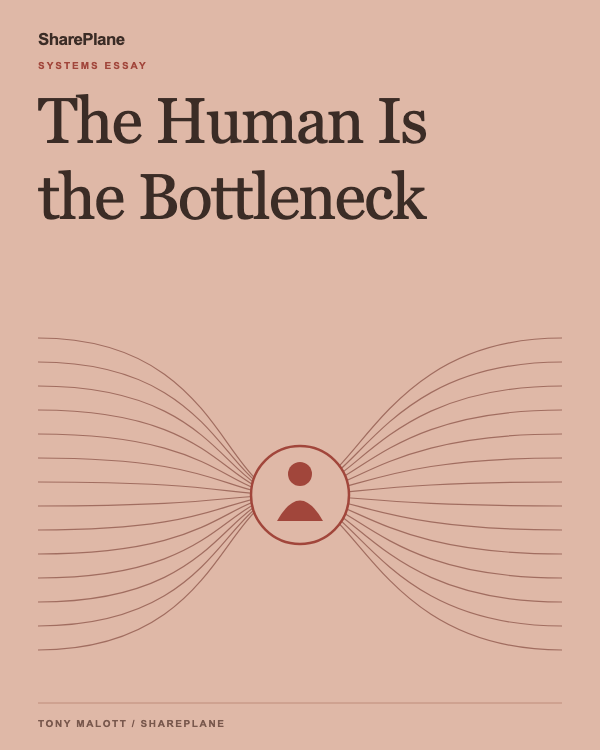
- companion toFour Days That Changed the Scale of One EngineerTony Malott examines 51 merged pull requests across two repositories and shows how context, authority, execution, verification, protected review, evidence, and learning changed the scale at which one accountable owner could operate. The force multiplier is not the model. The force multiplier is the system that surrounds the model with context, authority, bounded execution, deterministic verification, protected review, operational evidence, and durable learning.
Pairs the bottleneck thesis with measured post-checkpoint execution breadth.
Explore its graph →Citation details
companion_toFour Days That Changed the Scale of One Engineer → The Agents Were Never the Bottleneck
Pairs the bottleneck thesis with measured post-checkpoint execution breadth.
Read native Work ↗ - companionStop Prompting Agents. Start Managing Workers.A practical operating model for meaningful agent work: begin with a job, encode the work, bound the assignment, supervise through evidence, measure results, and expand autonomy only when repeatable proof earns a larger trust envelope. Agent workers become dependable only when organizations stop treating them as intelligent prompt boxes and start managing their work through explicit roles, encoded procedures, bounded authority, evidence, measurement, and earned autonomy.
This companion locates useful agent execution in the repositories, access, tools, authority, validation, and completion paths that make the worker model operational.
Explore its graph →Citation details
companionStop Prompting Agents. Start Managing Workers. → The Agents Were Never the Bottleneck
Build the workbench around the worker
Read native Work ↗ - companionThe Agent Is Not the Security BoundaryA first-person systems essay about model judgment, harness enforcement, external platform controls, and evidence and recovery as the real security boundary around coding agents. Do not ask whether the agent is trustworthy. Ask whether the system remains safe when the agent is wrong.
Connect bounded agent authority to the operating discipline required when orchestration, evidence, and integration become the real constraints.
Explore its graph →Citation details
companionThe Agent Is Not the Security Boundary → The Agents Were Never the Bottleneck
Companion: The Agents Were Never the Bottleneck
Read native Work ↗