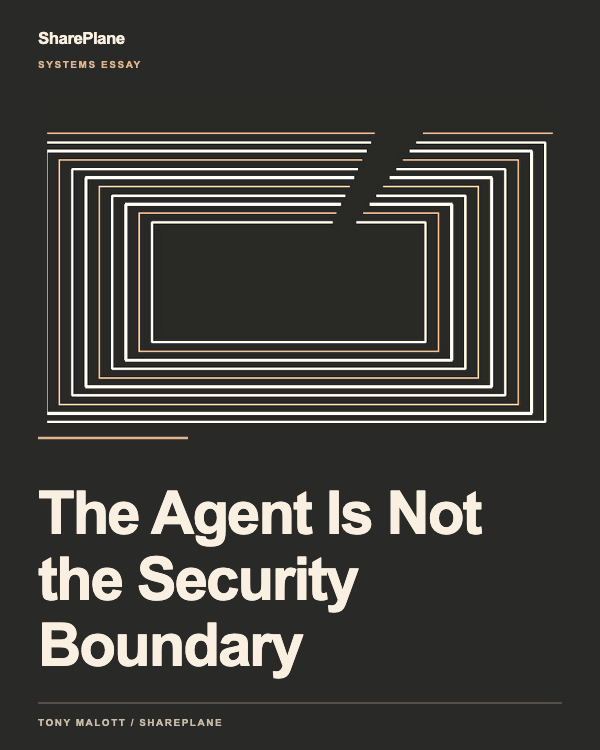
The Agent Is Not the Security Boundary
A first-person systems essay about model judgment, harness enforcement, external platform controls, and evidence and recovery as the real security boundary around coding agents. Do not ask whether the agent is trustworthy. Ask whether the system remains safe when the agent is wrong.
Read the article ↗View Work cover
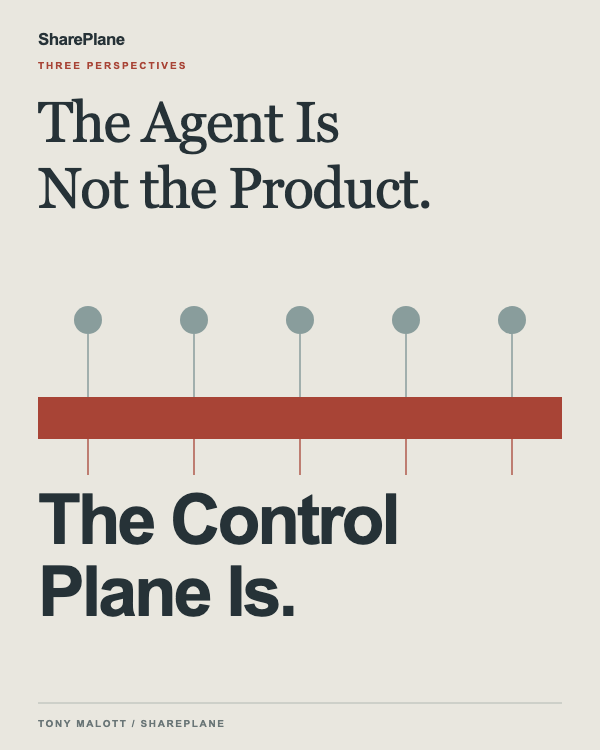
- companionThe Agent Is Not the Product. The Control Plane Is.The durable architecture includes identity isolation, bounded authority, secret separation, execution containment, mutation gates, independent observability, evidence, and recovery. Security is the mechanism that permits greater autonomy by bounding blast radius. The more useful an agent becomes, the less its safety can depend on the agent behaving well. The durable product is the governed execution environment around it.
Continue from the security boundary into the control-plane architecture that governs work around the agent.
Explore its graph →Citation details
companionThe Agent Is Not the Security Boundary → The Agent Is Not the Product. The Control Plane Is.
Companion: The Agent Is Not the Product
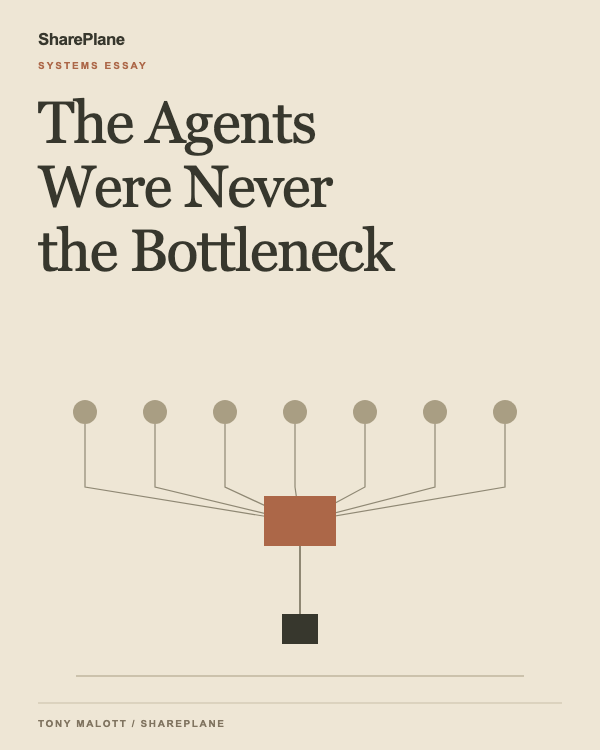
Read native Work ↗ - companionThe Agents Were Never the BottleneckA first-person systems essay about the engineered workbench surrounding useful agent execution, why learning the mechanics made trustworthy delegation possible, and how governable execution returned senior human attention to architecture, judgment, sequencing, taste, and risk. Capable agents became useful when Tony engineered the repositories, access, tools, authority, validation, evidence, and completion paths that made bounded work operational.
Connect bounded agent authority to the operating discipline required when orchestration, evidence, and integration become the real constraints.
Explore its graph →Citation details
companionThe Agent Is Not the Security Boundary → The Agents Were Never the Bottleneck
Companion: The Agents Were Never the Bottleneck
Read native Work ↗
- companionBeyond the AgentA systems thesis on why abundant machine execution shifts the enterprise AI bottleneck from intelligence toward authority, verification, institutional state, human judgment, and cheap trust, and why SharePlane is the control layer required beyond the agent. Frontier intelligence and execution are becoming abundant; institutional scarcity moves upward into coordination, verification, authority, human attention, current state, and trust.
The security-boundary thesis separates model capability from the surrounding system controls; Beyond the Agent generalizes that separation into institutional authority, evidence, current state, and trusted throughput.
Explore its graph →Citation details
companionBeyond the Agent → The Agent Is Not the Security Boundary
Companion: The Agent Is Not the Security Boundary
Read native Work ↗ - companionFrontier Inference Without Frontier CustodyA deterministic, privacy-preserving guide for classifying accessible context, selecting among local and remote inference architectures, bounding coding agents, reviewing re-identification risk, approving exact processing paths, and preserving evidence without copying the sensitive corpus. Keep authoritative source custody under organizational control. Export only the minimum reasoning surface required for the approved task.
Continue from information custody into the mechanical controls that keep an agent-bounded system safe when the agent is wrong.
Explore its graph →Citation details
companionFrontier Inference Without Frontier Custody → The Agent Is Not the Security Boundary
Companion: The Agent Is Not the Security Boundary
Read native Work ↗ - companionInnovation, Made VisibleTony Malott's public argument for finding recurring friction close to the work, testing the smallest responsible intervention, preserving evidence, and turning learning into reusable enterprise capability. Deterministic innovation wins because repeatable improvement creates more durable enterprise value than novelty without control.
The method treats AI assistance as bounded support inside a human-owned operating change, not as authority in itself.
Explore its graph →Citation details
companionInnovation, Made Visible → The Agent Is Not the Security Boundary
AI-assisted improvement still requires accountable controls
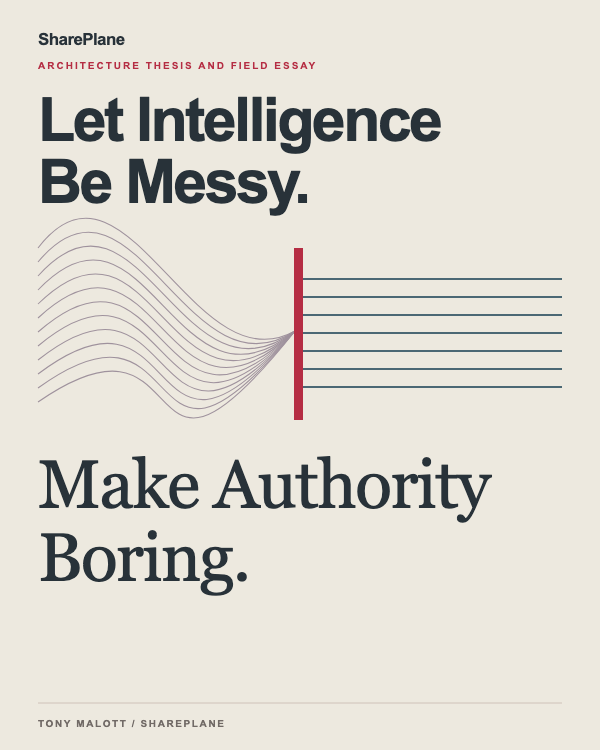
Read native Work ↗ - extendsLet Intelligence Be Messy. Make Authority Boring.AI is probabilistic intelligence. Use that capability where uncertainty creates value, but separate intelligence from authority. Trustworthy operation comes from independently enforced invariants, bounded capabilities, exact artifact identity, evidence, segregation of duties, revocation, and deterministic admission. Stop trying to make AI trustworthy as the primary safety strategy. Build systems that remain trustworthy when AI is not.
The earlier Work separates agent behavior from the surrounding security boundary. This Work generalizes that principle across models, generated code, deterministic software, validators, operators, and unknown failures.
Explore its graph →Citation details
extendsLet Intelligence Be Messy. Make Authority Boring. → The Agent Is Not the Security Boundary
Extend the security boundary into system trust
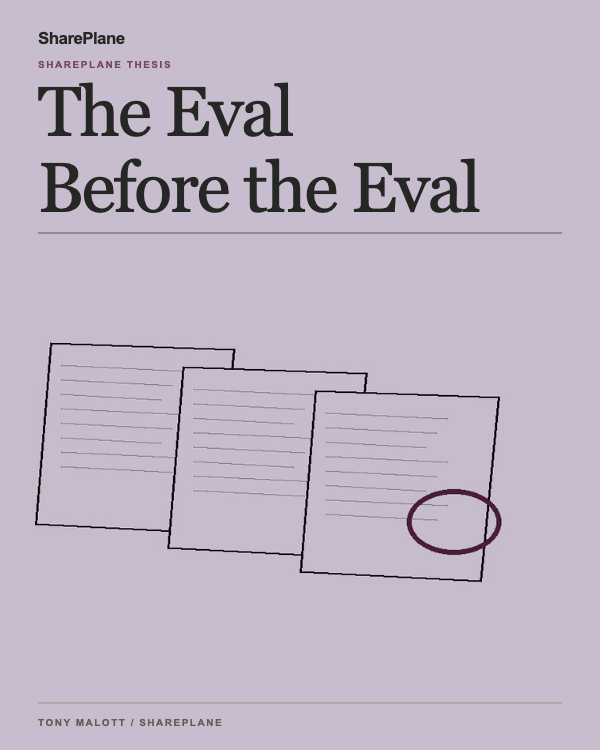
Read native Work ↗ - foundationThe Eval Before the EvalA SharePlane thesis on why ordinary AI evaluation begins too late when the objective itself has never been grounded, bounded, and admitted, and on Intent Admission as a governed execution boundary that preserves human authority without pretending human judgment is infallible. A sufficiently capable autonomous system can execute a bad objective beautifully; consequential intent needs an explicit, evidence-bearing admission boundary before autonomous amplification.
The security-boundary thesis separates agent capability from enforceable system controls; this Work extends that separation upstream by treating the objective itself as a governed input rather than an unquestioned command.
Explore its graph →Citation details
foundationThe Eval Before the Eval → The Agent Is Not the Security Boundary
Capability and credentials do not create governing authority
Read native Work ↗ - companionThe Telephone Is Not the RecorderA human-centered architecture and product-design exercise showing why governed conversational continuity belongs in a communication system that carries both call legs, with consent, retention, deletion, provenance, participant trust, and deliberate human review designed into the boundary. The problem is not that the iPhone cannot record both sides of a telephone call. The problem is that the iPhone does not own the call path.
The communications concept depends on executable consent, explicit lifecycle state, and accountable human review rather than trust in an endpoint or agent.
Explore its graph →Citation details
companionThe Telephone Is Not the Recorder → The Agent Is Not the Security Boundary
Keep authority in governed systems and human decisions
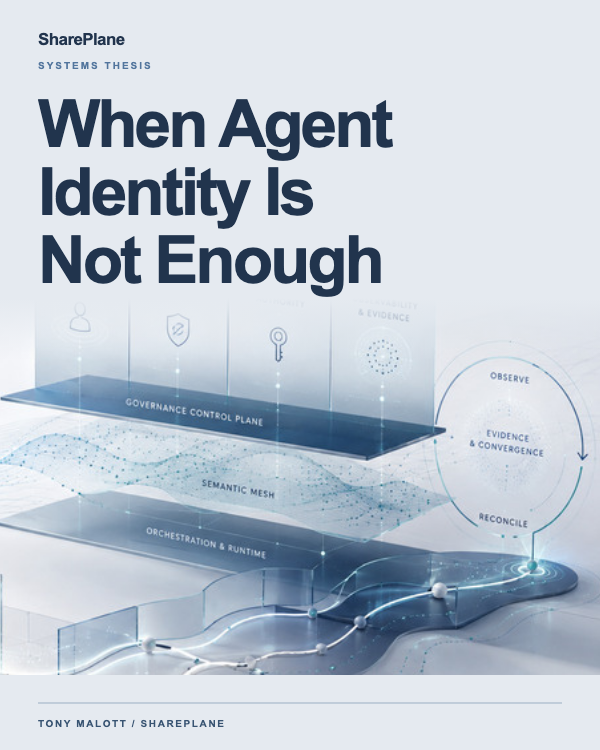
Read native Work ↗ - companionWhen Agent Identity Is Not EnoughA SharePlane systems thesis comparing Microsoft Agent 365 with GhostMesh, identifying where Microsoft's enterprise agent substrate should be consumed and where state-transition governance adds task-scoped authority, state-bound execution, temporary mutation claims, supersession, authority-aware reentry, evidence, and convergence. Enterprise agent governance becomes insufficient when a legitimate actor can still attempt an illegitimate state transition; identity, runtime enforcement, execution authority, evidence, and convergence must remain distinct control layers.
The security-boundary thesis separates model capability from surrounding system controls; this Work extends the distinction into current execution authority, state, claims, and convergence.
Explore its graph →Citation details
companionWhen Agent Identity Is Not Enough → The Agent Is Not the Security Boundary
Companion: The Agent Is Not the Security Boundary
Read native Work ↗ - companion toCopyable AgencyWhy digital intelligence changes the control problem
The control problem of copyable digital agency pairs with enforceable external controls.
Explore its graph →Citation details
companion_toCopyable Agency → The Agent Is Not the Security Boundary
Companion work
Read native Work ↗ - companion toThe Malleable Computer Is Here. Now Who Holds the Keys?A SharePlane Special examining Omarchy as an agent-native workstation substrate, its Quattro architecture and operational model, its security and enterprise boundaries, and the separate roles of Omarchy execution, GhostMesh authority, and SharePlane durable Work. Omarchy matters because it turns the desktop into inspectable, scriptable state that an AI agent can understand and alter. Its next decisive problem is not usability. It is authority: who may change what, under which policy, with what evidence, and how the machine proves what happened.
Agent-editable workstation state depends on real policy and enforcement boundaries.
Explore its graph →Citation details
companion_toThe Malleable Computer Is Here. Now Who Holds the Keys? → The Agent Is Not the Security Boundary
Companion work
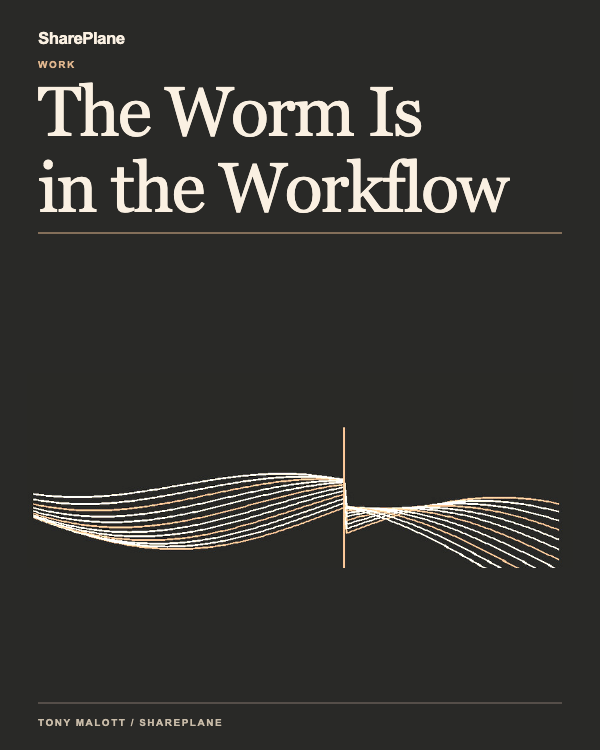
Read native Work ↗ - companion toThe Worm Is in the WorkflowPublic-source security essay arguing that modern software supply-chain compromise now propagates through developer workflow trust, not only bad packages. Shai-Hulud, Miasma, Go-adjacent poisoning, and the end of casual dependency trust
Workflow trust and broader external enforcement/evidence boundaries address related security questions.
Explore its graph →Citation details
companion_toThe Worm Is in the Workflow → The Agent Is Not the Security Boundary
Companion work
Read native Work ↗