The Agents Are Not the Bottleneck. You Are.
A technical and reflective thesis about the human-attention bottleneck created when agent execution becomes abundant, why parallel activity is not accepted throughput, and why mature orchestration needs admission control for decisions, review, exceptions, and closure. Agentic systems reduce the marginal cost of execution while increasing the potential rate of unresolved decisions. Once execution becomes cheap, human attention becomes the limiting resource.
Read the article ↗View Work cover

- foundationI Was Summoning Ghosts Until I Learned to Build the MachineA candid personal technical narrative about temporary cognitive instruments, fragmented thought, false breakthroughs, accumulated scar tissue, and the moment Git and software-delivery discipline turned conversation into a cockpit and the repository into durable memory. I thought I was learning how to use AI. What I was really learning was how to externalize intent, structure context, govern change, and convert finished thinking into mechanical execution.
The memoir shows the failures, fragmented thought, and Git breakthrough that made durable context and controlled execution necessary before the attention problem could be seen clearly.
Explore its graph →Citation details
foundationThe Agents Are Not the Bottleneck. You Are. → I Was Summoning Ghosts Until I Learned to Build the Machine
The origin and scar tissue
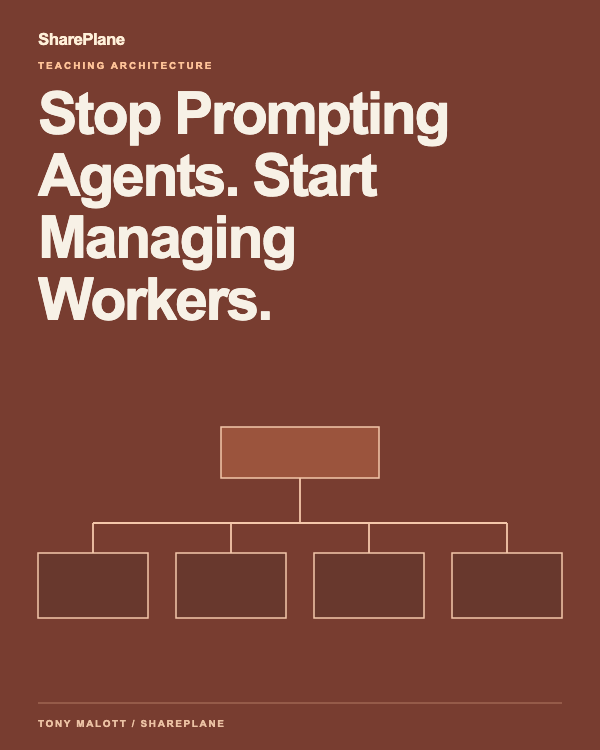
Read native Work ↗ - applicationStop Prompting Agents. Start Managing Workers.A practical operating model for meaningful agent work: begin with a job, encode the work, bound the assignment, supervise through evidence, measure results, and expand autonomy only when repeatable proof earns a larger trust envelope. Agent workers become dependable only when organizations stop treating them as intelligent prompt boxes and start managing their work through explicit roles, encoded procedures, bounded authority, evidence, measurement, and earned autonomy.
The teaching work turns the attention diagnosis into an operating model built from explicit roles, bounded assignments, evidence, measurement, and earned autonomy.
Explore its graph →Citation details
applicationThe Agents Are Not the Bottleneck. You Are. → Stop Prompting Agents. Start Managing Workers.
The worker-management response
Read native Work ↗
- continuationDemo DebtArticle-first SharePlane thesis defining demo debt as the liability created when impressive AI demos are mistaken for supportable operational capability. The demo proves the happy path; the real system begins where exceptions, ownership, recovery, and supportability enter the workflow.
Once demonstrations multiply, the constraint moves to human decisions, review, exceptions, integration, and closure—the organizational bottleneck developed in the strategic thesis.
Explore its graph →Citation details
continuationDemo Debt → The Agents Are Not the Bottleneck. You Are.
Follow the debt into the attention bottleneck
Read native Work ↗ - continuationI Was Summoning Ghosts Until I Learned to Build the MachineA candid personal technical narrative about temporary cognitive instruments, fragmented thought, false breakthroughs, accumulated scar tissue, and the moment Git and software-delivery discipline turned conversation into a cockpit and the repository into durable memory. I thought I was learning how to use AI. What I was really learning was how to externalize intent, structure context, govern change, and convert finished thinking into mechanical execution.
The strategic thesis follows the same governed system into the next constraint: one human can no longer responsibly absorb every decision, review, exception, and closure obligation the machine creates.
Explore its graph →Citation details
continuationI Was Summoning Ghosts Until I Learned to Build the Machine → The Agents Are Not the Bottleneck. You Are.
Follow the consequence upstream
Read native Work ↗ - continuationInference at the Ambiguity FrontierA general architecture thesis for AI-native systems: use probabilistic intelligence where ambiguity remains, convert stable reasoning into specifications and executable policy, push solved work into deterministic software, and reserve agents for novelty, diagnosis, exceptions, and change. Control Tower and SharePlane provide the field evidence rather than the premise. Inference belongs at the ambiguity frontier. Determinism belongs everywhere behind it.
Once execution becomes cheap and deterministic, the remaining constraint moves toward human specification and review.
Explore its graph →Citation details
continuationInference at the Ambiguity Frontier → The Agents Are Not the Bottleneck. You Are.
Continue into the human-attention bottleneck
Read native Work ↗ - continuationStop Prompting Agents. Start Managing Workers.A practical operating model for meaningful agent work: begin with a job, encode the work, bound the assignment, supervise through evidence, measure results, and expand autonomy only when repeatable proof earns a larger trust envelope. Agent workers become dependable only when organizations stop treating them as intelligent prompt boxes and start managing their work through explicit roles, encoded procedures, bounded authority, evidence, measurement, and earned autonomy.
Once bounded agent workers execute reliably, the constraint moves upstream to human specification, supervision, validation, integration, memory, and closure.
Explore its graph →Citation details
continuationStop Prompting Agents. Start Managing Workers. → The Agents Are Not the Bottleneck. You Are.
What changes after worker execution accelerates
Read native Work ↗ - continuationThe Best AI System Should Need Less AI TomorrowA flagship architecture thesis for AI-native systems: probabilistic intelligence should push into ambiguity, evidence should settle what worked, and repeated validated reasoning should migrate into deterministic machinery. Mature systems reserve inference for novelty, uncertainty, exceptions, and change instead of repeatedly paying models to rediscover solved procedures. Use intelligence to conquer ambiguity, capture what works, and retire inference when uncertainty disappears.
Once execution becomes cheap and deterministic, the remaining constraint moves toward human specification and review.
Explore its graph →Citation details
continuationThe Best AI System Should Need Less AI Tomorrow → The Agents Are Not the Bottleneck. You Are.
Continue into the human-attention bottleneck
Read native Work ↗ - companionThe Human Is the BottleneckA systems essay on why equivalent model access produces radically different outcomes, how software discipline converts potential into force multiplication, and why capability alone is never sufficient justification to build. As frontier model access broadens, the scarce advantage shifts to human imagination, judgment, decomposition, orchestration, verification, and restraint.
The companion essay examines how abundant agent execution creates a human attention bottleneck; this essay moves upstream to imagination, judgment, selection, and disciplined execution.
Explore its graph →Citation details
companionThe Human Is the Bottleneck → The Agents Are Not the Bottleneck. You Are.
Execution abundance shifts the constraint to human attention
Read native Work ↗ - companionToken BurnAn interactive, deterministic calculator for known token usage, recognizable AI workloads, image generation, and subscription-equivalent comparisons across a versioned snapshot of provider-direct pricing. Token composition, model choice, workload shape, and dated provider pricing must remain visible if AI consumption is going to become economically inspectable.
The strategic thesis explains how abundant execution consumes scarce human judgment. Token Burn exposes the parallel machine-side cost of that abundance through token, model, cache, output, and image-generation economics.
Explore its graph →Citation details
companionToken Burn → The Agents Are Not the Bottleneck. You Are.
Compare machine consumption with human attention
Read native Work ↗ - continuationYour Second Brain Is Not a Production ArchitectureA source-derived architecture explainer separating personal second-brain markdown workflows from production agent context-plane requirements. A personal memory system optimizes for one person's recall; production architecture must optimize for shared authority, isolation, recoverability, and verifiable state.
The strategic thesis shows the organizational consequence of relying on one person's context and attention after machine execution becomes abundant.
Explore its graph →Citation details
continuationYour Second Brain Is Not a Production Architecture → The Agents Are Not the Bottleneck. You Are.
Scale beyond one person's memory
Read native Work ↗