I Was Summoning Ghosts Until I Learned to Build the Machine
A candid personal technical narrative about temporary cognitive instruments, fragmented thought, false breakthroughs, accumulated scar tissue, and the moment Git and software-delivery discipline turned conversation into a cockpit and the repository into durable memory. I thought I was learning how to use AI. What I was really learning was how to externalize intent, structure context, govern change, and convert finished thinking into mechanical execution.
Read the article ↗View Work cover
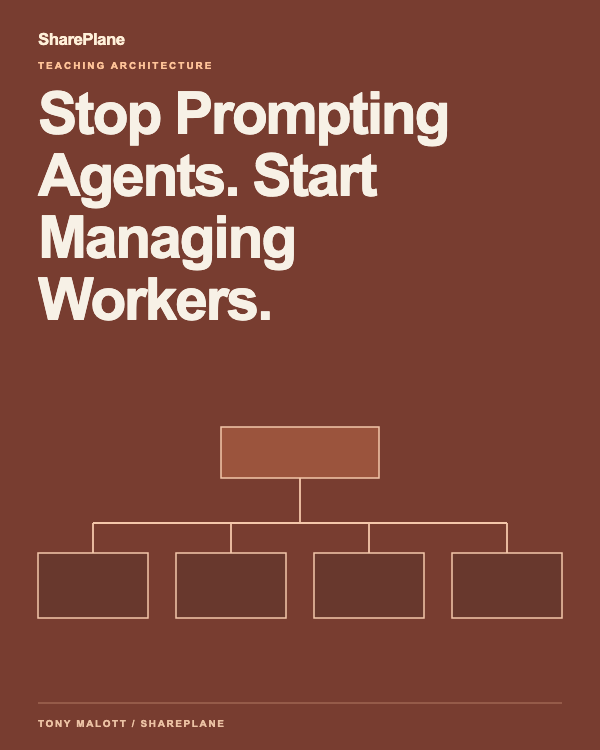
- applicationStop Prompting Agents. Start Managing Workers.A practical operating model for meaningful agent work: begin with a job, encode the work, bound the assignment, supervise through evidence, measure results, and expand autonomy only when repeatable proof earns a larger trust envelope. Agent workers become dependable only when organizations stop treating them as intelligent prompt boxes and start managing their work through explicit roles, encoded procedures, bounded authority, evidence, measurement, and earned autonomy.
The teaching work converts the memoir's lessons about context, tools, authority, validation, and evidence into a repeatable worker-management system.
Explore its graph →Citation details
applicationI Was Summoning Ghosts Until I Learned to Build the Machine → Stop Prompting Agents. Start Managing Workers.
Turn the scar tissue into an operating model
Read native Work ↗ - continuationThe Agents Are Not the Bottleneck. You Are.A technical and reflective thesis about the human-attention bottleneck created when agent execution becomes abundant, why parallel activity is not accepted throughput, and why mature orchestration needs admission control for decisions, review, exceptions, and closure. Agentic systems reduce the marginal cost of execution while increasing the potential rate of unresolved decisions. Once execution becomes cheap, human attention becomes the limiting resource.
The strategic thesis follows the same governed system into the next constraint: one human can no longer responsibly absorb every decision, review, exception, and closure obligation the machine creates.
Explore its graph →Citation details
continuationI Was Summoning Ghosts Until I Learned to Build the Machine → The Agents Are Not the Bottleneck. You Are.
Follow the consequence upstream
Read native Work ↗

- companionGhostMesh Was Waiting for Its TechnologyA first-person architecture origin story about learning to move continuity out of temporary intelligence and into durable authority, context, state, memory, policy, evidence, recovery, artifacts, and human judgment. GhostMesh is a persistent system built from temporary intelligence. The same durable-memory and temporary-worker pattern at its center was used to reconstruct its own history.
The earlier memoir follows the personal shift from ephemeral prompting to governed work; this distinct Work reconstructs the GhostMesh architecture and its evidence-backed lineage.
Explore its graph →Citation details
companionGhostMesh Was Waiting for Its Technology → I Was Summoning Ghosts Until I Learned to Build the Machine
I Was Summoning Ghosts Until I Learned to Build the Machine
Read native Work ↗ - foundationNuance Is Not Analysis ParalysisA first-person thesis about nuance, governed compression, bounded inquiry, and why AI weakens the old trade-off between intellectual depth and execution speed without relieving humans of judgment. AI makes full-fidelity preservation operationally practical because compression no longer has to happen once, permanently, and before future uses are known. Preserve first. Project later.
The memoir provides the scar tissue behind the insistence on durable context, inspectable systems, and refusing to mistake fluent compression for genuine understanding.
Explore its graph →Citation details
foundationNuance Is Not Analysis Paralysis → I Was Summoning Ghosts Until I Learned to Build the Machine
The lived origin
Read native Work ↗ - foundationStop Prompting Agents. Start Managing Workers.A practical operating model for meaningful agent work: begin with a job, encode the work, bound the assignment, supervise through evidence, measure results, and expand autonomy only when repeatable proof earns a larger trust envelope. Agent workers become dependable only when organizations stop treating them as intelligent prompt boxes and start managing their work through explicit roles, encoded procedures, bounded authority, evidence, measurement, and earned autonomy.
The memoir supplies the operational failures behind explicit context, authority, validation, receipts, and the shift from magical agents to governed workers.
Explore its graph →Citation details
foundationStop Prompting Agents. Start Managing Workers. → I Was Summoning Ghosts Until I Learned to Build the Machine
See why the worker model became necessary
Read native Work ↗ - foundationThe Agents Are Not the Bottleneck. You Are.A technical and reflective thesis about the human-attention bottleneck created when agent execution becomes abundant, why parallel activity is not accepted throughput, and why mature orchestration needs admission control for decisions, review, exceptions, and closure. Agentic systems reduce the marginal cost of execution while increasing the potential rate of unresolved decisions. Once execution becomes cheap, human attention becomes the limiting resource.
The memoir shows the failures, fragmented thought, and Git breakthrough that made durable context and controlled execution necessary before the attention problem could be seen clearly.
Explore its graph →Citation details
foundationThe Agents Are Not the Bottleneck. You Are. → I Was Summoning Ghosts Until I Learned to Build the Machine
The origin and scar tissue
Read native Work ↗ - foundationThe Hands I Never HadA personal systems essay on how AI removed the implementation barrier between decades of infrastructure, operational, user, and visual judgment and the software experiences Tony Malott wanted to build. AI did not give me systems judgment; it gave the judgment I already had the implementation capacity to express.
The memoir explains how Tony turned newly reachable work into governed, durable execution rather than leaving it trapped in temporary conversations and demonstrations.
Explore its graph →Citation details
foundationThe Hands I Never Had → I Was Summoning Ghosts Until I Learned to Build the Machine
See the system behind the new capability
Read native Work ↗ - companion toThe Subscription Was TuitionA first-person field report on treating a year of frontier AI use as a continuous technical apprenticeship, using GhostMesh as the laboratory and separating software spend from the repetitions, judgment, architecture, and systems that compounded from it. Frontier AI subscriptions became tuition only because sustained use against real problems turned access into repetitions, repetitions into operating judgment, and judgment into durable systems leverage.
The field narrative shows the personal transition from ephemeral prompting to durable context, authority, validation, and evidence.
Explore its graph →Citation details
companion_toThe Subscription Was Tuition → I Was Summoning Ghosts Until I Learned to Build the Machine
From prompting to governed work
Read native Work ↗ - companion toWhy I Built SharePlaneMy work was surviving in files and sessions while the reasoning that connected it kept getting expensive to reconstruct. I built SharePlane to preserve the work, its evidence, its decisions, and the path back into it. The work kept surviving. The working state did not.
A companion account of the early continuity and agent experiments that preceded the durable-Work approach.
Explore its graph →Citation details
companion_toWhy I Built SharePlane → I Was Summoning Ghosts Until I Learned to Build the Machine
The personal experiments behind the architecture
Read native Work ↗ - foundationYour Second Brain Is Not a Production ArchitectureA source-derived architecture explainer separating personal second-brain markdown workflows from production agent context-plane requirements. A personal memory system optimizes for one person's recall; production architecture must optimize for shared authority, isolation, recoverability, and verifiable state.
The memoir supplies the lived experience behind the architecture distinction: useful conversations and private context become durable only when they enter a governed system of record.
Explore its graph →Citation details
foundationYour Second Brain Is Not a Production Architecture → I Was Summoning Ghosts Until I Learned to Build the Machine
Begin with the personal failure mode
Read native Work ↗