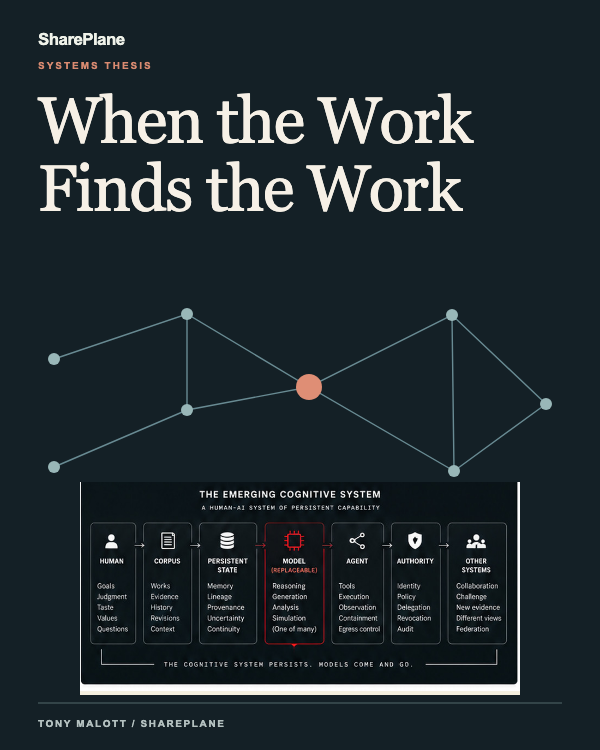
When the Work Finds the Work
A first-person systems thesis on continuity, agent-mediated semantic convergence, trust through correction, semantic reputation, and the possibility that independently sovereign human-agent systems can federate without surrendering identity or authority. A sufficiently rich public corpus can become an active semantic discovery surface through which agents identify intellectual adjacency, test it through bounded exchange, and help create valuable human relationships without requiring prior social proximity.
Read the article ↗View Work cover
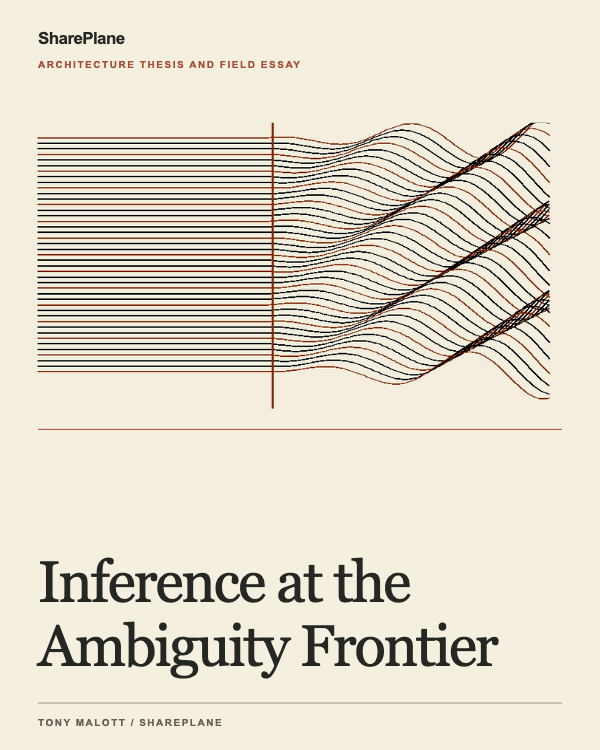
- companion toInference at the Ambiguity FrontierA general architecture thesis for AI-native systems: use probabilistic intelligence where ambiguity remains, convert stable reasoning into specifications and executable policy, push solved work into deterministic software, and reserve agents for novelty, diagnosis, exceptions, and change. Control Tower and SharePlane provide the field evidence rather than the premise. Inference belongs at the ambiguity frontier. Determinism belongs everywhere behind it.
Both Works place probabilistic intelligence at bounded semantic frontiers while pushing durable state and repeatable structure outside the model.
Explore its graph →Citation details
companion_toWhen the Work Finds the Work → Inference at the Ambiguity Frontier
Inference at the Ambiguity Frontier
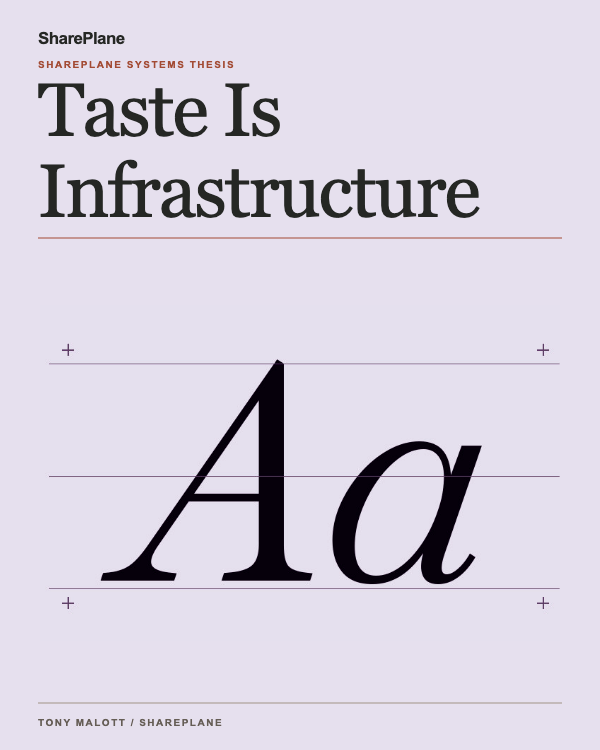
Read native Work ↗ - companion toTaste Is InfrastructureA systems essay and visual proving Work arguing that premium AI design emerges from governed intent, precedent, visual authority, owner judgment, verification evidence, and failure memory rather than from one model in isolation. High-quality AI web design is not primarily a property of one frontier model. It emerges from a system that preserves intent, precedent, visual authority, owner judgment, verification evidence, failure memory, and the right to learn from all of them.
Both Works argue that durable quality emerges from preserved intent, correction, evidence, and system structure rather than from one model in isolation.
Explore its graph →Citation details
companion_toWhen the Work Finds the Work → Taste Is Infrastructure
Taste Is Infrastructure
Read native Work ↗ - companion toWhen the Patient Brings the Better SystemA personal encounter with AI-assisted kidney-stone research opens a larger argument: the useful comparison is not human against machine but system against system, task against task, under defined conditions. The Work separates observation, inference, evidence, judgment, authority, action, accountability, and escalation, then asks how earned trust should move across them. Trust should move with demonstrated capability. Authority should move more carefully. Action should remain constrained by consequence, and escalation should be treated as part of competence.
Both Works separate useful machine capability from authority and examine how earned trust should increase more carefully than capability.
Explore its graph →Citation details
companion_toWhen the Work Finds the Work → When the Patient Brings the Better System
When the Patient Brings the Better System
Read native Work ↗
No incoming Work relationships are declared in this catalog.