The Most Expensive Model Is Often Compensation for Missing Control
A first-person operating essay about why stronger control architecture makes model routing more trustworthy and efficient without reducing the goal to choosing the cheapest model. Trusted completion cost falls when intent, authority, routing, and validation carry their share of the work.
Read the article ↗View Work cover
- related toThe Code Is No Longer the Hard PartA first-person systems essay about the cost inversion created by AI-assisted implementation and the operating model required to turn faster execution into durable institutional leverage. As AI reduces the relative cost of implementation, durable engineering value moves outward into intent, authority, context, orchestration, evidence, recovery, and institutional integration.
Issue #40 operationalizes and provides an economic and operational case for Issue #146 without collapsing the two independent Works.
Explore its graph →Citation details
related_toThe Most Expensive Model Is Often Compensation for Missing Control → The Code Is No Longer the Hard Part
Related companion Work
Read native Work ↗
- counterpointCognitive CapitalA Shareplane doctrine series about inference as capital formation, the cost of denied cognition, operator leverage, and how enterprises should allocate frontier cognition and autonomy. Machine cognition becomes organizational capital when validated reasoning is converted into persistent, reusable assets that preserve or increase capability while reducing future uncertainty, cost, risk, or marginal cognition.
Cognitive Capital distinguishes valuable inference spend from compensatory model spend caused by weak intent, routing, validation, or control. This relationship is projected inside the denied-cognition and allocation chapters rather than the parent landing page.
Explore its graph →Citation details
counterpointCognitive Capital → The Most Expensive Model Is Often Compensation for Missing Control
The Most Expensive Model Is Often Compensation for Missing Control
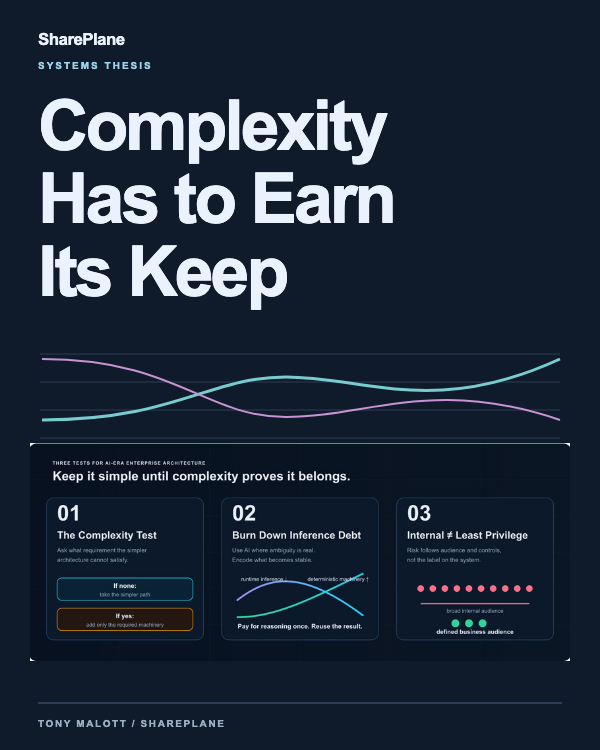
Read native Work ↗ - companion toComplexity Has to Earn Its KeepA first-person systems essay arguing for Portable Decision Surfaces, reconstruction packets, least-privilege distribution, and using AI to compile repeated reasoning into deterministic software instead of defaulting to another persistent application stack. Enterprise decision tools should start with governed data, deterministic portable software, and controlled refresh; persistent backend complexity should be added only when a concrete requirement proves it necessary.
Both Works argue that stronger surrounding control reduces unnecessary frontier reasoning and avoids paying repeatedly for ambiguity the system can already resolve.
Explore its graph →Citation details
companion_toComplexity Has to Earn Its Keep → The Most Expensive Model Is Often Compensation for Missing Control
The Most Expensive Model Is Often Compensation for Missing Control
Read native Work ↗ - companion toDone Has a Half-LifeArtificial intelligence changes the economics beneath completion. An accepted implementation can remain functional while changed capability, evidence, economics, requirements, dependencies, or risk erode its presumption of continued fitness. The answer is continuous reconsiderability with selective, governed adaptation. Everything meaningful should become explicitly done. Nothing meaningful should become permanently exempt from reconsideration.
The control Work shows how intent, routing, authority, and validation reduce trusted completion cost; this Work applies the same discipline to the marginal cost of safe improvement after acceptance.
Explore its graph →Citation details
companion_toDone Has a Half-Life → The Most Expensive Model Is Often Compensation for Missing Control
Connect MCSI to the control architecture around completion
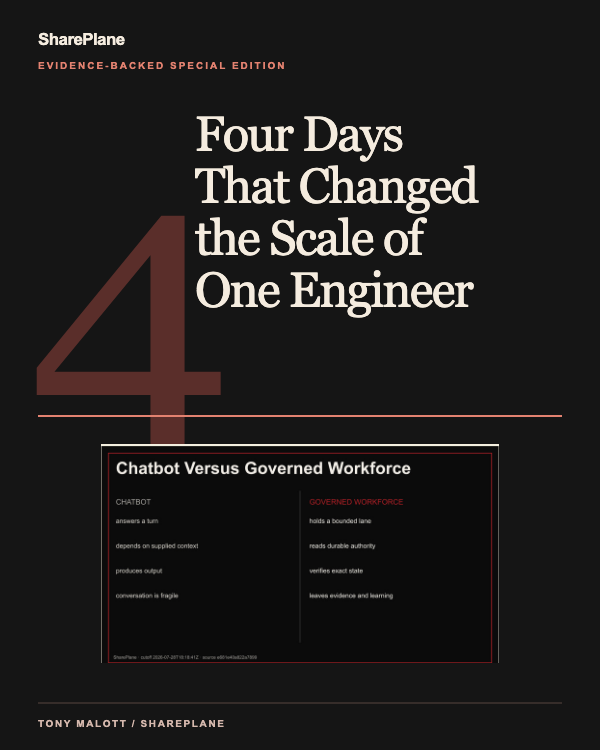
Read native Work ↗ - expandsFour Days That Changed the Scale of One EngineerTony Malott examines 51 merged pull requests across two repositories and shows how context, authority, execution, verification, protected review, evidence, and learning changed the scale at which one accountable owner could operate. The force multiplier is not the model. The force multiplier is the system that surrounds the model with context, authority, bounded execution, deterministic verification, protected review, operational evidence, and durable learning.
Provides a bounded example of leverage arising from control rather than model escalation.
Explore its graph →Citation details
expandsFour Days That Changed the Scale of One Engineer → The Most Expensive Model Is Often Compensation for Missing Control
Provides a bounded example of leverage arising from control rather than model escalation.
Read native Work ↗ - companionInference at the Ambiguity FrontierA general architecture thesis for AI-native systems: use probabilistic intelligence where ambiguity remains, convert stable reasoning into specifications and executable policy, push solved work into deterministic software, and reserve agents for novelty, diagnosis, exceptions, and change. Control Tower and SharePlane provide the field evidence rather than the premise. Inference belongs at the ambiguity frontier. Determinism belongs everywhere behind it.
Stronger intent, routing, validation, and control reduce compensatory model dependence.
Explore its graph →Citation details
companionInference at the Ambiguity Frontier → The Most Expensive Model Is Often Compensation for Missing Control
Companion: reduce model dependence through control
Read native Work ↗ - companionThe Best AI System Should Need Less AI TomorrowA flagship architecture thesis for AI-native systems: probabilistic intelligence should push into ambiguity, evidence should settle what worked, and repeated validated reasoning should migrate into deterministic machinery. Mature systems reserve inference for novelty, uncertainty, exceptions, and change instead of repeatedly paying models to rediscover solved procedures. Use intelligence to conquer ambiguity, capture what works, and retire inference when uncertainty disappears.
Stronger intent, routing, validation, and control reduce compensatory model dependence.
Explore its graph →Citation details
companionThe Best AI System Should Need Less AI Tomorrow → The Most Expensive Model Is Often Compensation for Missing Control
Companion: reduce model dependence through control
Read native Work ↗
Published Readers that explicitly compare this Work. These are editorial reading links, not independent corroboration.
- companionAn Open Agent Still Needs an Operator ↗
Costs must include permission checks, validation, retries and operator intervention.
- companionThe 12 GB GPU Has a Three-Budget Problem ↗
The larger-compute purchase reflex can compensate for undefined workload or weak operational control; this Reader supplies a concrete GPU sizing example.